



CMI Headers
 07-25-2012 | 09:36 AM
#1
Thread Starter
Registered
Joined: May 2012
Posts: 78
Likes: 0
From: las vegas
 CMI Headers
I'm thinking it's time to pull the headers and pressure test them and wanted to know what psi I need to put in them for the test?They have been run in fresh water and have 215 hrs on them.
 07-26-2012 | 07:56 AM
#2
Registered
Joined: Mar 2009
Posts: 1,194
Likes: 1
From: Delaware
The way I test mine is:
Pull them
Cap the inlet of the water distribution tube (1" bar stool caps with a hose clamp work very well for this.)
Fill the header with water.
Cap the water outlet at the top of the header.
Turn the header upside down and poke a needle chuck through the cap on the dist tube.
I dont really pay attention to the PSI, just pump some air in there and watch the collector for leaking water. You will see it shooting out if you have any leaks.
Pull them
Cap the inlet of the water distribution tube (1" bar stool caps with a hose clamp work very well for this.)
Fill the header with water.
Cap the water outlet at the top of the header.
Turn the header upside down and poke a needle chuck through the cap on the dist tube.
I dont really pay attention to the PSI, just pump some air in there and watch the collector for leaking water. You will see it shooting out if you have any leaks.
07-26-2012 | 08:48 AM
#3
Thread Starter
Registered
Joined: May 2012
Posts: 78
Likes: 0
From: las vegas
Thats a good idea,that way you don't need to submerge them and too much pressure will just leak past the needle.Thanks, will be pulling them tonight but I was telling my buddy that a leak is definate but no leak still leaves me worried about when they will leak.Mine are the early generation where the outer tube is welded to the flange so my confidence in them is shaken.If they test good I will run them till the winter and then decide if I need to bite the bullet and replace them.
07-26-2012 | 12:05 PM
#4

Frank's Marine Service


Joined: Sep 2002
Posts: 11,959
Likes: 142
From: Elkton, MD
I pressure check with a water hose on one end and a valve to purge air from the other end.
Turn on the hose, run it until all the air is out of the header. Close the valve.
Then, using a brazing/heating torch put a little heat around all of the header tubes near the bottom flange and inside the collector (two areas most prone to leaks). People think I'm crazy but I've seen headers leak only when there's heat on the metal. You're not trying to get them cherry red, you're just trying to simulate hot exhaust gases going through the header.
I've seen people dip the whole header in a tub of water and use air pressure but I didn't find that to be very practical.
Turn on the hose, run it until all the air is out of the header. Close the valve.
Then, using a brazing/heating torch put a little heat around all of the header tubes near the bottom flange and inside the collector (two areas most prone to leaks). People think I'm crazy but I've seen headers leak only when there's heat on the metal. You're not trying to get them cherry red, you're just trying to simulate hot exhaust gases going through the header.
I've seen people dip the whole header in a tub of water and use air pressure but I didn't find that to be very practical.
07-26-2012 | 01:08 PM
#5

Registered
Joined: Feb 2005
Posts: 4,400
Likes: 25
From: Michigan
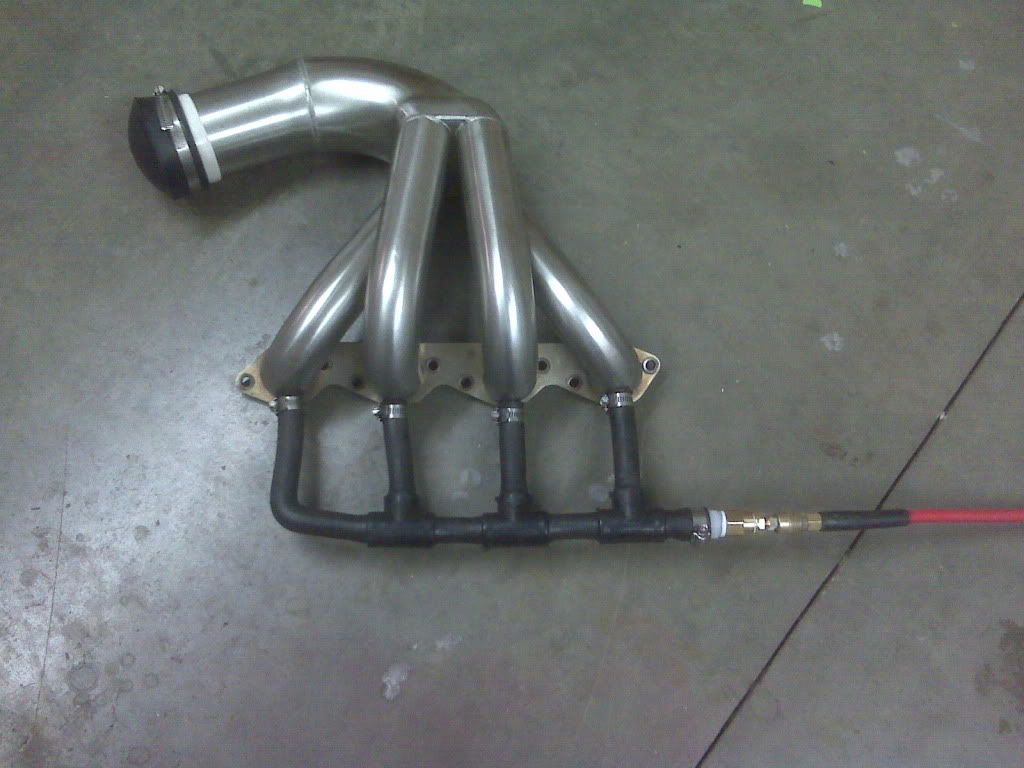
I put together a fitting to hook my compressor to the distribution tube. Plug the jumper(mine don't have jumpers but irrelevant). I set my regulator at 10 lbs and plugged it into the distribution tube. Then turned the air valve off(which is before the gauge). Came back an hour later and still at 10 lbs. If there was a leak it would have bled down. Nice thing about this is you can do it with the headers on the engine without worrying about filling a cylinder with water.
Panther - Good idea heating up the headers.
Panther - Good idea heating up the headers.
07-26-2012 | 05:15 PM
#6

Charter Member # 545

Joined: Dec 2000
Posts: 2,152
Likes: 2
From: Port Tobacco MD/Cape Coral Fl
Capping the headers then putting 60lbs of air pressure in them, and submerging them in a tank then looking for bubbles, was the way CMI told me they checked them. When Fountain was in business, they filled the header with water and pressurized them and looked for water leaking out.
I think Panther is on to something about the heat..making the metal expand and try to see if they will leak.
I think Panther is on to something about the heat..making the metal expand and try to see if they will leak.
07-26-2012 | 05:56 PM
#7
Registered
Joined: Jul 2006
Posts: 340
Likes: 0
From: The Sunshine State
Capping the headers then putting 60lbs of air pressure in them, and submerging them in a tank then looking for bubbles, was the way CMI told me they checked them. When Fountain was in business, they filled the header with water and pressurized them and looked for water leaking out.
I think Panther is on to something about the heat..making the metal expand and try to see if they will leak.
I think Panther is on to something about the heat..making the metal expand and try to see if they will leak.
Don't forget to twist the headers around to get all the air out of the curves in the tubes before you start. Twist it around again before removing from the water to see if any leaks were in the pockets and held the air from bubbling to the surface.
Takes a couple hours (beers) but it is worth the piece of mind.
Last edited by WOTW2E; 07-26-2012 at 05:59 PM.
07-26-2012 | 06:27 PM
#8
Banned
Joined: Jul 2011
Posts: 9,594
Likes: 46
From: Ft. Worth TX
Pressure them up with 50 lbs of air, we use heat also but use a paint stripper heat gun and a hand held temp gun to check the temp of the header itself. As mention you want to heat and cool the header as it cycles to see if it leaks from the expansion and contraction of the metal. Been dong it this way for years.
we double check them also with water in the water jackets and the heat gun for heating and cooling the header. We use food color for the water so its easier to see if one drop of water gets in the exhaust portion of the header.
we double check them also with water in the water jackets and the heat gun for heating and cooling the header. We use food color for the water so its easier to see if one drop of water gets in the exhaust portion of the header.
07-27-2012 | 11:05 AM
#9
Frank's Marine Service
Joined: Sep 2002
Posts: 11,959
Likes: 142
From: Elkton, MD
However, one day 10 years ago I was checking a set of CMI E-tops and a guy with about 20 years more experience than I have told me I needed to use some heat because sometimes they don't leak without heat.
I thought to myself, what a waste of time.... Then I tried it and sure as sh!t I found 3 leaks in my headers.
I've tested it this way ever since.
07-27-2012 | 02:15 PM
#10
Registered
Joined: Oct 2009
Posts: 74
Likes: 0
From: Newark, DE
I started doing it about 10 years ago. Before that I used water pressure alone.
However, one day 10 years ago I was checking a set of CMI E-tops and a guy with about 20 years more experience than I have told me I needed to use some heat because sometimes they don't leak without heat.
I thought to myself, what a waste of time.... Then I tried it and sure as sh!t I found 3 leaks in my headers.
I've tested it this way ever since.
However, one day 10 years ago I was checking a set of CMI E-tops and a guy with about 20 years more experience than I have told me I needed to use some heat because sometimes they don't leak without heat.
I thought to myself, what a waste of time.... Then I tried it and sure as sh!t I found 3 leaks in my headers.
I've tested it this way ever since.


