


350 Vortec Piston Selection for Ideal Compression and Quench...
 06-12-2014 | 01:56 PM
#1
Thread Starter
Registered
Joined: May 2014
Posts: 92
Likes: 0
 350 Vortec Piston Selection for Ideal Compression and Quench...
I’m having a 350 Vortec long block built and I have information overload on which pistons to use. I’m not looking to do a high performance build but I would like to tweak things a bit to make it a little better than stock. From what I’ve learned by reading the forum, I want a .038 quench and CR between 9.0:1 and 9.3:1 (I want to run 87 octane).
Specs on the build…
• 96-02 Vortec 350 rebuilt truck block (880 casting) and heads (062 or 906 casting)
• Victor Reinz 1178VM marine head gaskets and brass freeze plugs
• New Melling 22221 Cam with roller lifters (197/206 @.050 with .433/.450 lift and a 105/114 C/L)... very close to the stock merc 350 vortec cam
• New Edelbrock Performer Air Gap Vortec Intake
• New Edelbrock 1409 Marine Carb w/ electric choke
• Stock, cast iron exhaust manifolds & risers (stock, thru prop exhaust)
• Shop says they always resurface the heads and they take off 10-12 thousandths
The cost of the rebuilt long block with the new Melling cam and new pistons the shop usually uses (Silvolite 1470) is only $1300 (includes a $300 core charge). It comes with a 2 year warranty and they’re a reputable, local engine rebuilder that’s been in business since the 60’s. Those are stock, full dished pistons that will give me a .080 quench and, the builder says, 8.5:1 compression (I think he just quoted the stock 350 SBC CR)… Silvolite catalog says 7.9:1.
I realize those are far from the ideal pistons so that’s what I’d like to tweak in the build… that and resurface the block and use a thinner head gasket to get a .038 quench. The cost to deck the block is $225 which is out of the budget. The cost to resurface the block and take off what I need to get to a .038 quench is $75 which is within the budget. Piston budget is $250 max. I’m shooting for the ideal quench and compression but, for a $1000 long block that’s using the stock exhaust, I don’t see the value in spending $225 to deck the block and $5-600 for mirrored, reverse dome pistons.
These are the pistons I’m leaning toward. Speed Pro H815 Hypereutectic Coated at a cost of $210 (without rings)…

They’re not ideal but they’re better than the stock full dish pistons with the 45 degree chamfer and thin quench band. They’re also a true Vortec piston. From what I understand, the Vortec pistons have a smaller diameter (3.10 vs. 3.16), lighter weight (about 4 ounces), thinner rings, and a different skirt from the 86-95 350 SBC pistons.
These Speed Pros also have a 1.55 compression height (others are 1.425-1.54) which will get me closer to a .038 quench without having to take it off the block.
NPR also has a 1.55 compression height, true Vortec piston for $153 (with moly rings) p/n 10-828. Doesn’t say if they’re Hypereutectic or coated so I’m assuming they’re cast…

Here’s another pic that looks cast…

Clevite also makes a Hypereutectic Vortec piston p/n 224-3175 at a cost of $168 (no rings)…

But that one has a 1.54 compression height.
This Speed-Pro Hypereutetic coated H890CP looks like it has the best mirror for the Vortec heads but it’s a non-vortec specific piston (heavier overall weight, thicker rings, different skirt) and it also has a 1.425 compression height. Price is within the budget at $238 (no rings)…
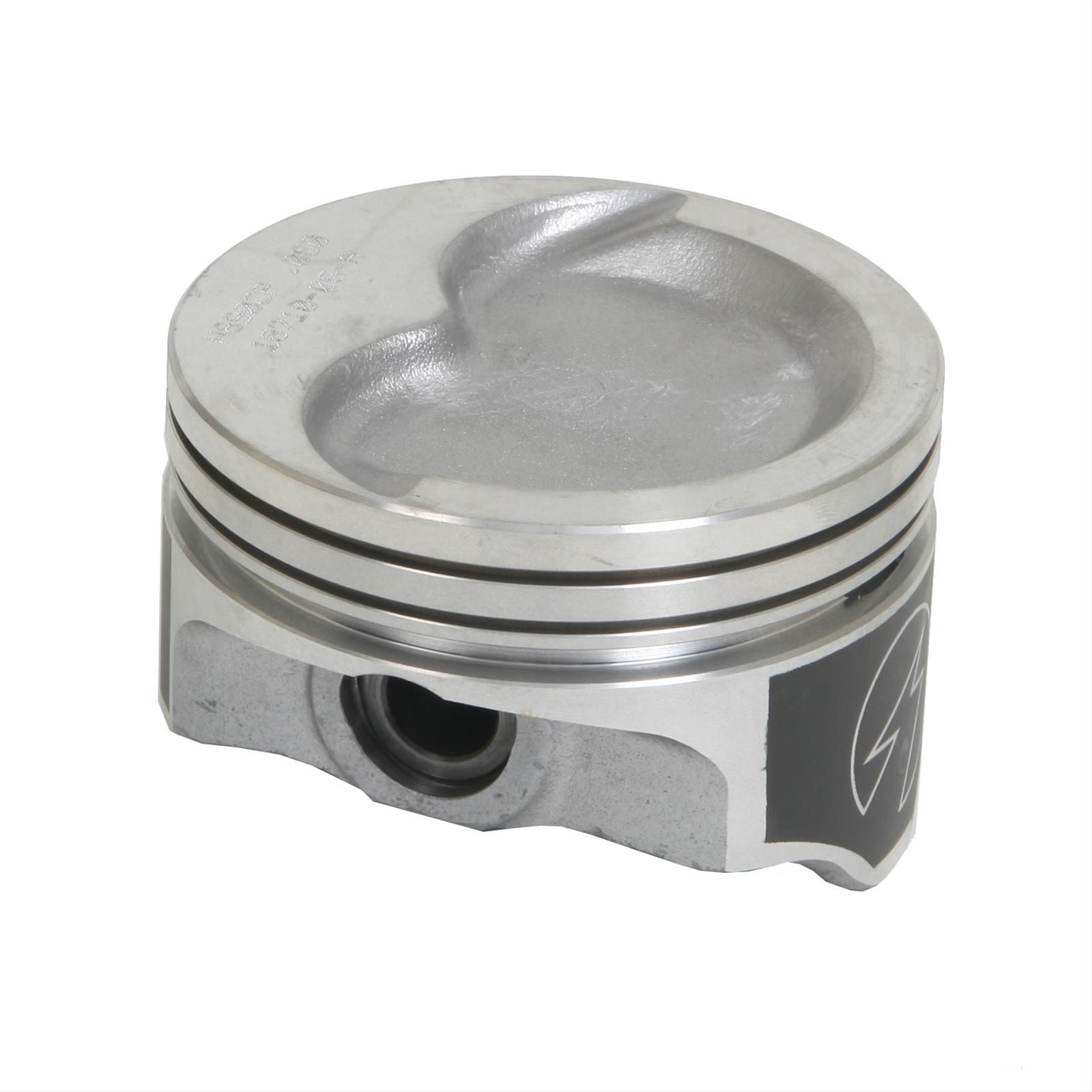
I like the better mirror of this piston but I don’t see how I can get a .038 quench just by resurfacing the block and this piston is also meant for the 86-95 SBC… not the vortec. Also, would this one piston work in all eight cylinders or would I need 2-4 different part numbers?
How important is a Vortec specific piston? Would I be better off with the heavier, wider D-Cup 86-95 piston or the lighter, smaller 96-02 dished Vortec spec piston? I’ve heard that the thinner rings on the Vortec pistons are actually less desirable then the thicker rings on the older style piston. I’ve also read that the additional weight of the older style piston can cause problems in a Vortec block if the crank/components are not balanced. I haven’t checked with the shop but I’m sure it will cost more to have them balance everything. But, if it’s not much more and D-Cup will be better, I’ll do it… assuming I can get the 1.425 compression height to a .038 quench without decking the block.
Please help me make a wise decision on piston selection or recommend any other pistons you think would work best for my build within my budget.
Specs on the build…
• 96-02 Vortec 350 rebuilt truck block (880 casting) and heads (062 or 906 casting)
• Victor Reinz 1178VM marine head gaskets and brass freeze plugs
• New Melling 22221 Cam with roller lifters (197/206 @.050 with .433/.450 lift and a 105/114 C/L)... very close to the stock merc 350 vortec cam
• New Edelbrock Performer Air Gap Vortec Intake
• New Edelbrock 1409 Marine Carb w/ electric choke
• Stock, cast iron exhaust manifolds & risers (stock, thru prop exhaust)
• Shop says they always resurface the heads and they take off 10-12 thousandths
The cost of the rebuilt long block with the new Melling cam and new pistons the shop usually uses (Silvolite 1470) is only $1300 (includes a $300 core charge). It comes with a 2 year warranty and they’re a reputable, local engine rebuilder that’s been in business since the 60’s. Those are stock, full dished pistons that will give me a .080 quench and, the builder says, 8.5:1 compression (I think he just quoted the stock 350 SBC CR)… Silvolite catalog says 7.9:1.
I realize those are far from the ideal pistons so that’s what I’d like to tweak in the build… that and resurface the block and use a thinner head gasket to get a .038 quench. The cost to deck the block is $225 which is out of the budget. The cost to resurface the block and take off what I need to get to a .038 quench is $75 which is within the budget. Piston budget is $250 max. I’m shooting for the ideal quench and compression but, for a $1000 long block that’s using the stock exhaust, I don’t see the value in spending $225 to deck the block and $5-600 for mirrored, reverse dome pistons.
These are the pistons I’m leaning toward. Speed Pro H815 Hypereutectic Coated at a cost of $210 (without rings)…
They’re not ideal but they’re better than the stock full dish pistons with the 45 degree chamfer and thin quench band. They’re also a true Vortec piston. From what I understand, the Vortec pistons have a smaller diameter (3.10 vs. 3.16), lighter weight (about 4 ounces), thinner rings, and a different skirt from the 86-95 350 SBC pistons.
These Speed Pros also have a 1.55 compression height (others are 1.425-1.54) which will get me closer to a .038 quench without having to take it off the block.
NPR also has a 1.55 compression height, true Vortec piston for $153 (with moly rings) p/n 10-828. Doesn’t say if they’re Hypereutectic or coated so I’m assuming they’re cast…
Here’s another pic that looks cast…
Clevite also makes a Hypereutectic Vortec piston p/n 224-3175 at a cost of $168 (no rings)…
But that one has a 1.54 compression height.
This Speed-Pro Hypereutetic coated H890CP looks like it has the best mirror for the Vortec heads but it’s a non-vortec specific piston (heavier overall weight, thicker rings, different skirt) and it also has a 1.425 compression height. Price is within the budget at $238 (no rings)…
I like the better mirror of this piston but I don’t see how I can get a .038 quench just by resurfacing the block and this piston is also meant for the 86-95 SBC… not the vortec. Also, would this one piston work in all eight cylinders or would I need 2-4 different part numbers?
How important is a Vortec specific piston? Would I be better off with the heavier, wider D-Cup 86-95 piston or the lighter, smaller 96-02 dished Vortec spec piston? I’ve heard that the thinner rings on the Vortec pistons are actually less desirable then the thicker rings on the older style piston. I’ve also read that the additional weight of the older style piston can cause problems in a Vortec block if the crank/components are not balanced. I haven’t checked with the shop but I’m sure it will cost more to have them balance everything. But, if it’s not much more and D-Cup will be better, I’ll do it… assuming I can get the 1.425 compression height to a .038 quench without decking the block.
Please help me make a wise decision on piston selection or recommend any other pistons you think would work best for my build within my budget.
Last edited by Gannz; 06-12-2014 at 02:06 PM.
 06-12-2014 | 02:08 PM
#2
Registered

Joined: Nov 2004
Posts: 14,185
Likes: 3,735
From: On A Dirt Floor
You are not building a HP motor so I would not sweat it. I'd worry about piston top design more if you where going to run dome pistons, which you are not.
Thin rings will mean nothing in this sort of basic build. Heavy pistons, neither. What ever will balance cheaper go for.
I do like adjusting quench.....closer the better especially when pushing the performance level, which again, you are not.
Get it as close as you can as cheap as you can and don't worry about.
Pssst: That cam is costing you big power. But, you already know that.
Thin rings will mean nothing in this sort of basic build. Heavy pistons, neither. What ever will balance cheaper go for.
I do like adjusting quench.....closer the better especially when pushing the performance level, which again, you are not.
Get it as close as you can as cheap as you can and don't worry about.
Pssst: That cam is costing you big power. But, you already know that.
06-12-2014 | 02:57 PM
#3
Thread Starter
Registered
Joined: May 2014
Posts: 92
Likes: 0
Thanks for that. I don't have any problems going cheap. :-)
About the cam... Since I'm saving on the pistons, should I put a little extra money in beehive springs and/or extra machine work on the heads so I can run an XM264, XM270, or LT4 Hot Cam? I'd like the extra power if it doesn't cost too much but my reasoning on using the close to stock cam was that I didn't think I'd actually get all the extra power of a better cam with the stock, thru prop exhaust.
I'd invest $400 in GLM aluminum manifolds and risers if it would mean I'd save on weight and be able to use all the extra power a better cam would produce. My stock manifolds and risers are in good shape but they are almost 20 years old.
The wife would not get on the boat if it had a thru hull exhaust.
About the cam... Since I'm saving on the pistons, should I put a little extra money in beehive springs and/or extra machine work on the heads so I can run an XM264, XM270, or LT4 Hot Cam? I'd like the extra power if it doesn't cost too much but my reasoning on using the close to stock cam was that I didn't think I'd actually get all the extra power of a better cam with the stock, thru prop exhaust.
I'd invest $400 in GLM aluminum manifolds and risers if it would mean I'd save on weight and be able to use all the extra power a better cam would produce. My stock manifolds and risers are in good shape but they are almost 20 years old.
The wife would not get on the boat if it had a thru hull exhaust.
Last edited by Gannz; 06-12-2014 at 03:00 PM.
06-12-2014 | 04:15 PM
#4
Registered
Joined: Nov 2004
Posts: 14,185
Likes: 3,735
From: On A Dirt Floor
What kind of boat do you have ? There are some boats that I agree that thru transom exhaust detracts from.
And about your wife, don't like to get into personal stuff, but I'm sure she makes you compromise with lots of stuff. LOL.
And about your wife, don't like to get into personal stuff, but I'm sure she makes you compromise with lots of stuff. LOL.
06-12-2014 | 05:04 PM
#6
Registered
Joined: Nov 2004
Posts: 14,185
Likes: 3,735
From: On A Dirt Floor
06-12-2014 | 05:23 PM
#7
Thread Starter
Registered
Joined: May 2014
Posts: 92
Likes: 0
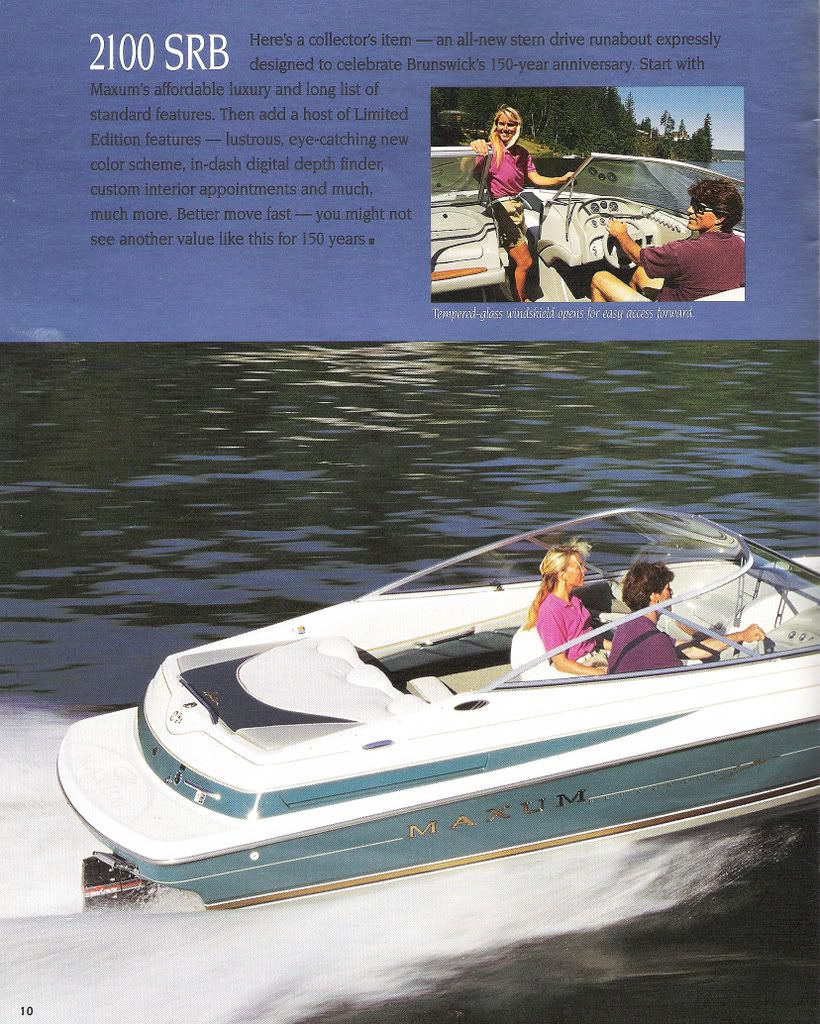
1995 Maxum 2100SRB. Alpha one with a Stingray Hydrofoil and 14-1/4", 19 degree stainless 3 blade prop. Originally powered by a pre-vortec 305. Weight is listed as 3035 lbs. without fuel, gear, or passengers. With the wife riding shotgun, 2-3 kids riding in the bow, and minimal gear it had enough power for my needs. Add two more adults to the stern and it was underpowered.
Last edited by Gannz; 06-12-2014 at 05:37 PM.
06-12-2014 | 10:28 PM
#8
Thread Starter
Registered
Joined: May 2014
Posts: 92
Likes: 0
So what do I do with the .012 that gets milled off the heads when calculating quench and compression?
Quench example…
1.74 (half stroke)
+5.7 (rod length)
+1.55 (compression height)
----------
8.99
Then…
9.025 (SBC deck height)
-8.99
-----------
.035 (deck clearance)
+.015 (gasket thickness)
------------
.050 quench
Since the gasket thickness is accounted for, shouldn’t I also count the .012 that gets milled off of the heads? That would give me…
.050
-.012 (surfaced head)
-----------
.038 (ideal quench)
And what do I do with the .012 that gets milled off the heads when calculating compression? I don’t know how to calculate it but wouldn’t shaving .012 off the heads make a 64cc vortec head chamber smaller? Say 62cc? Or, do I subtract the .012 from the deck clearance?
Quench example…
1.74 (half stroke)
+5.7 (rod length)
+1.55 (compression height)
----------
8.99
Then…
9.025 (SBC deck height)
-8.99
-----------
.035 (deck clearance)
+.015 (gasket thickness)
------------
.050 quench
Since the gasket thickness is accounted for, shouldn’t I also count the .012 that gets milled off of the heads? That would give me…
.050
-.012 (surfaced head)
-----------
.038 (ideal quench)
And what do I do with the .012 that gets milled off the heads when calculating compression? I don’t know how to calculate it but wouldn’t shaving .012 off the heads make a 64cc vortec head chamber smaller? Say 62cc? Or, do I subtract the .012 from the deck clearance?
06-13-2014 | 05:45 AM
#9
Registered
Joined: Nov 2004
Posts: 14,185
Likes: 3,735
From: On A Dirt Floor
Milling the head does nothing for quench. It adds compression by making the combustion chamber smaller.
Why ? Quench is distance from flat of piston to the flat sealing surface of head. Milling head does not make these closer. Milling block, thinner head gaskets, higher compression height pistons, longer rod with same pistons, more sroke wih same rod/pistons...etc,etc will decrease distance, of piston to head...thus decrease quench distance.
It is said anything over .060" quench is ineffective. Anything under that is 'okay' for a regular motor N/A motor not pushing envelope for compression vs fuel used and performance.Under .050" of course is more 'ideal' while those who strive to get better will go for close to .040".
Why ? Quench is distance from flat of piston to the flat sealing surface of head. Milling head does not make these closer. Milling block, thinner head gaskets, higher compression height pistons, longer rod with same pistons, more sroke wih same rod/pistons...etc,etc will decrease distance, of piston to head...thus decrease quench distance.
It is said anything over .060" quench is ineffective. Anything under that is 'okay' for a regular motor N/A motor not pushing envelope for compression vs fuel used and performance.Under .050" of course is more 'ideal' while those who strive to get better will go for close to .040".
Last edited by SB; 06-13-2014 at 05:48 AM.
06-13-2014 | 08:46 AM
#10
Thread Starter
Registered
Joined: May 2014
Posts: 92
Likes: 0
10-4. Thanks.
Does anyone make a .015-.021 marine head gasket? I've read about using .015 compressed thickness but I can't find anything thinner than .039 for a marine application. I found a reference to a McCord .015 stainless gasket but it was from 2003 and it looks like they're no longer made. I also found this reference but can't find the gasket...
"You can always use a mercury marine 5.7 head gasket..015 Stainless and readily available.
They are just a GM head gasket with merc marine sticker over the GM number."
Does anyone make a .015-.021 marine head gasket? I've read about using .015 compressed thickness but I can't find anything thinner than .039 for a marine application. I found a reference to a McCord .015 stainless gasket but it was from 2003 and it looks like they're no longer made. I also found this reference but can't find the gasket...
"You can always use a mercury marine 5.7 head gasket..015 Stainless and readily available.
They are just a GM head gasket with merc marine sticker over the GM number."

