



I/O Conversions engineering?
 01-13-2022 | 08:31 AM
#1
Thread Starter
Registered

Joined: Nov 2000
Posts: 1,048
Likes: 50
From: Glastonbury, CT
 I/O Conversions engineering?
OK I see a lot of people doing this who is doing the engineering on mounting that bracket and hanging all that weight on the transom? It cant be just fill the I/O hole and bolt on, do you tie in the stringers or add angel or knee supports? What about the corners were the side and bottom meet the transom?
Also when you go to get insurance what do you say, do they just accept the fact that ok now its outboards?
I like the possibility, but I cant believe its just bolt and go.
Also when you go to get insurance what do you say, do they just accept the fact that ok now its outboards?
I like the possibility, but I cant believe its just bolt and go.
 01-13-2022 | 08:46 AM
#2
Driver-441


Joined: Aug 2004
Posts: 12,017
Likes: 1,527
From: Lake George
Real outboard boats have knees tied into the stringers. IO conversion if done properly should get the same treatment. There are many, many things to consider though. Fuel tank placement, is the hull notched, cg, etc.
01-13-2022 | 08:54 AM
#3
Registered

Joined: Jun 2007
Posts: 7,347
Likes: 1,851
From: Merritt Island, FL
Saris is correct but a lot are just bolting on. Some fill, some put knees, I have seen one use aluminum plates bolted to the bracket then through bolted to the stringers as knees. I still think on a lot of these the CG has to be different than originally designed, particularly a couple stag I/O's I have seen converted, but I may be wrong since the weight is so much different. At the very least you would think fore aft may be right but would be higher then a I/O.
01-13-2022 | 09:15 AM
#4
Registered
Joined: Oct 2005
Posts: 1,094
Likes: 1,146
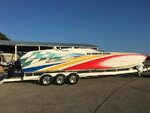
It all depends on the boat. Skater converted my 30 from Sterlings/Arnesons to 400Rs and didn't make any changes with the stringers/knees at the transom, but the boat was originally built with knees at the transom - like all inboard and outboard Skaters. We also didn't change the full bottom to a notched transom like so many outboard boats run, and it was one of the best running 30' Skater outboard ever (127mph w/ 400Rs and ran flat at speed, this claim verified by Bobby VanDine at Skater who also drove it). The CG didn't actually change (as verified on my hydrohoist lift, I didn't move the boat forward or aft and the lift still floated level after the conversion) because even though the weight was much further back with the outboards, there was a lot less of it. Though the CG didn't change, it doesn't mean the boat didn't run differently, it still was much flightier after the conversion, as the total dry weight went from 7,000#s as an I/O to 5,400#s as an OB - with the weight of the motors hanging off the back of the transom instead of being forward in the boat. We did put a lot of thought and effort into the conversion, so I'm not saying every boat is a simple job to make run correctly after going from I/O to OB, but it can definitely be done successfully. I'd recommend consulting with the manufacturer of the hull you're considering converting before spending any money towards the goal to make sure your I/O boat will work well with the conversion.
01-15-2022 | 07:04 PM
#5
Registered
Joined: Aug 2005
Posts: 1,133
Likes: 78
From: Point Pleasant/Demarest NJ
It all depends on the boat. Skater converted my 30 from Sterlings/Arnesons to 400Rs and didn't make any changes with the stringers/knees at the transom, but the boat was originally built with knees at the transom - like all inboard and outboard Skaters. We also didn't change the full bottom to a notched transom like so many outboard boats run, and it was one of the best running 30' Skater outboard ever (127mph w/ 400Rs and ran flat at speed, this claim verified by Bobby VanDine at Skater who also drove it). The CG didn't actually change (as verified on my hydrohoist lift, I didn't move the boat forward or aft and the lift still floated level after the conversion) because even though the weight was much further back with the outboards, there was a lot less of it. Though the CG didn't change, it doesn't mean the boat didn't run differently, it still was much flightier after the conversion, as the total dry weight went from 7,000#s as an I/O to 5,400#s as an OB - with the weight of the motors hanging off the back of the transom instead of being forward in the boat. We did put a lot of thought and effort into the conversion, so I'm not saying every boat is a simple job to make run correctly after going from I/O to OB, but it can definitely be done successfully. I'd recommend consulting with the manufacturer of the hull you're considering converting before spending any money towards the goal to make sure your I/O boat will work well with the conversion.
 01-16-2022 | 12:41 PM
#6
Registered
Joined: Mar 2002
Posts: 4,475
Likes: 2,111
From: Milton, Fla!
It depends a lot, on the hull.
A lot of them are designed to be either OB or IO w/minimal changes.
When we lived in Fla, I saw a lot of hack jobs, mostly fish boats or cheap pleasure boats.
Some just bolted the OB bracket over the IO hole!
Im just finishing a 25’ Checkmate single big block IO to twin OBs.
I test floated it as soon as was capable to ck float line and it was much closer than I thought.
According to my calculations, I’ve added approx 200lbs of weight.
But, moved that weight 5’ aft.
That resulted in the keel at the bow, to float about 4” higher than existing stain line.
The bigger change is in C of G which I am currently working on.
I built a galley for the cuddy and added a sink that I feed w/a 15 gl water tank I installed in the anchor locker.
And I added knees between transom/stringers and support across top of transom.
If you’re lucky enough to start w/a hull designed for either power packages, it wouldn’t be bad.
If you start w/a true IO boat as I did, it’s a HUGE project!
A lot of them are designed to be either OB or IO w/minimal changes.
When we lived in Fla, I saw a lot of hack jobs, mostly fish boats or cheap pleasure boats.
Some just bolted the OB bracket over the IO hole!
Im just finishing a 25’ Checkmate single big block IO to twin OBs.
I test floated it as soon as was capable to ck float line and it was much closer than I thought.
According to my calculations, I’ve added approx 200lbs of weight.
But, moved that weight 5’ aft.
That resulted in the keel at the bow, to float about 4” higher than existing stain line.
The bigger change is in C of G which I am currently working on.
I built a galley for the cuddy and added a sink that I feed w/a 15 gl water tank I installed in the anchor locker.
And I added knees between transom/stringers and support across top of transom.
If you’re lucky enough to start w/a hull designed for either power packages, it wouldn’t be bad.
If you start w/a true IO boat as I did, it’s a HUGE project!
Last edited by Twin O/B Sonic; 01-16-2022 at 07:39 PM.
01-18-2022 | 08:39 AM
#7
Thread Starter
Registered
Joined: Nov 2000
Posts: 1,048
Likes: 50
From: Glastonbury, CT


