


Testing a 12 v coil
 10-02-2023 | 03:32 PM
#1
Thread Starter
Registered

Joined: Feb 2009
Posts: 8,356
Likes: 1,515
From: NW Michigan
 Testing a 12 v coil
Just doing some trouble shooting. I lost spark on a MSD 6al application and thought I’d ck coil before replacing the box or changing out complete system. When I jump the two wires (blk & orange) from the MSD box and placing the plug wire near ground I get nothing with the key to on position.
The coil is reading is .5 on the primary (+ -). The secondary on each is 4.11 (coil wire to + & -)
Coil good or bad?
Note: Testing with a Matco em700 multimeter setting on ohms
The coil is reading is .5 on the primary (+ -). The secondary on each is 4.11 (coil wire to + & -)
Coil good or bad?
Note: Testing with a Matco em700 multimeter setting on ohms
 10-02-2023 | 07:09 PM
#2
Registered

Joined: Feb 2013
Posts: 1,463
Likes: 392
Not sure what the resistance should be for your coil but I know measuring resistances below abt 5 ohms is tough with a 2-wire ohmmeter. For those low resistances a 4-wire (or Kelvin type) connection is needed. From 0.5 ohms up to 2 ohms is in the ball-park for primary winding. 4.1 ohms sounds waay too low on secondary. Was that 4.1K ohms maybe?? Manuf of the coil would be the right ones to ask abt this.
The ratio of number of turns of the primary winding compared to the secondary winding determines how much the 12V gets amplified. So for example if the turns ratio is 1:1000, 12V on primary should give abt 12K volts on secondary.
If you secondary is actually 4.1K ohms that would be roughly a 1:8000 ratio. 12V X 8000= 96kV. Now you're a bit high but in the ball-park.
If secondary was 4.1 ohms or abt a 1:8 ratio, 12V X 8-= 96V not in the same state as the ball park.
You could just connect 12V to the + terminal and quickly short the - terminal to ground. When you break the ground connection, a spark should be generated on the secondary. Don't want the leave the - terminal grounded very long as it could burn up the primary windings in the coil. Adding a resistor in-line with either the pos or neg would help prevent damage to coil if left grounded too long. I would usually just tap the - terminal wire against the neg batt post as quick as I can.
Also; if testing for spark, need to plug the coil wire into coil and have an old spark plug on other end of coil wire. Ground spark plug. This way the secondary voltage has somewhere to go. If nothing is connected to the coil wire connection, the secondary voltage can get high enough to arc inside the coil burning through insulation and causing more problems.
The ratio of number of turns of the primary winding compared to the secondary winding determines how much the 12V gets amplified. So for example if the turns ratio is 1:1000, 12V on primary should give abt 12K volts on secondary.
If you secondary is actually 4.1K ohms that would be roughly a 1:8000 ratio. 12V X 8000= 96kV. Now you're a bit high but in the ball-park.
If secondary was 4.1 ohms or abt a 1:8 ratio, 12V X 8-= 96V not in the same state as the ball park.
You could just connect 12V to the + terminal and quickly short the - terminal to ground. When you break the ground connection, a spark should be generated on the secondary. Don't want the leave the - terminal grounded very long as it could burn up the primary windings in the coil. Adding a resistor in-line with either the pos or neg would help prevent damage to coil if left grounded too long. I would usually just tap the - terminal wire against the neg batt post as quick as I can.
Also; if testing for spark, need to plug the coil wire into coil and have an old spark plug on other end of coil wire. Ground spark plug. This way the secondary voltage has somewhere to go. If nothing is connected to the coil wire connection, the secondary voltage can get high enough to arc inside the coil burning through insulation and causing more problems.
Last edited by zz28zz; 10-02-2023 at 07:15 PM.
10-02-2023 | 07:16 PM
#3
Registered

Joined: Nov 2004
Posts: 14,154
Likes: 3,714
From: On A Dirt Floor
Every blaster II / hvc coil i’ve tested with cheap or expensive multimeter tests at .6-.7 ohms.
Maybe this will help
https://www.holley.com/blog/post/how...%20to%20ground.
Maybe this will help
https://www.holley.com/blog/post/how...%20to%20ground.
10-03-2023 | 05:32 PM
#4
Thread Starter
Registered
Joined: Feb 2009
Posts: 8,356
Likes: 1,515
From: NW Michigan
Pulled another MSD blaster coil from boat and got much different ohms so after swapping I now have the box working as should. The two wire connection was bad also (one the dist side) Very strange the male pins had no reading from the front side but could get on the back side of plastic connector. Makes no sense to me but…
10-04-2023 | 04:03 PM
#5
Thread Starter
Registered
Joined: Feb 2009
Posts: 8,356
Likes: 1,515
From: NW Michigan
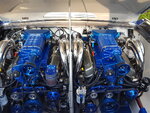
This car been a nightmare! How coil went out and bad connection from a hot lap around the hood but now I pulled number one plug to get tdc and rolled it over and antifreeze shot out like it hadn’t been laid since 1969. New sbf 408 with j302 heads. Engine sat for several years after built waiting on car restoration.
Possible from moisture the head gasket had a bad blow out. Pulled plug on the other bank and it’s fine. Like wtf 😳
Possible from moisture the head gasket had a bad blow out. Pulled plug on the other bank and it’s fine. Like wtf 😳


 10-04-2023 | 04:49 PM
#7
Registered
Joined: Jan 2007
Posts: 2,090
Likes: 1,214
From: Murrayville Georgia
from what little I know of those heads they had a thin deck and were know to pop head gaskets. not saying that is the reason but who knows. what do you know of the engine? was it decked, etc? may be that the head or deck was warped or other and caused the issue?
10-05-2023 | 07:44 AM
#8
Thread Starter
Registered
Joined: Feb 2009
Posts: 8,356
Likes: 1,515
From: NW Michigan
I don’t know much about the j302 heads other than they were superior flowing but short live CA based Co. They have a bbc exhaust pattern which meant custom headers. Ran extremely strong.
You very well could be right though. I should probably pull the other side as well or wait until I survey the damage. This isn’t like seeping rather blowing out. Even after I turned the engine over for a solid 10 seconds there’s still bunch more all the way up to spark plug. None in the oil though so rings must have seated decent at least. Lol
11-01-2023 | 02:55 PM
#9
Thread Starter
Registered
Joined: Feb 2009
Posts: 8,356
Likes: 1,515
From: NW Michigan
Correctamendo - You got that right! Probably less than 200 miles + - and have a blown head gasket. Oddly enough I found it when the MSD took a crap and after I put the new distributor in I thought i thought I was off 180 cause it cranked then stopped like a hydro lock. Pulled #1 plug to confirm tdc and antifreeze shot out like no other.
Did some more research on the Alan root j302 heads and sure enough a common problem. Shallow deck etc etc. Getting a set of trick flows I think so std headers will bolt up also. I should’ve done this from the get go. Those heads were the chit back in 80’s - mid 90’s as all there was for most part (sbf) however 30 plus years later here we are.
11-01-2023 | 07:54 PM
#10

VIP Member


Joined: Jul 2017
Posts: 1,740
Likes: 298
From: Sodus MI
Ben at precision offshore up here in mi built the engine for his project and went a different direction which resulting in me buying it. Block was surfaced and not sure about heads but I’d imagine at least cked. They were new and ported and assm by valako were he worked at the time. Machine shop who did the work still up and running.
I don’t know much about the j302 heads other than they were superior flowing but short live CA based Co. They have a bbc exhaust pattern which meant custom headers. Ran extremely strong.
You very well could be right though. I should probably pull the other side as well or wait until I survey the damage. This isn’t like seeping rather blowing out. Even after I turned the engine over for a solid 10 seconds there’s still bunch more all the way up to spark plug. None in the oil though so rings must have seated decent at least. Lol
I don’t know much about the j302 heads other than they were superior flowing but short live CA based Co. They have a bbc exhaust pattern which meant custom headers. Ran extremely strong.
You very well could be right though. I should probably pull the other side as well or wait until I survey the damage. This isn’t like seeping rather blowing out. Even after I turned the engine over for a solid 10 seconds there’s still bunch more all the way up to spark plug. None in the oil though so rings must have seated decent at least. Lol

