Drilling thru reat seat fiberglass
 03-29-2026 | 05:29 PM
#1
Thread Starter
Registered

Joined: Jun 2007
Posts: 111
Likes: 13
 Drilling thru reat seat fiberglass
In the process of installing a relay to allow the engine hatch cover to rise quicker. Thinking of placing a circuit breaker on the positive wire to battery, but if it blows/tirps I would need to open engine hatch to reset it. SO, though it would be better to place the circuit breaker in cockpit of boat. And I've identified a good spot near rear seat where it will be accessible (even with the hatch closed) but hidden from view. Question is: Is there any problem drilling a small hole in the fiberglass material that forms the base of the rear seat in order to run wires thru? This would essentially create a "connection" between the engine compartment and the cockpit of the boat.
 03-29-2026 | 06:19 PM
#2
Registered


Joined: Jun 2021
Posts: 3,554
Likes: 2,153
From: SW Ohio
In the process of installing a relay to allow the engine hatch cover to rise quicker. Thinking of placing a circuit breaker on the positive wire to battery, but if it blows/tirps I would need to open engine hatch to reset it. SO, though it would be better to place the circuit breaker in cockpit of boat. And I've identified a good spot near rear seat where it will be accessible (even with the hatch closed) but hidden from view. Question is: Is there any problem drilling a small hole in the fiberglass material that forms the base of the rear seat in order to run wires thru? This would essentially create a "connection" between the engine compartment and the cockpit of the boat.
Define "small"....
For the record, most boats have some passage from engine well to cockpit. I've got openings in the back of my side pockets that lead right into the engine well.
Thanks. Brad.
03-29-2026 | 08:17 PM
#3
Thread Starter
Registered
Joined: Jun 2007
Posts: 111
Likes: 13
Small would be about 1/2’ diameter.
My side pockets have speaker enclosures, hence there’s no easy connection. And drilling through the backseat fiberglass would allow me to put the switch in a perfect location.
My side pockets have speaker enclosures, hence there’s no easy connection. And drilling through the backseat fiberglass would allow me to put the switch in a perfect location.
03-30-2026 | 07:14 AM
#4

Registered

Joined: Feb 2001
Posts: 703
Likes: 67
From: Warwick, MD USA
I've always mounted my hatch relays in a plastic "project box" in the section under the rear seat. I just used an in-line fuse. If you have a dead battery you can then access the relay to jump from another battery to lift up your engine hatch to deal with the dead battery.
03-30-2026 | 03:05 PM
#5
Registered
Joined: Jun 2009
Posts: 9,993
Likes: 6,484
From: Chicago
That`s not going to make it much faster.
It`s probably .75/second unit .
Theres units that are 3"/sec. Now thats a difference you can actually see.
https://www.firgelliauto.com/
It`s probably .75/second unit .
Theres units that are 3"/sec. Now thats a difference you can actually see.
https://www.firgelliauto.com/
 03-31-2026 | 07:14 AM
#8
Registered
Joined: Feb 2001
Posts: 703
Likes: 67
From: Warwick, MD USA
My experience has been that the relay mounted "near" the hatch ram with larger wire at least doubles the speed of a slow ram. The slow ram is a consequence of a longer power wire run to and from the DPDT switch on the dash and likely undersized wire on the circuit. It's an inexpensive upgrade that's worth the effort IMO.
03-31-2026 | 07:46 AM
#9
Registered
Joined: Jun 2021
Posts: 3,554
Likes: 2,153
From: SW Ohio
My experience has been that the relay mounted "near" the hatch ram with larger wire at least doubles the speed of a slow ram. The slow ram is a consequence of a longer power wire run to and from the DPDT switch on the dash and likely undersized wire on the circuit. It's an inexpensive upgrade that's worth the effort IMO.
Wally was kind enough to post a pic way back in 2011....
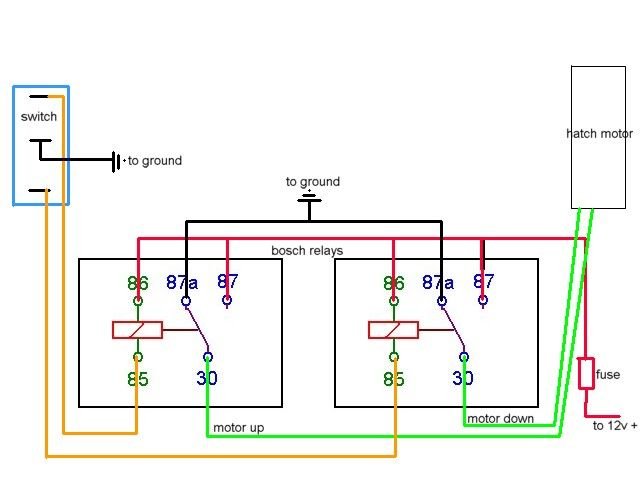
I wouldn't mind my hatch moving a bit faster.

Thanks. Brad.
Last edited by Brad Christy; 03-31-2026 at 07:58 AM.