


Odd Dyno results
 01-09-2007 | 07:10 PM
#11
Thread Starter
Registered
Joined: Feb 2004
Posts: 28
Likes: 0
From: Edmond, Ok.
 Re: Odd Dyno results
Float levels are good, idle transfer slots are "square".
I have thought about a single plane intake, I guess I am afraid of killing some torque on the bottom, and I don't want to raise the RPM.
I have thought about a single plane intake, I guess I am afraid of killing some torque on the bottom, and I don't want to raise the RPM.
 01-09-2007 | 07:53 PM
#12
Registered

Joined: Oct 2000
Posts: 1,382
Likes: 3
From: Spicewood, Texas USA
Re: Odd Dyno results
The coupler I use on my dyno weighs a good 20 lbs. So, the rotating mass is quite a bit heavier when on the dyno. This may be contributing to a run on problem, just like idling too fast. Plus in the boat you have added drag from the drive. This could explain why it has runon on the dyno and not in the boat. I like to run my natually aspirated marine engines around 12.5-12.8 at WOT. You need to install an 02 sensor and measure it in full marine trim. That can effect the A/F a lot.
01-10-2007 | 07:25 AM
#13
Registered
Joined: May 2001
Posts: 1,673
Likes: 1
From: Lake Lanier, GA
Re: Odd Dyno results
Not knowing how high you pulled the engine it would be hard to say for certain, but most likely the open spacer would have shown a little more power up higher (outside of where you're using this engine).
Most likely it's just the way the combination is running on the dyno.
Here's some information about spacers:
Carburetor Spacers:
Carburetors spacers can be a very useful tuning aid when working on your streetcar, or racecar. A spacer can be used to move the torque and power-band where it is more usable in your application, or they can be used to help work out inefficiencies in your combination.
4-Hole Spacers. As a rule of thumb a 4-hole designed spacer (4 individual holes one under each barrel of your carburetor) will increase your throttle response, and acceleration. They can also move the torque and power-band down in the RPM range. This is accomplished by keeping the air and fuel flowing in more of a column, which increases the air velocity. This can be a perfect addition if your vehicles throttle response is not as good as you’d like, or you’re getting passed when you pick up the throttle coming off of the corning. A 4-hole spacer can also help make up for something in the intake tract being larger than optimal (too large of a carburetor, cam, intake, etc.)
Open Spacers. As a rule of thumb an open designed spacer (1 big hole underneath your carburetor) will decrease your throttle response, and acceleration. They can also move the torque and power-band up in the RPM range. This is accomplished by increasing the plenum area, which will help in the higher RPM’s. This can be a perfect addition if your vehicle has traction problems when accelerating, or coming off of the corner. A 4-hole spacer can also help make up for something in the intake tract being smaller than optimal (too small of a carburetor, cam, intake, etc.)
Combination Spacers. A combination spacer (half 4-hole, and half open) can give you the best of both worlds. Increasing your throttle response, and acceleration over not using a spacer, and increasing or broadening the torque and power-band.
Plenum Dividers. A Plenum divider does as the name implies divides the plenum in an open plenum intake manifold from side to side. These are generally used to help prevent fuel slosh from side to side in high G load Oval-Track, or Road-Race applications. It is common on certain engines to have lean cylinders do to fuel slosh. A SBC oval track engine running on methanol can run lean on cylinders 3 & 5 while cylinders 4 & 6 will run rich. A plenum divider can help eliminate this.
Spacer thickness. Varying the thickness of your spacer will affect how it affects your engine. Normally the thicker the spacer the more of an affect if will have on your combination. Meaning if a ½” thick spacer helps you a little a 2” thick spacer can give you more of the same affect.
Spacer Material. There are many different types of materials used for manufacturing spacers. They all have pro’s and con’s. Wood for example is a great material as far as thermo efficiency, but can wick fuel, which is not safe. Plastic, or composite spacers are also very good at not transferring heat, but are not as strong, and can be harder to modify. Generally Phenolic fiber, or Aluminum is preferred. Phenolic is very good at not transferring heat, but can be hard to modify. Aluminum is not as good at heat dissipation, but can be ported or modified easily to work on specific applications.
Spacer Tuning. Since each spacer will react differently on each combination there is not a right or wrong type. Spacers are a great tool to have to help dial in a new combination, or tune your racecar for varying track conditions. Swapping out a spacer is a very simple change that can have great impact on the drivability of your streetcar, or racecar or even your boat. Having a couple types, and thickness of spacers around is always a good investment.
Most likely it's just the way the combination is running on the dyno.
Here's some information about spacers:
Carburetor Spacers:
Carburetors spacers can be a very useful tuning aid when working on your streetcar, or racecar. A spacer can be used to move the torque and power-band where it is more usable in your application, or they can be used to help work out inefficiencies in your combination.
4-Hole Spacers. As a rule of thumb a 4-hole designed spacer (4 individual holes one under each barrel of your carburetor) will increase your throttle response, and acceleration. They can also move the torque and power-band down in the RPM range. This is accomplished by keeping the air and fuel flowing in more of a column, which increases the air velocity. This can be a perfect addition if your vehicles throttle response is not as good as you’d like, or you’re getting passed when you pick up the throttle coming off of the corning. A 4-hole spacer can also help make up for something in the intake tract being larger than optimal (too large of a carburetor, cam, intake, etc.)
Open Spacers. As a rule of thumb an open designed spacer (1 big hole underneath your carburetor) will decrease your throttle response, and acceleration. They can also move the torque and power-band up in the RPM range. This is accomplished by increasing the plenum area, which will help in the higher RPM’s. This can be a perfect addition if your vehicle has traction problems when accelerating, or coming off of the corner. A 4-hole spacer can also help make up for something in the intake tract being smaller than optimal (too small of a carburetor, cam, intake, etc.)
Combination Spacers. A combination spacer (half 4-hole, and half open) can give you the best of both worlds. Increasing your throttle response, and acceleration over not using a spacer, and increasing or broadening the torque and power-band.
Plenum Dividers. A Plenum divider does as the name implies divides the plenum in an open plenum intake manifold from side to side. These are generally used to help prevent fuel slosh from side to side in high G load Oval-Track, or Road-Race applications. It is common on certain engines to have lean cylinders do to fuel slosh. A SBC oval track engine running on methanol can run lean on cylinders 3 & 5 while cylinders 4 & 6 will run rich. A plenum divider can help eliminate this.
Spacer thickness. Varying the thickness of your spacer will affect how it affects your engine. Normally the thicker the spacer the more of an affect if will have on your combination. Meaning if a ½” thick spacer helps you a little a 2” thick spacer can give you more of the same affect.
Spacer Material. There are many different types of materials used for manufacturing spacers. They all have pro’s and con’s. Wood for example is a great material as far as thermo efficiency, but can wick fuel, which is not safe. Plastic, or composite spacers are also very good at not transferring heat, but are not as strong, and can be harder to modify. Generally Phenolic fiber, or Aluminum is preferred. Phenolic is very good at not transferring heat, but can be hard to modify. Aluminum is not as good at heat dissipation, but can be ported or modified easily to work on specific applications.
Spacer Tuning. Since each spacer will react differently on each combination there is not a right or wrong type. Spacers are a great tool to have to help dial in a new combination, or tune your racecar for varying track conditions. Swapping out a spacer is a very simple change that can have great impact on the drivability of your streetcar, or racecar or even your boat. Having a couple types, and thickness of spacers around is always a good investment.
Last edited by RumRunner; 01-11-2007 at 07:08 AM.
 01-11-2007 | 12:19 AM
#15
Thread Starter
Registered
Joined: Feb 2004
Posts: 28
Likes: 0
From: Edmond, Ok.
Re: Odd Dyno results
Thanks Doug,
That is a good read.
We limited the pulls to 5400r's (my choice) and the motor was still making power, so it's possible I might have seen additional hp at a higher RPM.
That is a good read.
We limited the pulls to 5400r's (my choice) and the motor was still making power, so it's possible I might have seen additional hp at a higher RPM.
01-11-2007 | 12:27 AM
#16
Thread Starter
Registered
Joined: Feb 2004
Posts: 28
Likes: 0
From: Edmond, Ok.
Re: Odd Dyno results
The coupler I use on my dyno weighs a good 20 lbs. So, the rotating mass is quite a bit heavier when on the dyno. This may be contributing to a run on problem, just like idling too fast. Plus in the boat you have added drag from the drive. This could explain why it has runon on the dyno and not in the boat. I like to run my natually aspirated marine engines around 12.5-12.8 at WOT. You need to install an 02 sensor and measure it in full marine trim. That can effect the A/F a lot.
How would a guy install an 02 in the riser of my Stainless marine manifolds?
01-11-2007 | 07:09 AM
#17
Registered
Joined: May 2001
Posts: 1,673
Likes: 1
From: Lake Lanier, GA
Re: Odd Dyno results
If the power hadn't rolled over (or peaked) where you stopped the pulls you most likely would have seen more gain, but making power outside of your operating range doesn't really do you any good.
01-11-2007 | 10:17 AM
#18
Registered
Joined: Oct 2000
Posts: 1,382
Likes: 3
From: Spicewood, Texas USA
Re: Odd Dyno results
The rotational mass theory makes sense. I'm probably on the edge of detonation with the octane, compression and a/f. Occasionally I will mix 10 percent 110 octane with 91, and according to my calculator it yeilds 93.
How would a guy install an 02 in the riser of my Stainless marine manifolds?
How would a guy install an 02 in the riser of my Stainless marine manifolds?
01-11-2007 | 12:05 PM
#19
Thread Starter
Registered
Joined: Feb 2004
Posts: 28
Likes: 0
From: Edmond, Ok.
Re: Odd Dyno results
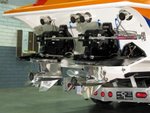
I can weld stainless. So the sensor would pass through the water jacket, maybe through a sleeve? And the bung is welded to the inner(exhaust pipe)?
Would you happen to have a picture?
Would you happen to have a picture?
01-11-2007 | 12:36 PM
#20
Rob

Joined: Aug 2001
Posts: 21,637
Likes: 12
From: Ms
Re: Odd Dyno results
__________________
.
The Only Time You Have To Much Ammo Is When Your Swimming Or On Fire.
.
The Only Time You Have To Much Ammo Is When Your Swimming Or On Fire.

