


Whipple By pass and Actuator valve
 10-03-2009 | 02:05 PM
#21

Thread Starter
Gold Member


Joined: May 2002
Posts: 1,127
Likes: 0
From: DFW

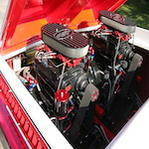
I ordered 2 complete 1.5" bypass valves on Thursday. I'm planning on installing the "valve" on the alum. plate that bolts to the top of the PSI's. There seems to be enough room in the front, see the picture, to mount the valve and vacuum cyl. I'm planning on discharging into an existing port below the blower, see picture, at the side of the intercooler. Comments?
Gary
Gary
 10-03-2009 | 03:08 PM
#22
Thread Starter
Gold Member
Joined: May 2002
Posts: 1,127
Likes: 0
From: DFW
Gary, Does the inter-cooler side cap cover an opening into the cooler core/fins ? If so, Bernelis' principle of venturi effect may cause a core temperature imbalance. An imbalance could cause a margin change between some fins and worst case, "puddling"....Just guessing, of course.
10-03-2009 | 03:32 PM
#23
Platinum Member


Joined: Oct 2000
Posts: 1,057
Likes: 29
From: Santa Barbara CA. USA
Yes, the cap covers an opening in the side of the intercooler. Other than going to the very front of the manifold, below the intercooler, where I have 3, 1/8npt "ports" to check 1) boost, 2) Hobbs switch set @ 4psi to engage a Weldon electric fuel pump to supplement the mechanical fuel pump, 3) Knock sensor, there is no place to plumb in a port to "dump" the mixture from above the blower. There is no room at the rear of the manifold, below the blower as the distributor is right in the way. What can I "hurt/harm" by dumping into the side of the intercooler? I realize that this is not an ideal location, but I have no where else to go. Any other suggestions?
Gary
Gary
10-03-2009 | 03:35 PM
#24
Platinum Member
Joined: Oct 2000
Posts: 1,057
Likes: 29
From: Santa Barbara CA. USA
Distribution bugs me, so goes the "tent" to keep air flow centered as apposed to off center. Also how will the inter-cooler leak effect cooling ? At first blush it seems safest to go through the inter-cooler and plumb "out" the tent.
I'm not sure what you mean by the above. Can you clarify please?
I'm not sure what you mean by the above. Can you clarify please?
10-03-2009 | 04:57 PM
#25
Thread Starter
Gold Member
Joined: May 2002
Posts: 1,127
Likes: 0
From: DFW
Gary, Don't hold me accountable, I'm trying to get my arms around the bypass concept as well, with limited information.
Post# 19 is intended to convey a possible method of circulating excessive pressure.
We know #7&8 are usually the hottest, because of distribution. Distribution of fuel/air is probably more of a challenge with carburetors than closed loop fuel injection. Either carbs or injection rely on an air intake plenum known as the intake manifold.
Your PSI blower pushes air/fuel, under pressure, forward to the front of the blower case. Pressurized ratio of air/fuel then flows down through the cooler core, into the plenum and is distributed to each of the eight runners. An interrupted or disturbed air/fuel flow may cause any one of the cylinders to be negatively effected.
Conversely, were the air/fuel to go through the cooler as normal, without possible interruption, by your side plate venturi, then it could be managed in the plenum/intake.
The floor of most blower intake manifolds is not flat. Typically, floor centerline has an inverted "V" shape to improve "distribution" to the runners. My thought is to go through the "V" with an opening, into the lifter valley with plumbing and out though an end of the valley web. Of course, for the engine without a block mounted distributor, the distributor hole would be convenient.
Post# 19 is intended to convey a possible method of circulating excessive pressure.
We know #7&8 are usually the hottest, because of distribution. Distribution of fuel/air is probably more of a challenge with carburetors than closed loop fuel injection. Either carbs or injection rely on an air intake plenum known as the intake manifold.
Your PSI blower pushes air/fuel, under pressure, forward to the front of the blower case. Pressurized ratio of air/fuel then flows down through the cooler core, into the plenum and is distributed to each of the eight runners. An interrupted or disturbed air/fuel flow may cause any one of the cylinders to be negatively effected.
Conversely, were the air/fuel to go through the cooler as normal, without possible interruption, by your side plate venturi, then it could be managed in the plenum/intake.
The floor of most blower intake manifolds is not flat. Typically, floor centerline has an inverted "V" shape to improve "distribution" to the runners. My thought is to go through the "V" with an opening, into the lifter valley with plumbing and out though an end of the valley web. Of course, for the engine without a block mounted distributor, the distributor hole would be convenient.
10-03-2009 | 05:08 PM
#26
Platinum Member
Joined: Oct 2000
Posts: 1,057
Likes: 29
From: Santa Barbara CA. USA
I'm in, I believe, the same situation as you. I'm just trying to see if this "system" is applicable to my application. If you look at the bottom of a PSI blower, you will see a series of 3, for lack of a better term, channels. These are designed to take the rear discharge outlet, that a PSI has, and channel the mixture equally to all areas of the intake. I don't know if this will affect the introduction of the outlet of the air valve or not.
10-04-2009 | 10:31 AM
#27
Thread Starter
Gold Member
Joined: May 2002
Posts: 1,127
Likes: 0
From: DFW
I'm in, I believe, the same situation as you. I'm just trying to see if this "system" is applicable to my application. If you look at the bottom of a PSI blower, you will see a series of 3, for lack of a better term, channels. These are designed to take the rear discharge outlet, that a PSI has, and channel the mixture equally to all areas of the intake. I don't know if this will affect the introduction of the outlet of the air valve or not.
Is it possible the signal part of the system would benefit from a vacuum/dry sump pump pulling somewhere around 10 inches.
10-07-2009 | 07:58 AM
#28
Thread Starter
Gold Member
Joined: May 2002
Posts: 1,127
Likes: 0
From: DFW
I'm in, I believe, the same situation as you. I'm just trying to see if this "system" is applicable to my application. If you look at the bottom of a PSI blower, you will see a series of 3, for lack of a better term, channels. These are designed to take the rear discharge outlet, that a PSI has, and channel the mixture equally to all areas of the intake. I don't know if this will affect the introduction of the outlet of the air valve or not.


