


ENGINES HEIGHT + X DIMENSIONS (With pictures)


 01-08-2022 | 11:49 AM
#13
VIP Member


Joined: Jun 2021
Posts: 3,475
Likes: 2,099
From: SW Ohio

I would think the dynamic in play is prop walk. Turning the props out would work to keep the transom behind the boat, like arrow fletchings.
Thanks. Brad.
(937)545-8991
01-08-2022 | 05:34 PM
#14
Thread Starter
Registered

Joined: Dec 2021
Posts: 32
Likes: 6
From: Marbella, Spain
Thank you very much guys for your replies!
Let me help about the concepts props spinning and toe.
first to talk about the spinning, we have to forget the upper part of the props:
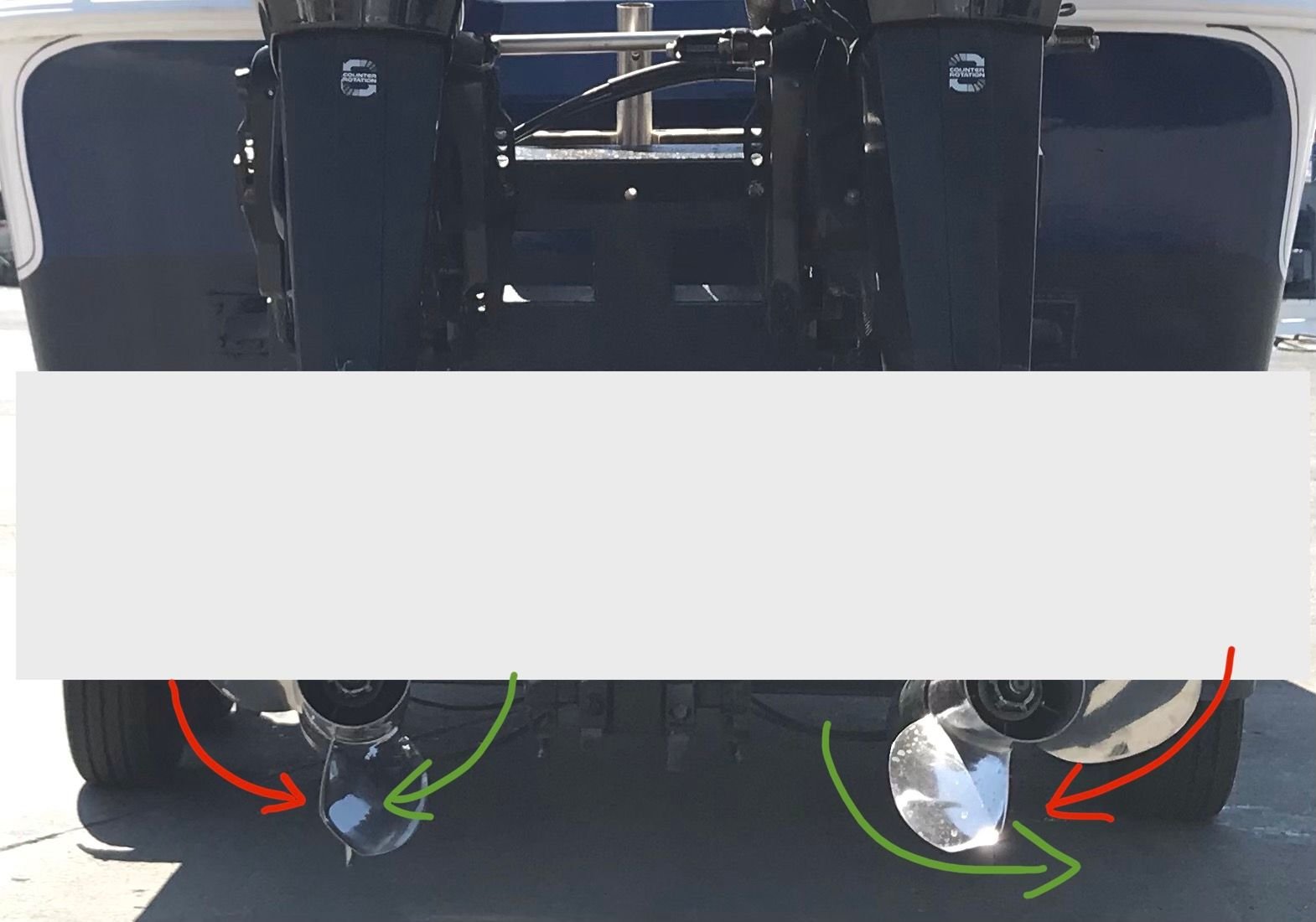
There is not a consensus of how to name Turning in as I will explain (90%) or the opposite (for me is easier the opposite indeed)
- Turning out (Red): it’s a paradox, but most people called it “turn out”, but when you analyse the bite in the water of the prop (the arrows) you realise it works in practice as “turn in”. Any way we call it “turn out”
This is the most common rigging in classical offshore and the reason is because the bite is opposite of the V, and you can achieve cleaner water and lift more the engines.
The direction of the turbulence will go inside.
- Turning in (green): you can use it in some special cases, for example if you have a boat designed for single engine and you have mounted two. (The bite of the props will be closer to the V. In a boat like mine, could be an smart option.
the direction of the turbulence goes outside.
From this point, if you analyse, which option will provide more Sternlift, probably will be turning in (green), but is much less relevant when we think only in the green/red arrows, isn’t it?
***
Toeing: the Key is to rigging the bullets as straight to the water as possible. Imagine a Salmon swiming up a river. The fish needs to go straight as possible against flow.
- Toe in (props out): is the most common way. It’s used on heavy boats with the engines just on the stern or I/O. The boat is splitting the water and you have to match the bullets with the flow.
- Toe out (props in): it’s used in special cases, as boats with brackets (long X dimension) or with steps. The boat splits the water but then the water takes an interior direction, and you have to match that flow. If the boat is slow you need to be around 1”toed. If your boat is very fast, you can run almost straight.
- Almost straight: you have to analyse X dimension, V angle, weight and speed. The faster, the less toe in/out you need.
***
How to combine Spinning + Toeing.
the idea is that the turbulences of both props have to match in some-point in the rooster.
in my boat 25ft light boat +65MPH the turbulences have to match around 60ft behind.
If your boat is heavier and slower, they have to match before.
- Toe in (props out) + turn out (red): in a heavy boat, I/O or engines just on the stern, you toe in to match the flow with the bullets, but then the turbulences will run to the sides, soo you choose red arrows to impulse the turbulences in, in order to find each other 30-40ft after the boat.
- Toe out (props in) + Turn in (green): in big X dimensions, you match the bullets with the flow, but the turbulences will go also to the middle point very fast, and can meet each other at 15 or 25ft. If you want to increase this distance, you can choose green arrows that will help you to split the turbulences.
- Toe out (props in) + turn out (red): you can replicate the behaviour of a single engine boat, matching the turbulences very close to the boat.
- Toe in (props out) + Turn in (green): imagine if you have an split-hull and you want the turbulences to keep straight and no meeting each other in any moment.
in the end, after all written, most important is:
1.- Toeing: Match the flow, no mater more.
2.- Spinning: In V, red arrows, cleaner water, no mater more.
Forget about stern/bow lifting benefits (you can get is better with other rigging issues), forget about speed gain (bullets straight to the flow=fast), forget about turbulence matching, ect,,
thanks again guys, please I want to know how much you would lift the engines in my case. I have PSI gauges.
Let me help about the concepts props spinning and toe.
first to talk about the spinning, we have to forget the upper part of the props:
There is not a consensus of how to name Turning in as I will explain (90%) or the opposite (for me is easier the opposite indeed)
- Turning out (Red): it’s a paradox, but most people called it “turn out”, but when you analyse the bite in the water of the prop (the arrows) you realise it works in practice as “turn in”. Any way we call it “turn out”
This is the most common rigging in classical offshore and the reason is because the bite is opposite of the V, and you can achieve cleaner water and lift more the engines.
The direction of the turbulence will go inside.
- Turning in (green): you can use it in some special cases, for example if you have a boat designed for single engine and you have mounted two. (The bite of the props will be closer to the V. In a boat like mine, could be an smart option.
the direction of the turbulence goes outside.
From this point, if you analyse, which option will provide more Sternlift, probably will be turning in (green), but is much less relevant when we think only in the green/red arrows, isn’t it?
***
Toeing: the Key is to rigging the bullets as straight to the water as possible. Imagine a Salmon swiming up a river. The fish needs to go straight as possible against flow.
- Toe in (props out): is the most common way. It’s used on heavy boats with the engines just on the stern or I/O. The boat is splitting the water and you have to match the bullets with the flow.
- Toe out (props in): it’s used in special cases, as boats with brackets (long X dimension) or with steps. The boat splits the water but then the water takes an interior direction, and you have to match that flow. If the boat is slow you need to be around 1”toed. If your boat is very fast, you can run almost straight.
- Almost straight: you have to analyse X dimension, V angle, weight and speed. The faster, the less toe in/out you need.
***
How to combine Spinning + Toeing.
the idea is that the turbulences of both props have to match in some-point in the rooster.
in my boat 25ft light boat +65MPH the turbulences have to match around 60ft behind.
If your boat is heavier and slower, they have to match before.
- Toe in (props out) + turn out (red): in a heavy boat, I/O or engines just on the stern, you toe in to match the flow with the bullets, but then the turbulences will run to the sides, soo you choose red arrows to impulse the turbulences in, in order to find each other 30-40ft after the boat.
- Toe out (props in) + Turn in (green): in big X dimensions, you match the bullets with the flow, but the turbulences will go also to the middle point very fast, and can meet each other at 15 or 25ft. If you want to increase this distance, you can choose green arrows that will help you to split the turbulences.
- Toe out (props in) + turn out (red): you can replicate the behaviour of a single engine boat, matching the turbulences very close to the boat.
- Toe in (props out) + Turn in (green): imagine if you have an split-hull and you want the turbulences to keep straight and no meeting each other in any moment.
in the end, after all written, most important is:
1.- Toeing: Match the flow, no mater more.
2.- Spinning: In V, red arrows, cleaner water, no mater more.
Forget about stern/bow lifting benefits (you can get is better with other rigging issues), forget about speed gain (bullets straight to the flow=fast), forget about turbulence matching, ect,,
thanks again guys, please I want to know how much you would lift the engines in my case. I have PSI gauges.
01-09-2022 | 03:25 PM
#15
Registered

Joined: Jan 2006
Posts: 3,858
Likes: 790
From: St. Pete Beach, FL
When turning out, the outside of the prop is getting more water than the inside. The outside of the prop which is turning down into the water then pushes the motors up and creates stern lift.
When it’s turning in, the outside blades are pulling the motors down and prying the bow up.
I can switch rotation on my motors by swapping a resistor side to side.
Turning out, I get so much stern lift that I have nearly no perceptible planing speed. The boat just stays flat.
Turning in my min planing speed goes up to about 30 because the stern is getting pulled down so much, picking the bow up a lot. My props are fairly large with a lot of cup so the effect is magnified.
Anyways, if max speed is your goal. Turning in should pick you up 2-3mph. You’ll sacrifice some fuel economy and mid range slower cruising speeds, and docking is much harder.
You can combat with the planing speed issues of turning in with some long tabs. Mine are too short to negate this. So I keep em turning out.
01-09-2022 | 03:50 PM
#16
Thread Starter
Registered
Joined: Dec 2021
Posts: 32
Likes: 6
From: Marbella, Spain
Very interesting #HogieRoll as you could try both spinning type in your boat.
it’s true than in my case, spinning out is bringing to much stern lift, then the boat runs flat as an arrow, I like that attitude, but when cross the 55MPH line it becomes very light and unstable. I can “drive trough” till 62MPH
I will try rising the engines 4,5”, the appropriate rigging by numbers, and I will check if I can maintain the attitude, but gaining in stability with more controlled stern lift.
if I can run till 65 stable then I can improve some MPH, maybe touching 70.
I’m thinking why turn in is faster in your case. Maybe because props are carrying less the weight of the stern? or because the props got closer to the surface, as it bites closer to the V?
it’s true than in my case, spinning out is bringing to much stern lift, then the boat runs flat as an arrow, I like that attitude, but when cross the 55MPH line it becomes very light and unstable. I can “drive trough” till 62MPH
I will try rising the engines 4,5”, the appropriate rigging by numbers, and I will check if I can maintain the attitude, but gaining in stability with more controlled stern lift.
if I can run till 65 stable then I can improve some MPH, maybe touching 70.
I’m thinking why turn in is faster in your case. Maybe because props are carrying less the weight of the stern? or because the props got closer to the surface, as it bites closer to the V?
01-10-2022 | 07:03 AM
#17
Registered
Joined: Jan 2006
Posts: 3,858
Likes: 790
From: St. Pete Beach, FL
Very interesting #HogieRoll as you could try both spinning type in your boat.
it’s true than in my case, spinning out is bringing to much stern lift, then the boat runs flat as an arrow, I like that attitude, but when cross the 55MPH line it becomes very light and unstable. I can “drive trough” till 62MPH
I will try rising the engines 4,5”, the appropriate rigging by numbers, and I will check if I can maintain the attitude, but gaining in stability with more controlled stern lift.
if I can run till 65 stable then I can improve some MPH, maybe touching 70.
I’m thinking why turn in is faster in your case. Maybe because props are carrying less the weight of the stern? or because the props got closer to the surface, as it bites closer to the V?
it’s true than in my case, spinning out is bringing to much stern lift, then the boat runs flat as an arrow, I like that attitude, but when cross the 55MPH line it becomes very light and unstable. I can “drive trough” till 62MPH
I will try rising the engines 4,5”, the appropriate rigging by numbers, and I will check if I can maintain the attitude, but gaining in stability with more controlled stern lift.
if I can run till 65 stable then I can improve some MPH, maybe touching 70.
I’m thinking why turn in is faster in your case. Maybe because props are carrying less the weight of the stern? or because the props got closer to the surface, as it bites closer to the V?
To go fast in V you need to “carry the bow” by keeping it out of the water. This helps pack air under the boat and reduces your wetted area. All fast non stepped Vs are attempting to ride on only the last little bit of the hull just in front of the transom.
01-10-2022 | 07:17 AM
#18
Registered
Joined: Mar 2002
Posts: 4,470
Likes: 2,106
From: Milton, Fla!
I have done same.
On my first twin OB 24’ Sonic I switched the gear cases to test rotation.
They we’re turning out and the boat ran perfect.
25” V-6 JohnRudes on 6” manual Jack plates on a 19” bracket.
After reading all the reports of turning in giving me 2 - 3 mph, I switched to turning in.
W/no other changes, one motor (I think port) now cavitated coming on plane and would no longer carry the bow at speed.
I think I lost 2 -3 mph.
That was an old Donzi design w/a round keel and not a straight vee.
That build taught me to listen to everyone but try it yourself anyway.
That rig proved most theories wrong.
Also tested toe in vs toe out and saw/felt nothing.
And as it was running the magic 80 mph that the industry said you needed nose cones, so I added them too.
Went from being fastest w/neutral trim to requiring full up trim just to fly the bow and lost 3 mph!
Knocked the cones off and got it all back!
On my first twin OB 24’ Sonic I switched the gear cases to test rotation.
They we’re turning out and the boat ran perfect.
25” V-6 JohnRudes on 6” manual Jack plates on a 19” bracket.
After reading all the reports of turning in giving me 2 - 3 mph, I switched to turning in.
W/no other changes, one motor (I think port) now cavitated coming on plane and would no longer carry the bow at speed.
I think I lost 2 -3 mph.
That was an old Donzi design w/a round keel and not a straight vee.
That build taught me to listen to everyone but try it yourself anyway.
That rig proved most theories wrong.
Also tested toe in vs toe out and saw/felt nothing.
And as it was running the magic 80 mph that the industry said you needed nose cones, so I added them too.
Went from being fastest w/neutral trim to requiring full up trim just to fly the bow and lost 3 mph!
Knocked the cones off and got it all back!
The lift vs dig of the prop rotation is caused by the angle of the water hitting the prop coming off the V bottom.
When turning out, the outside of the prop is getting more water than the inside. The outside of the prop which is turning down into the water then pushes the motors up and creates stern lift.
When it’s turning in, the outside blades are pulling the motors down and prying the bow up.
I can switch rotation on my motors by swapping a resistor side to side.
Turning out, I get so much stern lift that I have nearly no perceptible planing speed. The boat just stays flat.
Turning in my min planing speed goes up to about 30 because the stern is getting pulled down so much, picking the bow up a lot. My props are fairly large with a lot of cup so the effect is magnified.
Anyways, if max speed is your goal. Turning in should pick you up 2-3mph. You’ll sacrifice some fuel economy and mid range slower cruising speeds, and docking is much harder.
You can combat with the planing speed issues of turning in with some long tabs. Mine are too short to negate this. So I keep em turning out.
When turning out, the outside of the prop is getting more water than the inside. The outside of the prop which is turning down into the water then pushes the motors up and creates stern lift.
When it’s turning in, the outside blades are pulling the motors down and prying the bow up.
I can switch rotation on my motors by swapping a resistor side to side.
Turning out, I get so much stern lift that I have nearly no perceptible planing speed. The boat just stays flat.
Turning in my min planing speed goes up to about 30 because the stern is getting pulled down so much, picking the bow up a lot. My props are fairly large with a lot of cup so the effect is magnified.
Anyways, if max speed is your goal. Turning in should pick you up 2-3mph. You’ll sacrifice some fuel economy and mid range slower cruising speeds, and docking is much harder.
You can combat with the planing speed issues of turning in with some long tabs. Mine are too short to negate this. So I keep em turning out.
01-10-2022 | 07:49 AM
#19
Thread Starter
Registered
Joined: Dec 2021
Posts: 32
Likes: 6
From: Marbella, Spain
Thanks again guys,
#TwinO/BSonic your information is very useful for me, I guess my boat has similar wet area as yours, 25ft, but angled stern and peaky bow. Also my keel is rounded, not straight.
As you mention, with out-spinning our attitude is nice, no reason to change, same as if you can run with standard lower units in a nice height and you are not in surface props, is not necessary lower pick ups.
You are in the nice height when the water of the roosters grows till the top of the engine cages.
What props are you running?
I’m 23P (infamous) attwood ballistic cuped and label.
V is 145º rounded and X dimension is 53,3”
How much height is your cav plate below?
my calculations is 5,5” below +or-
Maybe I will plug the upper two (of 8) lower unit intakes. I guess I will have like 1” security distance from the water intakes, plugg-in the two upper will give an other 1” extra security distance if Im running in choppy seas.
Thanks again.
#TwinO/BSonic your information is very useful for me, I guess my boat has similar wet area as yours, 25ft, but angled stern and peaky bow. Also my keel is rounded, not straight.
As you mention, with out-spinning our attitude is nice, no reason to change, same as if you can run with standard lower units in a nice height and you are not in surface props, is not necessary lower pick ups.
You are in the nice height when the water of the roosters grows till the top of the engine cages.
What props are you running?
I’m 23P (infamous) attwood ballistic cuped and label.
V is 145º rounded and X dimension is 53,3”
How much height is your cav plate below?
my calculations is 5,5” below +or-
Maybe I will plug the upper two (of 8) lower unit intakes. I guess I will have like 1” security distance from the water intakes, plugg-in the two upper will give an other 1” extra security distance if Im running in choppy seas.
Thanks again.

