


Holley Hard Lines
 04-15-2023 | 09:36 PM
#1
Thread Starter
Registered


Joined: Oct 2000
Posts: 1,531
Likes: 614
From: Lake Ozark, MO USA
 Holley Hard Lines
Anyone done a replacement of the 500HP carb hard lines on a Gen 6? From fuel pump to carb. Want to change out the hard lines to braided flex, + pressure gauge. Is AN6 the way to go? I am being lazy here, probably already covered somewhere, but a quick search did not show anything.

 04-16-2023 | 04:59 PM
#4
Registered

Joined: Nov 2004
Posts: 14,154
Likes: 3,714
From: On A Dirt Floor
I’ve seen the following few different places:
Quote:
Fuel Hose: When fuel hose is used it must be either USCG Type A1-15, USCG Type B1-15. Where you use it determines what type you use.
From the fuel inlet on the engine (usually the fuel pump) to the carburetor you must use Type A1-15.
Each fuel vent line or fill line must be USCG Type A1-15 and the line from the fuel tank to the engine inlet must be type A1-15;
UNLESS:
if no more than five ounces of fuel is discharged in 2 1/2 minutes when:
(A) The hose is severed at the point where maximum drainage of fuel would occur,
(B) The boat is in its static floating position, and
(C) The fuel system is filled to the capacity market on the tank label.
Then you may use Type B1-15.
As a practical matter, few boat builders want to have to stock two types of hose, so most buy only Type A1 and use it everywhere. This is fine. Just be sure that you put in your owner's manual that the hose from the fuel pump to the carburetor and the vent and fill hose must be TYPE A1-15.
So what is the difference between A1, and B1. USCG Type A hose has to pass the 2 ½ minute fire test, B does not. The theory is the A is under more pressure than B, and being on the engine is exposed to more danger of fire than B. Since B is between the pump and the tank, if a leak occurs, the pressure rapidly drops to zero and the pump just sucks air, stopping the engine. Fuel doesn't get sprayed all over the place. The fuel line between the fuel pump and the carburetor, or fuel rail, is under pressure and if a leak develops, fuel will be sprayed around the hot engine. So there is a greater risk of fire. This hose must be A1-15 which is fire resistant. In addition, A1 hose is required when the hose always has fuel in it. Hose that only has fuel in it briefly, such as the fuel fill hose may be B1.
You do not have to use hose! You can use metallic lines. Some manufacturers do. For example, Mercury Marine inboard engines come with steel fuel line from the fuel pump to the carburetor. Metal lines do not allow vapor to escape through the fuel line walls.
Metallic fuel Lines: If you use metallic fuel lines, the ones that run from the fuel tank to the fuel inlet on the engine must be one of the following; seamless annealed copper, nickel-copper, or copper-nickel. From the fuel pump to the carburetor they can be any metal you want to use. Beware. You could set up a galvanic couple and the tube will be eaten away like powder. Choose carefully if you use metal fuel line from the pump to the carburetor. Do not use copper tubing. Pure copper is very subject to galvanic corrosion and cracking from vibration.
Anti-Siphon: The fuel line on a boat must run uphill, or else you have to have an anti-siphon device. An Anti-Siphon valve is that annoying little valve that most builders put at the tank outlet, that seems to get clogged at the most inconvenient times. So, if the top of the fuel tank is higher than the inlet on your fuel pump you have to put anti-siphon in the system. This is because the possibility exists that your entire fuel tank could siphon out into your carburetor, and fill up your manifold, and ruin your whole day! So, the solution is obvious. If you don't want this nasty little gadget in the fuel line, put the tank lower than the engine fuel inlet. But, also make sure none of the fuel line between the tank and the fuel inlet on the engine dips below the level of the tank top.
:unquote
04-16-2023 | 05:20 PM
#5
Registered
Joined: Nov 2004
Posts: 14,154
Likes: 3,714
From: On A Dirt Floor
Okay, found it from coast guard themselves here:
https://www.uscgboating.org/assets/1...YC.1002.01.pdf
I screenshot’d that page:
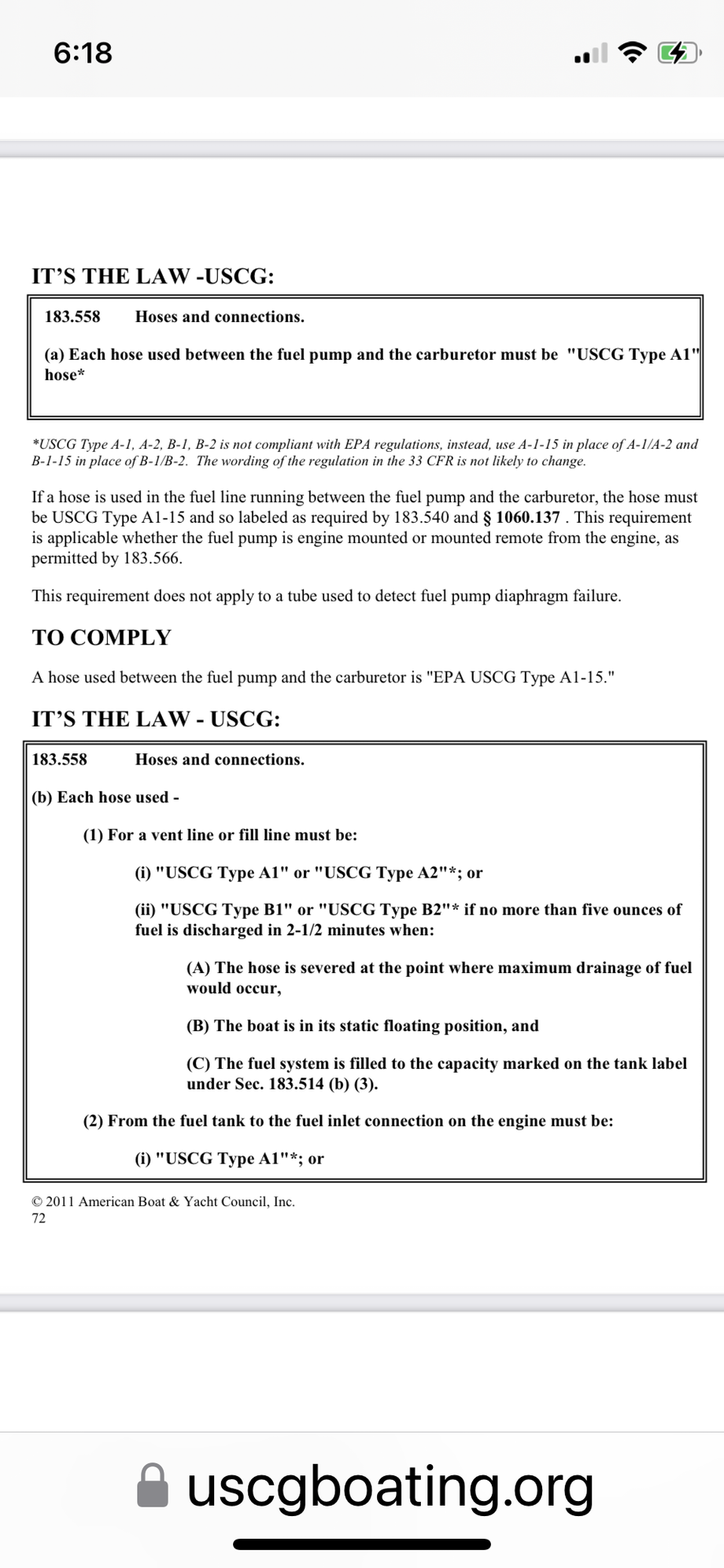
https://www.uscgboating.org/assets/1...YC.1002.01.pdf
I screenshot’d that page:
04-16-2023 | 08:38 PM
#6
Thread Starter
Registered
Joined: Oct 2000
Posts: 1,531
Likes: 614
From: Lake Ozark, MO USA
Well that figures! The hard lines tend to leak off and on because there is constant side pressure on the fittings at the carb. Also, servicing sticky floats and jets, means fuel all over wet shop rags or on the engine. I guess that the race boats do not have to meet that regulation. Thanks for the heads up.
04-16-2023 | 09:30 PM
#7
Registered
Joined: Nov 2004
Posts: 14,154
Likes: 3,714
From: On A Dirt Floor
Okay, i run into that at times with hard lines not wanting to seal. Especially quadrajets. I unbolt carb from intake, attach the oe hard lines, then with pressure, bolt the carb down.
Now, if you read my post above, you can use rubber lines. Instead of having to pull the rubber lines off barbed fittings when carb or fuel pump service time, you can use an fittings that are swivel with barb. Some companies make them. :thumbs
My ATI 502mpi supercharger used rubber lines on (aeroquip i believe) brass swivel push lock fittings. Thise hoses and fittings saw 60*psi. I lol’d ATI usibg these in kits but it held together.
Now, if you read my post above, you can use rubber lines. Instead of having to pull the rubber lines off barbed fittings when carb or fuel pump service time, you can use an fittings that are swivel with barb. Some companies make them. :thumbs
My ATI 502mpi supercharger used rubber lines on (aeroquip i believe) brass swivel push lock fittings. Thise hoses and fittings saw 60*psi. I lol’d ATI usibg these in kits but it held together.


