


8.1 SS riser pin hole leaks , only one side
 03-27-2025 | 02:40 PM
#1
Thread Starter
Registered
Joined: Feb 2023
Posts: 14
Likes: 0
 8.1 SS riser pin hole leaks , only one side
My port side SS risers are developing pin hole leaks pretty quickly , I got 800hrs or so out of first one and the second is at around 200hrs and already starting to fail. Still on first riser for starboard side and it looks fine. First one failed at various welds and second one is also. Scratching my head on this one, I chalked up the first failure to bad materials but now with the 2nd having the same problem I'm looking for a different cause. I've measured the riser for a voltage while running but didn't see anything for what that's worth. Computer and oil filter are mounted to port side riser on brackets welded on but pinholes are not clustered around those welds in particular. I flush with fresh water after every trip for about 5 mins at 1500rpm. Any thoughts appreciated.
Last edited by KonaD; 03-27-2025 at 10:38 PM.
 03-30-2025 | 09:16 AM
#2
Thread Starter
Registered
Joined: Feb 2023
Posts: 14
Likes: 0
When I get to 10 posts I can put up a photo or two. Reading a bunch on stainless corrosion and different ways it gets started. Both risers began corroding along the edge of welds, this seems to be consistent with intergranular corrosion which by my reading so far is caused by improper material handling and / or use of material with too high carbon content. I've been chasing my tail looking at mechanisms for accelerated galvanic corrosion (compared to starboard riser) but now I'm coming to the conclusion the riser makers just tell me that by default to deflect responsibility. I know for sure the first outfit can't or won't make good on the defective piece, I believe the 2nd won't by choice based on them telling me I have a galvanic corrosion issue and they won't warranty the riser beyond spot welding the current holes this one time ( this 2nd riser has about 200 hrs on it.) Maybe they just can't make these things properly consistently? Skilled welders and quality materials are expensive I'm sure. But this leaves me with the question of what the best solution to keep my boat going is. Stock volvo setup is out, that is a known failed design that will grenade the engine in this application (Carolina Classic 25) within 500hrs. Stock mercury exhaust with 3" extra risers? If I have the clearance it's probably a viable alternative with some fiddling around making brackets for the computer and fuse box. Maybe I'll roll the dice one more time on stainless and try the Hi-Teks out this time. The header design is appealing for it's simplicity.
Last edited by KonaD; 03-30-2025 at 09:38 AM.


 03-30-2025 | 11:00 PM
#5
Registered


Joined: Aug 2019
Posts: 1,250
Likes: 420
From: BC
The risers are developing pin hole leaks to the inside, or outside?
The leaks are generating on the weld beads...and cracking as well? Or just pin hole leaks?
Where do you boat? Salt water consitions vary by region.
Hot salt water is actually hard on even 316L stainless. As an example, salt water hot tubs etc use titanium heat exchangers vs stainless.
If the stainless weld beads were not done with an inert gas on the reverse side, that can also be an issue.
You can develop electrolysis issues in places you don't expect. Even the fiberglass can conduct.
It's odd that your having the issues on the same side, so you may be on to something there.
Maybe adding a little pencil zinc would help if you don't find any other issue?
The leaks are generating on the weld beads...and cracking as well? Or just pin hole leaks?
Where do you boat? Salt water consitions vary by region.
Hot salt water is actually hard on even 316L stainless. As an example, salt water hot tubs etc use titanium heat exchangers vs stainless.
If the stainless weld beads were not done with an inert gas on the reverse side, that can also be an issue.
You can develop electrolysis issues in places you don't expect. Even the fiberglass can conduct.
It's odd that your having the issues on the same side, so you may be on to something there.
Maybe adding a little pencil zinc would help if you don't find any other issue?
03-30-2025 | 11:44 PM
#6
Thread Starter
Registered
Joined: Feb 2023
Posts: 14
Likes: 0
Boating in Hawaii. Salinity is comparable to offshore South Carolina or Florida ~35 ppt. There are a lot of SS risers in boats seeing the same hot salt water mine are I have to believe. Also, remember that the original starboard side riser is still intact so it's possible to see roughly 1200hrs of hot salt water at least in a well executed riser. The pin holes I've detected were on the outside. Did not detect any between exhaust passage and cooling jacket but that doesn't mean they were not there in first riser. 2nd riser was sent back to fabricator for spot weld patching of 2 leaks, they did not pressure test to see if there are more. I should probably pull the riser again soon and bore scope the exhaust ports. The first riser did develop cracks eventually as well but I can't remember if it was after having local machine shop try to spot weld some of the leaks just to get another month out of it or so. It didn't work. 2nd riser is just starting to show pin hole issues and I'm trying to get ahead of it if I can. I don't have a convincing theory about how this problem is galvanic since the only metals the riser is in contact with would be anodes to the SS cathode. When I look at the two risers and the way they corroded or are corroding it looks very much like how intergranular corrosion is described.

 04-06-2025 | 12:43 PM
#10
Thread Starter
Registered
Joined: Feb 2023
Posts: 14
Likes: 0
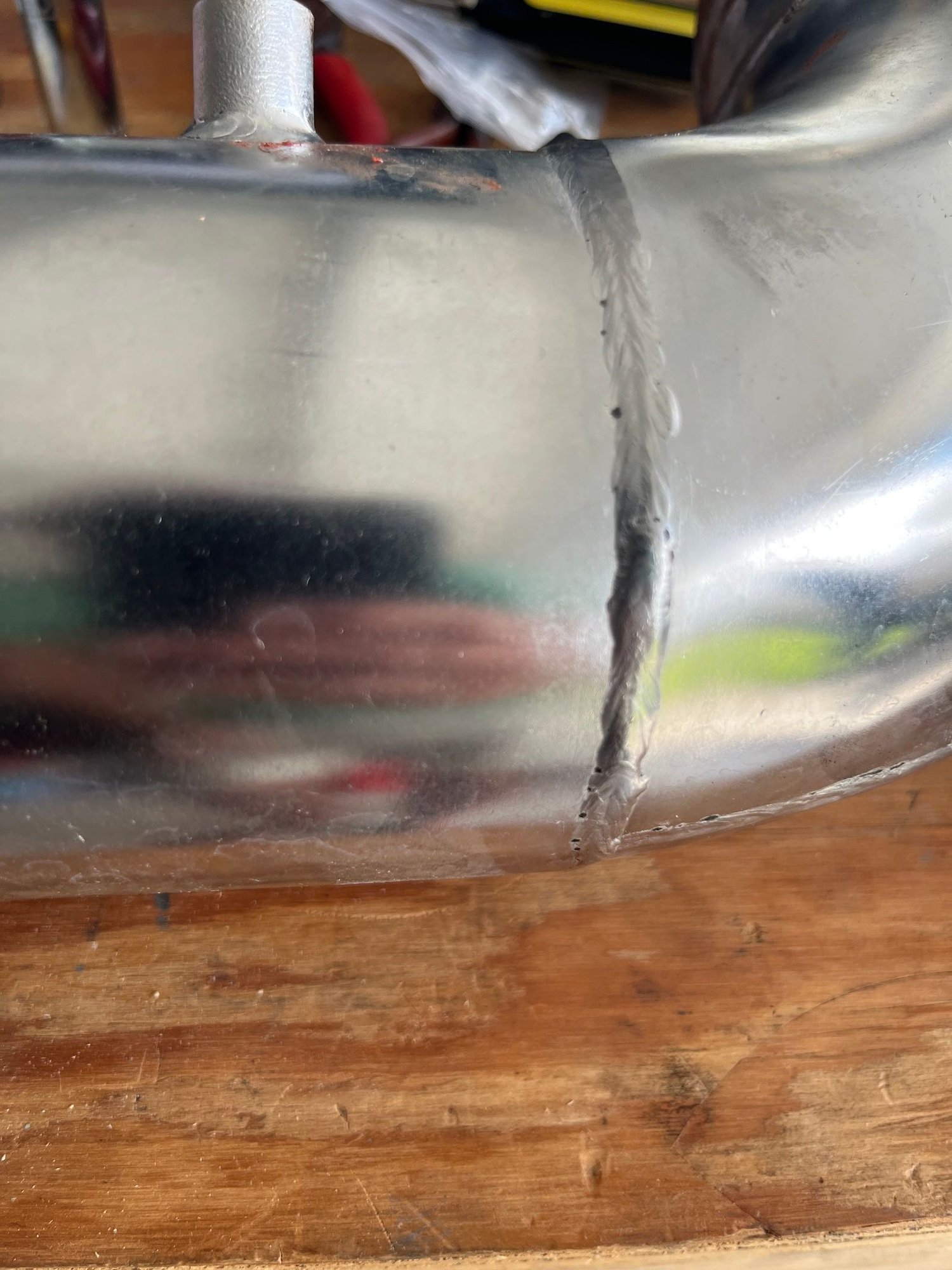
Getting a crash course in mechanisms of corrosion in stainless steel in marine applications and weld inspection. The photos above, especially the 2nd are great examples for illustrating what a poor weld in 316 looks like and the resulting sensitivity to intergranular corrosion from the chromium depletion in the heat affected zone of the weld. If you receive a part where the welds look sloppy and irregular as in the photo above, expect to see pin hole corrosion develop very quickly, as this piece did, if you are in a salt water environment. Here's a counter example of a well executed weld in SS below. Notice the "stack of dimes" appearance. This is the first indication of a properly executed weld by a skilled fabricator and conversely, your first warning of an inferiorly made piece in it's absence. Also, if your part is going to be used for salt water ask for 316L , not 316 dual spec , not 316 to further reduce the chances of corrosion spots developing at the edges of the welds.

Last edited by KonaD; 04-06-2025 at 01:28 PM.


