


Weak Charging System....?
 07-23-2025 | 06:34 AM
#11
Thread Starter
VIP Member


Joined: Jun 2021
Posts: 3,509
Likes: 2,135
From: SW Ohio

Fuel Pump hard mounted to the hull is likely your megaphone issue.
Sounds to me like you have the perfect setup. CFO is complaining about the fuel pump...and not the thru-hull exhaust....
Having a voltmeter directly connected to the batts is the way to go. Even digital would be goo. One for each batt.
Your blowers are not taking up a lot of current...no different than running headlights...heater fan, wipers etc. What isnthe Holley drawing?
18A fuel pump
5A Blowers
?? HOLLEY
Not a lot of draw.
The thing to do is test the current output of the Alt while in use. Inductive meter. Otherwise, you're just guessing.
Sounds to me like you have the perfect setup. CFO is complaining about the fuel pump...and not the thru-hull exhaust....
Having a voltmeter directly connected to the batts is the way to go. Even digital would be goo. One for each batt.
Your blowers are not taking up a lot of current...no different than running headlights...heater fan, wipers etc. What isnthe Holley drawing?
18A fuel pump
5A Blowers
?? HOLLEY
Not a lot of draw.
The thing to do is test the current output of the Alt while in use. Inductive meter. Otherwise, you're just guessing.
I have no idea what the alternator is actually putting out. Like I said, I had it tested, while the engine was out, and it was over performing at the time. Don't remember the number. It's been a hot minute. What's the spec output of the OWM 496 alternator? I'll try and check it again this weekend.
I would agree that we are not drawing that much. But the overall feeling is that the alternator is barely keeping up. My main wonder is around the fact that we are now charging both batteries simultaneously, whereas before, it was only the one the battery selector switch was set to.
If memory serves, there's a 10A fuse on the power input wire going to the ECM, but there is also a fuse at the relay for the injectors.
It was suggested that I run the two blowers through a relay when I installed the second blower, and I elected to draw straight from the switch. I even bumped up the breaker to 10A (replacing a 5A). Maybe I need to address that over the winter, too.
The thru-transom exhaust sound is normal. The fuel pump whine is new, and, to be fair, it IS an annoying sound. And it's fairly prominent at idle. She said it can be heard as she's walking down the ramp after parking the truck.
Thanks. Brad.
 07-23-2025 | 07:32 AM
#12
Registered
Joined: Oct 2024
Posts: 96
Likes: 39
From: York Haven, PA
Its not a free diagnosis.. but this is a good piece of kit to have on a boat anyways..
I believe the stock 496 alternator is 65A.
You can measure DC current with a clamp meter like this so you can get actual amperage output from your alternator..
One thing I'm wondering is if your checking your voltage levels at idle? Most alternators, except special built ones, are barely putting out anything at idle RPM. Most won't output full capacity until at least 2000 RPM, so unless you're checking voltage levels at higher rpms, it won't really be accurate unless you're rev'ed up a bit. But again, checking voltage levels isn't really telling you the full story.. You need to be able to measure current output to see if its actually keeping up with the charging needs.
You also mentioned you are using a battery isolator.. These are essentially diodes, which have a nominal voltage drop of 0.6 to 0.7 volts.. So the output of your battery isolator will never be higher than your alternator voltage output minus 0.6 volts.. So if you spend a lot of time idling around the lake, your isolator voltage will be too low to charge.. You should check the voltage at the input and output of the isolator and verify this voltage drop.
I think step one is to actually measure your alternator output voltage and current at 2000ish RPM.

I believe the stock 496 alternator is 65A.
You can measure DC current with a clamp meter like this so you can get actual amperage output from your alternator..
One thing I'm wondering is if your checking your voltage levels at idle? Most alternators, except special built ones, are barely putting out anything at idle RPM. Most won't output full capacity until at least 2000 RPM, so unless you're checking voltage levels at higher rpms, it won't really be accurate unless you're rev'ed up a bit. But again, checking voltage levels isn't really telling you the full story.. You need to be able to measure current output to see if its actually keeping up with the charging needs.
You also mentioned you are using a battery isolator.. These are essentially diodes, which have a nominal voltage drop of 0.6 to 0.7 volts.. So the output of your battery isolator will never be higher than your alternator voltage output minus 0.6 volts.. So if you spend a lot of time idling around the lake, your isolator voltage will be too low to charge.. You should check the voltage at the input and output of the isolator and verify this voltage drop.
I think step one is to actually measure your alternator output voltage and current at 2000ish RPM.
07-23-2025 | 08:14 AM
#14
Thread Starter
VIP Member
Joined: Jun 2021
Posts: 3,509
Likes: 2,135
From: SW Ohio
I have not. But one of them is brand new and they both meter about the same. It's certainly worth looking into.
Thanks. Brad.
07-23-2025 | 08:31 AM
#15
Thread Starter
VIP Member
Joined: Jun 2021
Posts: 3,509
Likes: 2,135
From: SW Ohio
Its not a free diagnosis.. but this is a good piece of kit to have on a boat anyways..
https://www.amazon.com/dp/B0BP7CWZ1Y...d_asin_title_1
I believe the stock 496 alternator is 65A.
You can measure DC current with a clamp meter like this so you can get actual amperage output from your alternator..
One thing I'm wondering is if your checking your voltage levels at idle? Most alternators, except special built ones, are barely putting out anything at idle RPM. Most won't output full capacity until at least 2000 RPM, so unless you're checking voltage levels at higher rpms, it won't really be accurate unless you're rev'ed up a bit. But again, checking voltage levels isn't really telling you the full story.. You need to be able to measure current output to see if its actually keeping up with the charging needs.
You also mentioned you are using a battery isolator.. These are essentially diodes, which have a nominal voltage drop of 0.6 to 0.7 volts.. So the output of your battery isolator will never be higher than your alternator voltage output minus 0.6 volts.. So if you spend a lot of time idling around the lake, your isolator voltage will be too low to charge.. You should check the voltage at the input and output of the isolator and verify this voltage drop.
I think step one is to actually measure your alternator output voltage and current at 2000ish RPM.
https://www.amazon.com/dp/B0BP7CWZ1Y...d_asin_title_1
I believe the stock 496 alternator is 65A.
You can measure DC current with a clamp meter like this so you can get actual amperage output from your alternator..
One thing I'm wondering is if your checking your voltage levels at idle? Most alternators, except special built ones, are barely putting out anything at idle RPM. Most won't output full capacity until at least 2000 RPM, so unless you're checking voltage levels at higher rpms, it won't really be accurate unless you're rev'ed up a bit. But again, checking voltage levels isn't really telling you the full story.. You need to be able to measure current output to see if its actually keeping up with the charging needs.
You also mentioned you are using a battery isolator.. These are essentially diodes, which have a nominal voltage drop of 0.6 to 0.7 volts.. So the output of your battery isolator will never be higher than your alternator voltage output minus 0.6 volts.. So if you spend a lot of time idling around the lake, your isolator voltage will be too low to charge.. You should check the voltage at the input and output of the isolator and verify this voltage drop.
I think step one is to actually measure your alternator output voltage and current at 2000ish RPM.
Thanks for the spec on the alternator. I was thinking 70A but didn't really know.
It's the idle speed output I'm most worried about. But, I'll admit, I don't recall actually looking at the volt gauge on the dash while running down the lake. I'll have to do that.
BlueSea Systems calls it an ACR; Automatic Charging Relay. It's just a switch. I don't believe it has diodes. I believe its default is open circuit, isolating the batteries whenever it sees a load (starting, radio, bad battery, etc) or no current, and closes when it sees a charge. It doesn't really have an "output". It is just a switched bridge between the two output lugs of the selector switch. I guess with this said, it would stand to reason that we are seeing a positive charge, over that of demand, or the ECM battery would be down significantly by the end of the day' Logic being, if there were no charge above demand, the ACR would open, and a charge would only go to the battery the selector switch was set on, which has been #2. Am I reasoning that out correctly?
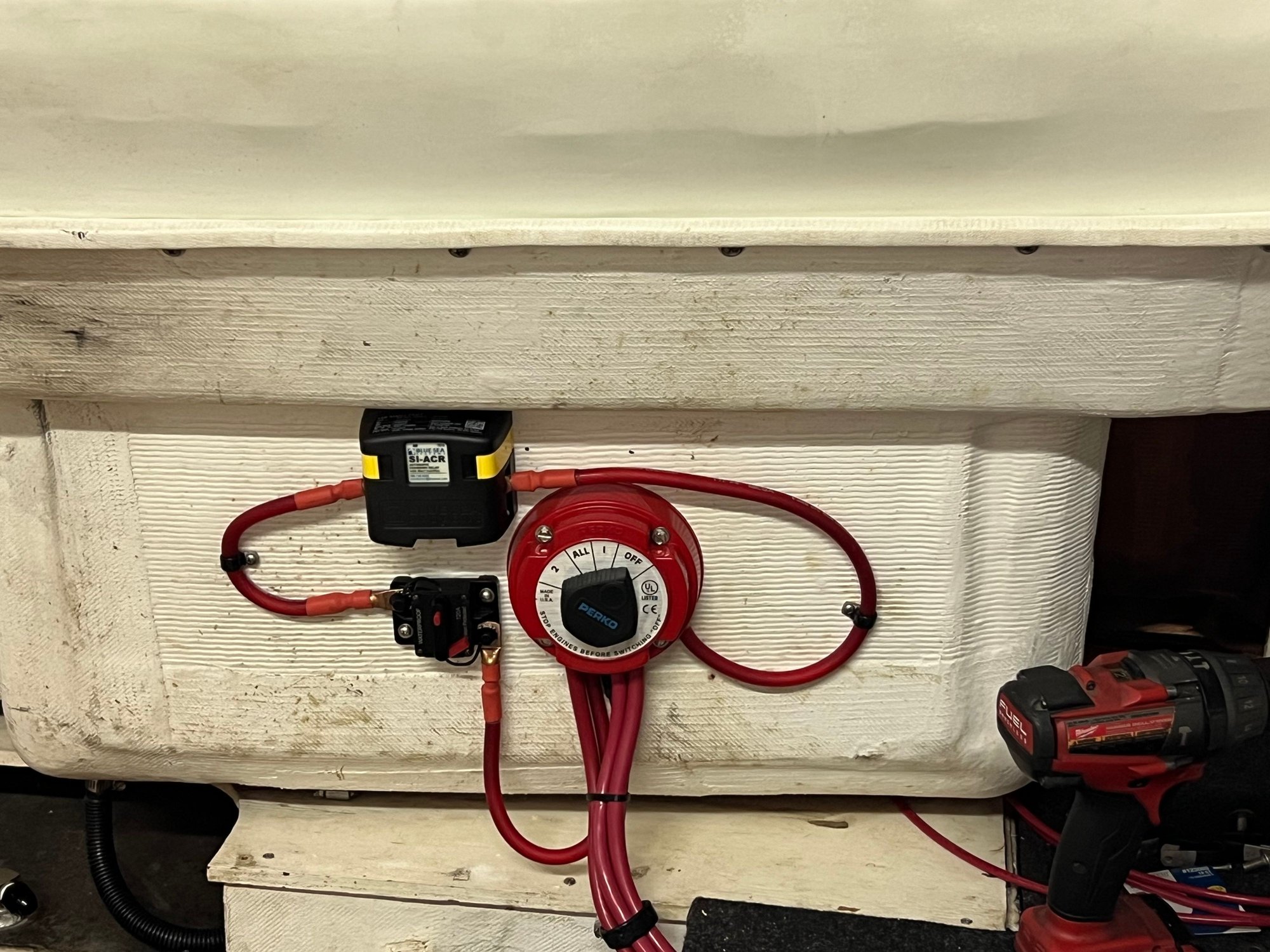
There is a ground wire that has since been connected to the ACR that allows it to be an active circuit, detecting current.
Thanks. Brad.
Last edited by Brad Christy; 07-23-2025 at 08:36 AM.
07-23-2025 | 08:54 AM
#16

Forum Regulator

Joined: May 2001
Posts: 24,211
Likes: 1,608
From: Worldwide
We all know manufacturing QC has gone to shlt since Covid. I can attest as I had a brutal wreck in my racecar due to a simple failed brake component. And we've all at one time or another pulled a brand new broken product out of the box.
07-23-2025 | 09:23 AM
#17
Registered
Joined: Oct 2024
Posts: 96
Likes: 39
From: York Haven, PA
AShipShow,
BlueSea Systems calls it an ACR; Automatic Charging Relay. It's just a switch. I don't believe it has diodes. I believe its default is open circuit, isolating the batteries whenever it sees a load (starting, radio, bad battery, etc) or no current, and closes when it sees a charge. It doesn't really have an "output". It is just a switched bridge between the two output lugs of the selector switch. I guess with this said, it would stand to reason that we are seeing a positive charge, over that of demand, or the ECM battery would be down significantly by the end of the day' Logic being, if there were no charge above demand, the ACR would open, and a charge would only go to the battery the selector switch was set on, which has been #2. Am I reasoning that out correctly?
There is a ground wire that has since been connected to the ACR that allows it to be an active circuit, detecting current.
Thanks. Brad.
BlueSea Systems calls it an ACR; Automatic Charging Relay. It's just a switch. I don't believe it has diodes. I believe its default is open circuit, isolating the batteries whenever it sees a load (starting, radio, bad battery, etc) or no current, and closes when it sees a charge. It doesn't really have an "output". It is just a switched bridge between the two output lugs of the selector switch. I guess with this said, it would stand to reason that we are seeing a positive charge, over that of demand, or the ECM battery would be down significantly by the end of the day' Logic being, if there were no charge above demand, the ACR would open, and a charge would only go to the battery the selector switch was set on, which has been #2. Am I reasoning that out correctly?
There is a ground wire that has since been connected to the ACR that allows it to be an active circuit, detecting current.
Thanks. Brad.
07-23-2025 | 09:31 AM
#18
Registered

Joined: Jun 2007
Posts: 7,318
Likes: 1,824
From: Merritt Island, FL
Some good advise here, I am a dual engine but isolate and use dual blowers. You should not have low voltage issues, pretty much anything over 1200 rpm and I hover right around 14v. (13.8).
The bilge blower could be put on a relay, amazing how much that helps, I also did it with my hatch ram.
Check the current and voltage out right at the alternator first, then go from there. Who know you may have a bad connection on the main alternator feed. Sometimes even the crimp gets bad.
I use these relays in my little boat.
The bilge blower could be put on a relay, amazing how much that helps, I also did it with my hatch ram.
Check the current and voltage out right at the alternator first, then go from there. Who know you may have a bad connection on the main alternator feed. Sometimes even the crimp gets bad.
I use these relays in my little boat.
07-23-2025 | 09:33 AM
#19
Registered
Joined: Jun 2007
Posts: 7,318
Likes: 1,824
From: Merritt Island, FL
AShipShow,
Thanks for the spec on the alternator. I was thinking 70A but didn't really know.
It's the idle speed output I'm most worried about. But, I'll admit, I don't recall actually looking at the volt gauge on the dash while running down the lake. I'll have to do that.
BlueSea Systems calls it an ACR; Automatic Charging Relay. It's just a switch. I don't believe it has diodes. I believe its default is open circuit, isolating the batteries whenever it sees a load (starting, radio, bad battery, etc) or no current, and closes when it sees a charge. It doesn't really have an "output". It is just a switched bridge between the two output lugs of the selector switch. I guess with this said, it would stand to reason that we are seeing a positive charge, over that of demand, or the ECM battery would be down significantly by the end of the day' Logic being, if there were no charge above demand, the ACR would open, and a charge would only go to the battery the selector switch was set on, which has been #2. Am I reasoning that out correctly?
There is a ground wire that has since been connected to the ACR that allows it to be an active circuit, detecting current.
Thanks. Brad.
Thanks for the spec on the alternator. I was thinking 70A but didn't really know.
It's the idle speed output I'm most worried about. But, I'll admit, I don't recall actually looking at the volt gauge on the dash while running down the lake. I'll have to do that.
BlueSea Systems calls it an ACR; Automatic Charging Relay. It's just a switch. I don't believe it has diodes. I believe its default is open circuit, isolating the batteries whenever it sees a load (starting, radio, bad battery, etc) or no current, and closes when it sees a charge. It doesn't really have an "output". It is just a switched bridge between the two output lugs of the selector switch. I guess with this said, it would stand to reason that we are seeing a positive charge, over that of demand, or the ECM battery would be down significantly by the end of the day' Logic being, if there were no charge above demand, the ACR would open, and a charge would only go to the battery the selector switch was set on, which has been #2. Am I reasoning that out correctly?
There is a ground wire that has since been connected to the ACR that allows it to be an active circuit, detecting current.
Thanks. Brad.
07-23-2025 | 11:25 AM
#20
Registered
Joined: May 2009
Posts: 629
Likes: 408
From: Indiana
Lot of good info for ya here Brad. If you’re running 12.5 at idle with a load on your prob ok. Speaking from my PQ experience the dash wiring isn’t great. They run small insufficient gauge wire to the helm and daisy chain everything together. Two things I did that helped a lot; first - run a large power and ground up near helm, set up 2 buss bars and supply dash from there.
Second, power your hatch ram through relays at the rear and control the relays with your dash switch. Your hatch will run faster and won’t make strange things happen with dash while raising hatch.
You probably run at least 3000-3500 when cruising so if alt output is ok at 2000 your good to go.
Second, power your hatch ram through relays at the rear and control the relays with your dash switch. Your hatch will run faster and won’t make strange things happen with dash while raising hatch.
You probably run at least 3000-3500 when cruising so if alt output is ok at 2000 your good to go.

