496 Head Bolt Length
 01-15-2026 | 09:15 PM
#11
Thread Starter
VIP Member


Joined: Jun 2021
Posts: 3,533
Likes: 2,137
From: SW Ohio

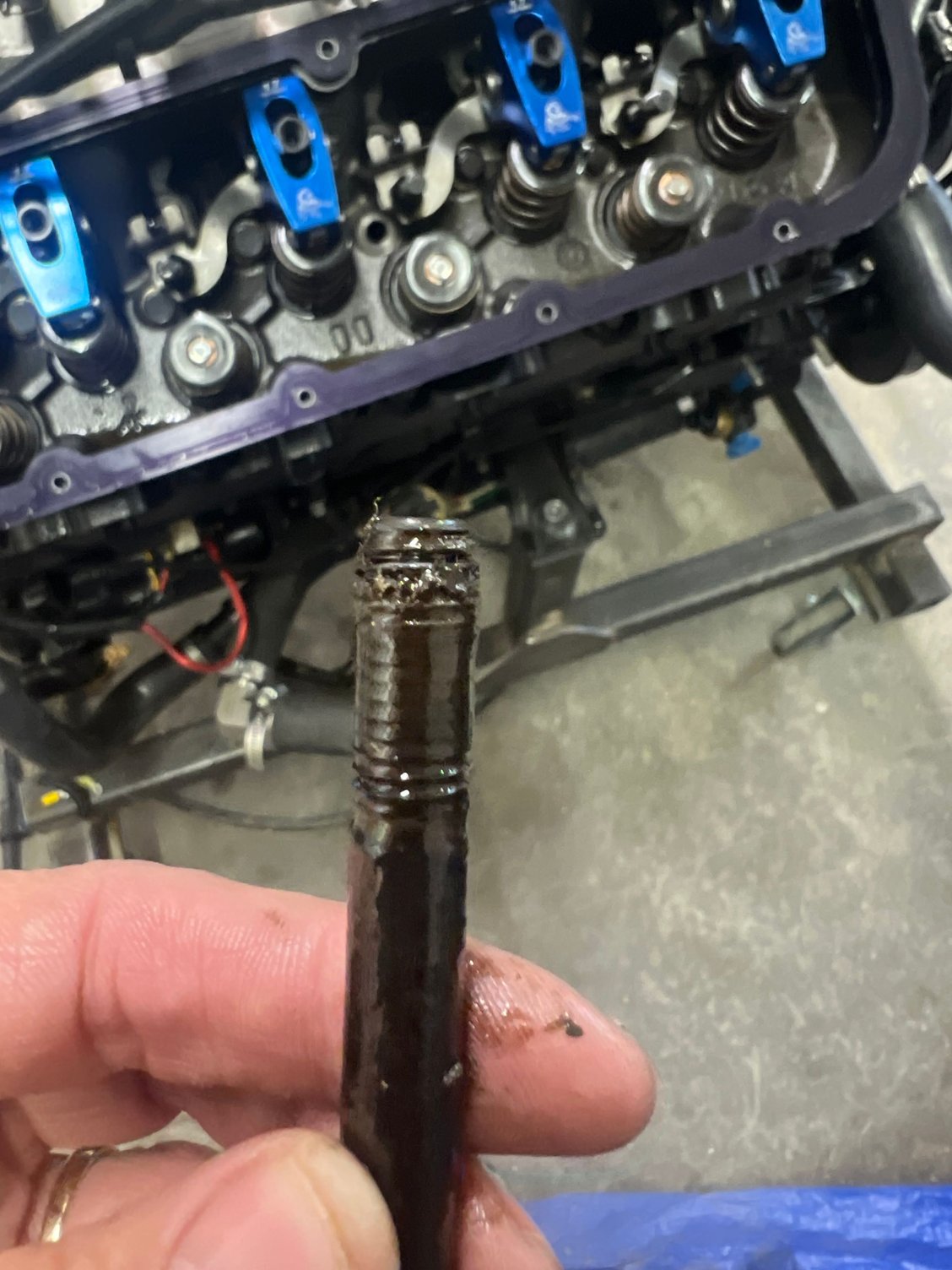
Per advice from Larry at Raylar, 65ft/lbs for the long and mid-length ones, and 60ft/lbs for the short ones. He said he was not a fan of the <X> ft/bls + X° of rotation theory. 33 of the 34 came to torque just fine. But that one never even got close. A more experienced builder would have gave up and stopped before it snapped.
The funny thing is that, when I asked him about the bolts he sold me being shorter than the OEMs I’d just pulled out, Larry told me to just put it together and run it. I don’t doubt him, but I don’t have a wall of bare blocks to go through when/if I rip the threads out of mine.
Personally, I don’t understand the concept of tightening something to the point it’s ready to break. I’ve read/heard it explained a dozen times. Still doesn’t compute with me. A friend of mine who used to build drag engines on a hobby basis said they used to call them “torque-to-fail”. The term seems accurate in my mind.
The guy that’s been doing the Holley tuning for me is who told me that Fel-Pro’s quality has gone to sh!t in the last couple years. Both he and his dad (who builds the engines in their shop) categorically refuse to use anything from Fel-Pro anymore.
Thanks. Brad.
Last edited by Brad Christy; 01-15-2026 at 09:40 PM.
 01-15-2026 | 09:29 PM
#12
Thread Starter
VIP Member
Joined: Jun 2021
Posts: 3,533
Likes: 2,137
From: SW Ohio
Tartilla,
Just below flush of the deck. It snapped off pretty clean, even if not flat/level. I was able to drill into it and get an easy-out to get a bite on it and got it out pretty easy with no damage to the tapped threads.
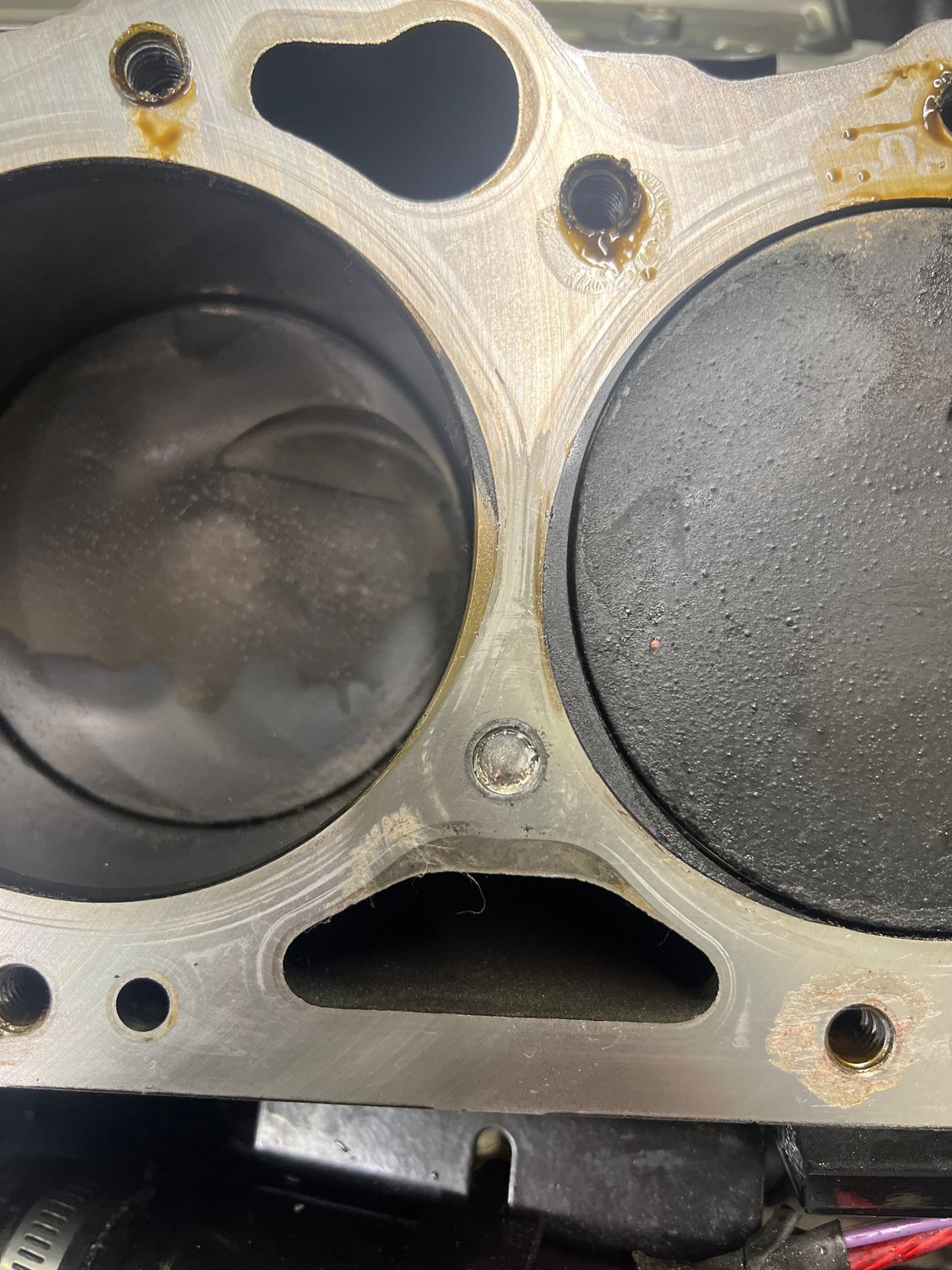
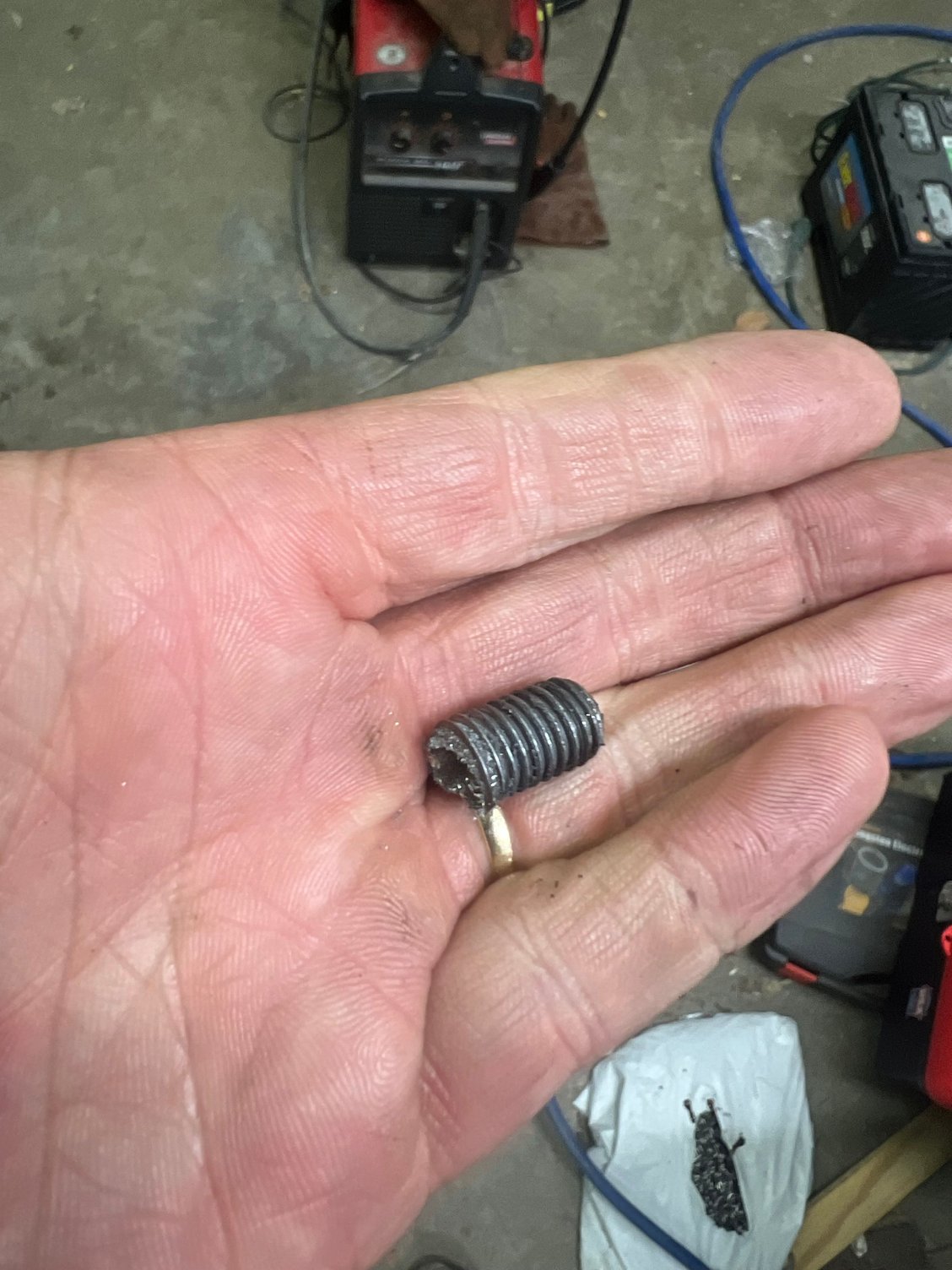
I’m fairly well convinced it was just a faulty bolt. The problem is that that one faulty bolt made them all scrap, if you follow the “one use” rule for TTY bolts.
Thanks. Brad.
Just below flush of the deck. It snapped off pretty clean, even if not flat/level. I was able to drill into it and get an easy-out to get a bite on it and got it out pretty easy with no damage to the tapped threads.
I’m fairly well convinced it was just a faulty bolt. The problem is that that one faulty bolt made them all scrap, if you follow the “one use” rule for TTY bolts.
Thanks. Brad.
Last edited by Brad Christy; 01-15-2026 at 09:40 PM.
01-15-2026 | 09:54 PM
#13
Thread Starter
VIP Member
Joined: Jun 2021
Posts: 3,533
Likes: 2,137
From: SW Ohio
Guys,
For the record….

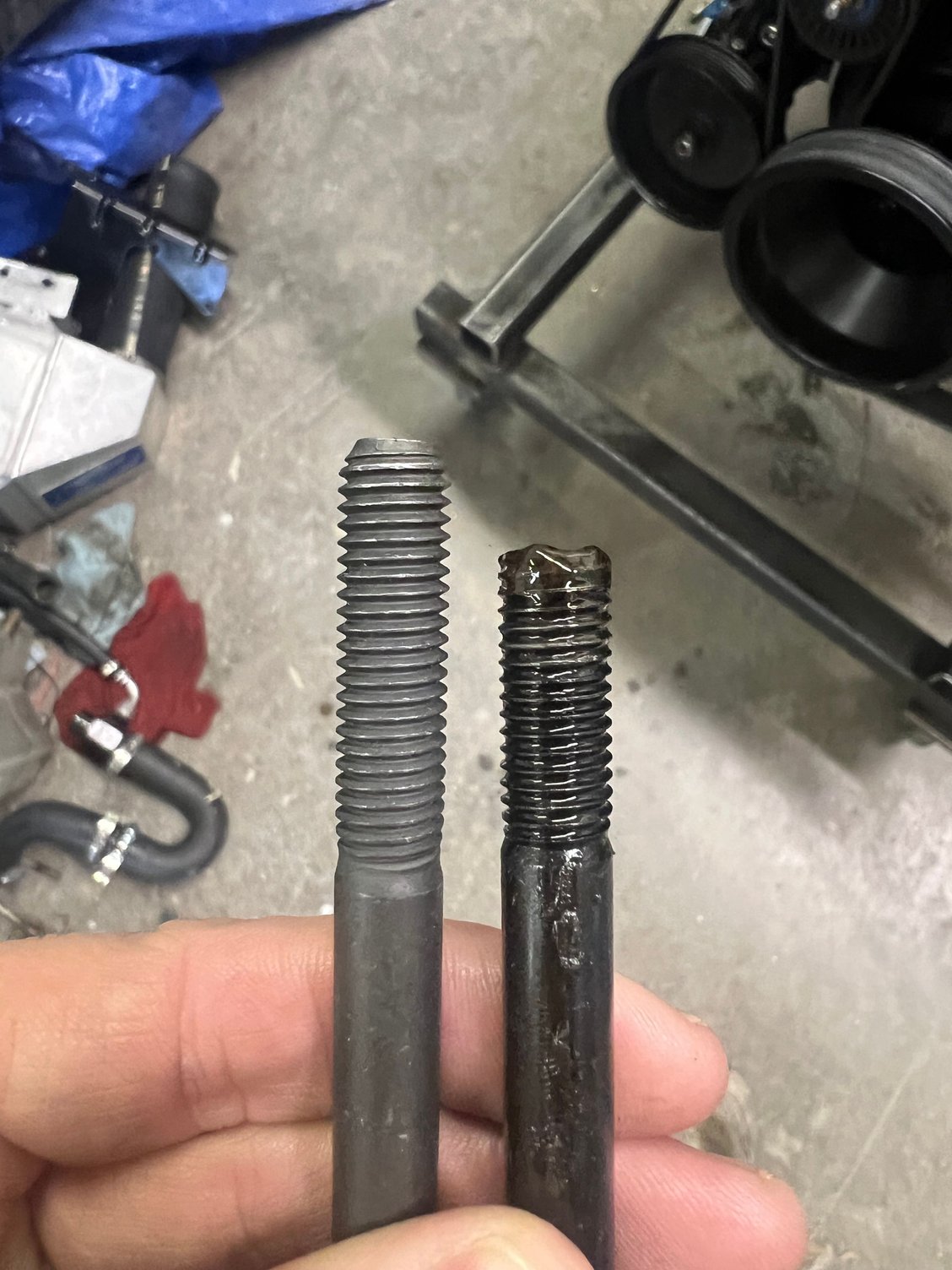
This shows the difference between the ARP (100mm UHL) and the CAT (110mm UHL) bolts. Nothing wrong with the ARPs. Just not long enough. You can clearly see where the engagement stopped on the shorter ARP bolt, and how much more engagement I’ll have with the 110mm long bolts. Same deal with the short bolts; 60mm as opposed to 50mm.
Thanks. Brad.
For the record….
This shows the difference between the ARP (100mm UHL) and the CAT (110mm UHL) bolts. Nothing wrong with the ARPs. Just not long enough. You can clearly see where the engagement stopped on the shorter ARP bolt, and how much more engagement I’ll have with the 110mm long bolts. Same deal with the short bolts; 60mm as opposed to 50mm.
Thanks. Brad.
01-15-2026 | 11:04 PM
#14
Registered

Joined: Jun 2009
Posts: 9,989
Likes: 6,483
From: Chicago
With the updated tensile strengths—CAT bolt at 170,000 psi and ARP bolt at 180,000 psi—the difference is relatively small (about 6% higher for the ARP). This puts both in a similar high-strength category, comparable to premium Grade 8 or better fasteners, and well above typical OEM specs in many applications (often around 150,000–160,000 psi for standard high-stress bolts).
However, the ARP's ~6% higher tensile strength, combined with ARP's typical quality advantages (e.g., rolled threads post-heat treat for ~10x better fatigue life in some cases, tighter tolerances), makes the shorter ARP bolt very competitive—and potentially preferable—for reliability in demanding applications. Many BBC builders favor ARP precisely because of these engineered benefits, even if engagement is slightly less.
Key Comparison Factors
- Ultimate Tensile Strength (UTS): ARP edges out slightly at 180 ksi vs. CAT's 170 ksi. This means the ARP can theoretically handle a bit more peak load before failure, assuming identical diameter and material quality.
- Thread Engagement:
- CAT (110 mm length, 22 threads): More engagement (~1.57 inches if ~14 TPI typical for 7/16" BBC heads), spreading load over more threads → lower stress per thread, better resistance to stripping (especially critical in cast iron blocks), and improved fatigue life under thermal cycling/high cylinder pressures.
- ARP (100 mm length, 15 threads): Still solid engagement (~1.07 inches), exceeding common minimums of 1–1.5x bolt diameter (~9–12 threads for safety in performance builds). ARP's manufacturing advantages (e.g., threads often rolled after heat treat for better fatigue resistance and grain flow) help compensate for fewer threads.
- Overall Clamping & Durability:
- In a high-performance BBC setup (e.g., boosted, high-compression, or high-RPM), the ARP's slight strength edge + superior metallurgy (better fatigue properties, precise tolerances) often makes it more reliable long-term, even with marginally less engagement.
- The CAT's extra threads provide a safety buffer against thread shear or pull-out in the block, which can be valuable if the block is older/worn or if you're pushing extreme loads where gasket sealing is marginal.
Is More Thread Engagement Worth It?
Yes, more engagement is still worth prioritizing in most cases—especially if your build involves high cylinder pressures (boost, nitrous, big cam) where the block threads see the highest risk of failure. The extra 7 threads on the CAT bolt distribute stress better, reducing the chance of localized yielding or stripping, which can happen before the bolt itself fails.However, the ARP's ~6% higher tensile strength, combined with ARP's typical quality advantages (e.g., rolled threads post-heat treat for ~10x better fatigue life in some cases, tighter tolerances), makes the shorter ARP bolt very competitive—and potentially preferable—for reliability in demanding applications. Many BBC builders favor ARP precisely because of these engineered benefits, even if engagement is slightly less.
Recommendation
- Go with the ARP (100 mm, 15 threads) if you're building for max performance/reliability, following ARP's install specs (proper lube like Ultra-Torque, accurate torque/stretch, clean threads). The small strength bump and overall quality likely outweigh the engagement difference.
- Choose the CAT (110 mm, 22 threads) if your block/head combo benefits from maximum thread depth (e.g., to avoid bottoming out concerns or for extra margin in a cast iron block under sustained high loads), or if cost/availability favors it.
01-16-2026 | 06:14 AM
#16
Thread Starter
VIP Member
Joined: Jun 2021
Posts: 3,533
Likes: 2,137
From: SW Ohio
I don't disagree with your sentiment at all. But.... It’s not a guinea pig experiment. It’s been done. The CAT bolts are fine. UTS is plenty for my relatively low boost application. It wasn’t a bolt failure I was concerned about. I agree: Nothing better than ARP. If ARP had had 110mm UHL bolts, we would be having THAT discussion instead. It was the block. With only 10mm of thread engagement, it was the cast iron block that was going to give before the bolts. And that’s worse than the bolt failing. I don’t want to think about what would be involved with correcting threads ripped out of the block. I don’t have to worry about that now. With ~20mm of thread engagement, assuming there’s that much thread in the hole before it breaks into the coolant passage, we are at maximum thread strength, so I’m getting all of that UTS, instead of a third of it (it’s not a linear scale). I am 100% confident in all of the things I’ve done this winter, and this one snag had been eating at me. Now it’s a problem solved. It’s kinda like this: I wonder what the UTS of the TTY bolts are, but I KNOW the CAT bolts are stronger, even if not as strong as the ARPs. If the TTY bolts are sufficient, the CAT bolts are a huge step in the right direction, and I don’t have to worry about the inadequate thread engagement undermining the UTS advantage, leaving me with perfect bolts and a scrap block.
FTR…. I looked into the studs. ARP offers a set. They are just expensive a farq, and I’m running on a pretty thin, and quiet
 , budget.
Thanks. Brad.
Last edited by Brad Christy; 01-16-2026 at 06:43 AM.