


4 Blade or 5 Blade prop?

 10-18-2005 | 02:20 PM
#2
Registered
Joined: Mar 2002
Posts: 5,143
Likes: 1
From: Cajun Country
 Re: 4 Blade or 5 Blade prop?
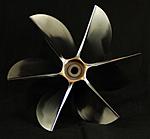
The differences are really in the perfromance changes due to the additional blade. Each time you add a blade you will experience, improved hole shot, increased acceleration & increased cruise speeds. Additionally, each time a blade is added the stern lift is increased . There are alot of variables that must be considered before you can determine the overall benefits of the different propellers, on different boats.
Julie
Julie

 10-19-2005 | 03:42 PM
#6
Registered
Joined: Mar 2002
Posts: 5,143
Likes: 1
From: Cajun Country
Re: 4 Blade or 5 Blade prop?
The additional blade(s) definitely creates a more balanced prop. With a noticeable difference between a four and five blade. There is a noticeable difference between a 5 and 6 blade as well. There is less vibration with more blades, especially at higher drive heights.
I also believe there is less stress on the drive with more blades, the vibration you feel from the prop is coming through the drive. The exception being when the boat is launched. When the boat lands a 5 or 6 blade is going to hook up harder and will load the drive up more than a 4 blade will.
I also believe there is less stress on the drive with more blades, the vibration you feel from the prop is coming through the drive. The exception being when the boat is launched. When the boat lands a 5 or 6 blade is going to hook up harder and will load the drive up more than a 4 blade will.
10-19-2005 | 05:48 PM
#7

Offshoreonly Advertiser


Joined: Jun 2003
Posts: 3,878
Likes: 47
From: Princeton, Wisconsin
 Re: 4 Blade or 5 Blade prop?
This could become a book.
We find the biggest differences from 3-4 and 4-5 blade props because of the distance between load and un load is greater than 5-6.
Planing and cruise speeds almost always improve going from 3-4 and 4-5 blades. BUT, not always. 5-6 can improve this also but not as drastic as the others.
"Certain" hulls respond better to more blades. Even the ones that don't like more blades, most likely will improve on the low end to a certain point and then can't handle the additional stern lift. (I see we now agree, more blades, more stern lift.)
More blades less vibration. More blades better hook up which means higher loads on drive components. However, with the correct hp/wt/drive combo it saves drives because of the smoothness. On the other hand, "high" hp with such hook up can be detrimental to a Bravo, Alpha or comparable drive.
One other important thought.................more metal in the water is additional drag. What does this mean?????????
What wins, less slip or more drag? Hummmmmmmm.
We find the biggest differences from 3-4 and 4-5 blade props because of the distance between load and un load is greater than 5-6.
Planing and cruise speeds almost always improve going from 3-4 and 4-5 blades. BUT, not always. 5-6 can improve this also but not as drastic as the others.
"Certain" hulls respond better to more blades. Even the ones that don't like more blades, most likely will improve on the low end to a certain point and then can't handle the additional stern lift. (I see we now agree, more blades, more stern lift.)
More blades less vibration. More blades better hook up which means higher loads on drive components. However, with the correct hp/wt/drive combo it saves drives because of the smoothness. On the other hand, "high" hp with such hook up can be detrimental to a Bravo, Alpha or comparable drive.
One other important thought.................more metal in the water is additional drag. What does this mean?????????
What wins, less slip or more drag? Hummmmmmmm.
__________________
Brett Anderson / BBLADES Professional Propellers
920-295-4435 http://www.bblades.com/
[email protected]
Brett Anderson / BBLADES Professional Propellers
920-295-4435 http://www.bblades.com/
[email protected]
10-20-2005 | 02:55 PM
#8
Registered
Joined: Oct 2005
Posts: 3
Likes: 0
Re: 4 Blade or 5 Blade prop?
The amount of blades on a prop also depands on de pitch ratio and the revs it is running at. The higher the pitch ratio the more blades you should have to prevent very high pitch ratio per blade, this improves efficiency. A slow reving prop with high speeds requires a lot of pitch and also a high amount of blades. (class 1 Cats) Fast turning props require less pitch and therefor less blades (F1 outboard motors, Hydro planes).
10-22-2005 | 07:19 AM
#9
Registered
Joined: Mar 2002
Posts: 5,143
Likes: 1
From: Cajun Country
Re: 4 Blade or 5 Blade prop?
The saying that more blades are slower does not necessarily apply to todays high performance boats.
What is commonly misunderstood is that more blades does not necessarily mean there is more prop, or metal, in the water. With some of the new hull designs we are able to raise the drive higher than with older hull designs. By raising the drive there is less drag from the lower unit, but it usually requires more blades to make up for the loss of metal in the water caused by the higher drive height. So in the end there is the same amount of blade area in the water as there was before with a deeper drive with fewer blades.
This can only be done with hulls that will naturally carry the bow without the propeller or drive pushing the bow up. That is another reason why you will find most of the high performance boats with props that have a lower rake angle than in the past. These hulls do not need the bow to be carried by the props.
All of this dial in is done on a case by case basis. The down side is when you have a high performance boat that is dialed in just right it will also be very sensitive to weight and set up changes. in short a boat that is very dialed in with a high drive height, 6 blade props, cg just right, etc may not be the best set up for your needs.
Matt
What is commonly misunderstood is that more blades does not necessarily mean there is more prop, or metal, in the water. With some of the new hull designs we are able to raise the drive higher than with older hull designs. By raising the drive there is less drag from the lower unit, but it usually requires more blades to make up for the loss of metal in the water caused by the higher drive height. So in the end there is the same amount of blade area in the water as there was before with a deeper drive with fewer blades.
This can only be done with hulls that will naturally carry the bow without the propeller or drive pushing the bow up. That is another reason why you will find most of the high performance boats with props that have a lower rake angle than in the past. These hulls do not need the bow to be carried by the props.
All of this dial in is done on a case by case basis. The down side is when you have a high performance boat that is dialed in just right it will also be very sensitive to weight and set up changes. in short a boat that is very dialed in with a high drive height, 6 blade props, cg just right, etc may not be the best set up for your needs.
Matt


