


Outdrives parallel and chine walk
 04-21-2023 | 08:13 AM
#1
Thread Starter
Registered
Joined: Jan 2022
Posts: 710
Likes: 209
From: West Michigan
 Outdrives parallel and chine walk
I had my outdrives as parallel to each other as I could because it seems to me to be the most efficient path through the water is slicing not wedging. Also less of a side force on the outdrives. I am just getting my drives reinstalled and thought I would float the question to see if there is a "possible" link between chine walk and drive alignment. I'm sure there are other reasons for toe in or out but I am only interested if there is more overall stability in toe in or out and would that help reduce the tendency to chine walk? Any thoughts on this? Thanks for your help.
 04-21-2023 | 08:44 AM
#2
Registered

Joined: Oct 2005
Posts: 6,213
Likes: 376
From: Plainville/Old Lyme, CT Boca Raton, FL
If you’re spinning in which pushes the props together, you want the propshafts about 1/4” wider than parallel. If you’re spinning out, which pulls them apart, you want the propshafts 1/4” closer than parallel.
 04-21-2023 | 08:57 AM
#4
Were doomed!


Joined: Oct 2000
Posts: 7,096
Likes: 1,393
From: Chicago, IL
There could be....keep in mind the reason for having the drives "toe'd in/out" is due to the drives "Flexing" when under load....so depending on how your props are turning the drives will want to go inwards or outwards. Ive always gone by this:
Props spinning inwards then you want 1/16-1/8 Toe-out (the nose or bullet of drive apart from each other)
Props spinning outwards then you want 1/16-1/8" Toe-in
Also make sure everything back there is tight.....no slop in the hinge pins, or tie bar etc....if you have hyd steering make sure no air in the system.....no hyd steering make sure the cable is not stretched. You also need to play with drive height as you are running...sometime it just takes a little more trim to get it to settle down....each boat is different. Some boats just have a hull that doesnt like speed and you just have to deal with it or get the bottom blueprinted and straight.....lots of variables.
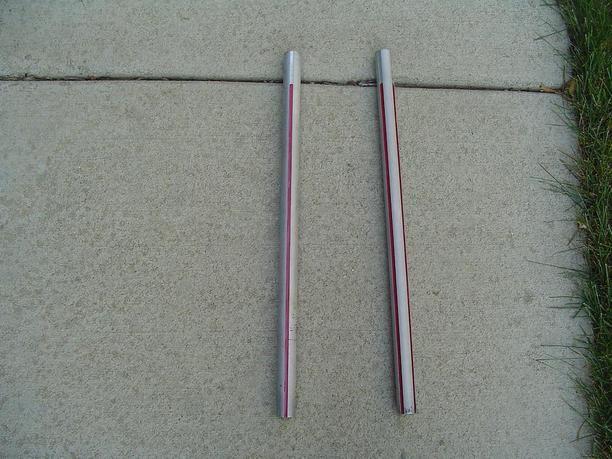
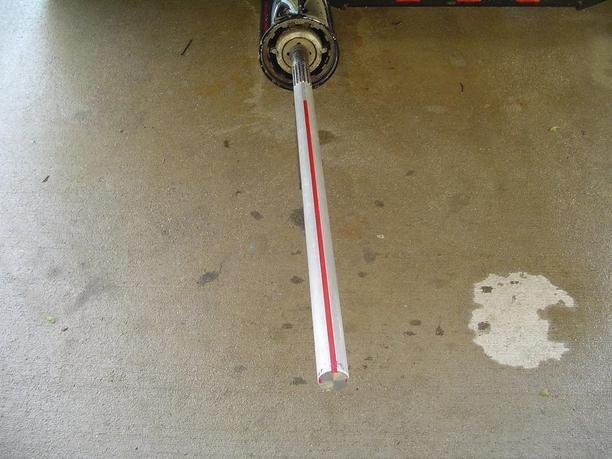
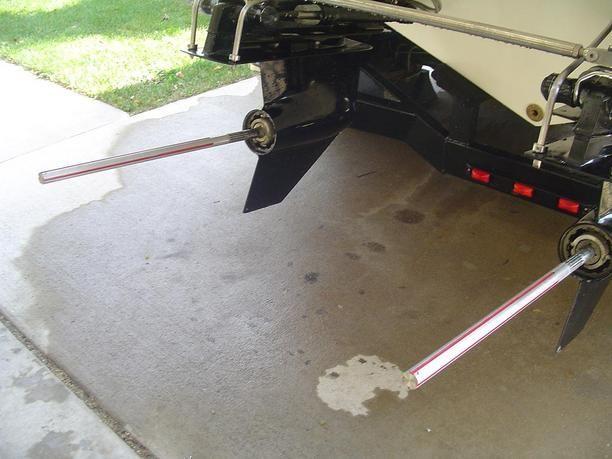
A number of years back i made myself these alignment bars. You thread them on the prop shafts and just measure from front to back. Then you know they are dead parallel and can measure the nose cones and adjust +/- easily
Props spinning inwards then you want 1/16-1/8 Toe-out (the nose or bullet of drive apart from each other)
Props spinning outwards then you want 1/16-1/8" Toe-in
Also make sure everything back there is tight.....no slop in the hinge pins, or tie bar etc....if you have hyd steering make sure no air in the system.....no hyd steering make sure the cable is not stretched. You also need to play with drive height as you are running...sometime it just takes a little more trim to get it to settle down....each boat is different. Some boats just have a hull that doesnt like speed and you just have to deal with it or get the bottom blueprinted and straight.....lots of variables.
A number of years back i made myself these alignment bars. You thread them on the prop shafts and just measure from front to back. Then you know they are dead parallel and can measure the nose cones and adjust +/- easily
__________________
-Wally
Money can't buy happiness, but it can buy horsepower. And I've never seen a sad person hauling a$$!
-Wally
Money can't buy happiness, but it can buy horsepower. And I've never seen a sad person hauling a$$!
04-21-2023 | 11:23 AM
#5
Thread Starter
Registered
Joined: Jan 2022
Posts: 710
Likes: 209
From: West Michigan
There could be....keep in mind the reason for having the drives "toe'd in/out" is due to the drives "Flexing" when under load....so depending on how your props are turning the drives will want to go inwards or outwards. Ive always gone by this:
Props spinning inwards then you want 1/16-1/8 Toe-out (the nose or bullet of drive apart from each other)
Props spinning outwards then you want 1/16-1/8" Toe-in
Also make sure everything back there is tight.....no slop in the hinge pins, or tie bar etc....if you have hyd steering make sure no air in the system.....no hyd steering make sure the cable is not stretched. You also need to play with drive height as you are running...sometime it just takes a little more trim to get it to settle down....each boat is different. Some boats just have a hull that doesnt like speed and you just have to deal with it or get the bottom blueprinted and straight.....lots of variables.
A number of years back i made myself these alignment bars. You thread them on the prop shafts and just measure from front to back. Then you know they are dead parallel and can measure the nose cones and adjust +/- easily
Props spinning inwards then you want 1/16-1/8 Toe-out (the nose or bullet of drive apart from each other)
Props spinning outwards then you want 1/16-1/8" Toe-in
Also make sure everything back there is tight.....no slop in the hinge pins, or tie bar etc....if you have hyd steering make sure no air in the system.....no hyd steering make sure the cable is not stretched. You also need to play with drive height as you are running...sometime it just takes a little more trim to get it to settle down....each boat is different. Some boats just have a hull that doesnt like speed and you just have to deal with it or get the bottom blueprinted and straight.....lots of variables.
A number of years back i made myself these alignment bars. You thread them on the prop shafts and just measure from front to back. Then you know they are dead parallel and can measure the nose cones and adjust +/- easily
FYI, everything is tight. I do have full hydraulic steering and all of the misc. pins etc. are in great shape. There is no movement in the drives once it's all set. For those who don't have full hydraulic steering, I highly recommend it.
04-21-2023 | 02:13 PM
#6
Were doomed!
Joined: Oct 2000
Posts: 7,096
Likes: 1,393
From: Chicago, IL
Yes we are....maybe explained differently but same....just try small adjustments and see how the boat reacts.........set them dead parallel and run the boat...then go toe-in by 1/8" and see how it runs....if better then give it another 1/8 and see if thats better. If worse or no change then go opposite way.
I have been told by some old timers you want to dial in the wake behind the boat to converge together some 35-50' behind the boat when running. A buddy of mine actually adjusted his outboards by taking off the tie-bar and letting the motors find their own centerline while in drive at idle ...I guess the premise of it is the laminar flow of the water below the boat will "guide" the bullet of the lower into its ideal position. He's done a handful more boats for friends like this with outboards and they all love the way the boats run. Some have actually gained up to 2mph on top end doing this. Obviously its next to impossible to do this on an I/O
I have been told by some old timers you want to dial in the wake behind the boat to converge together some 35-50' behind the boat when running. A buddy of mine actually adjusted his outboards by taking off the tie-bar and letting the motors find their own centerline while in drive at idle ...I guess the premise of it is the laminar flow of the water below the boat will "guide" the bullet of the lower into its ideal position. He's done a handful more boats for friends like this with outboards and they all love the way the boats run. Some have actually gained up to 2mph on top end doing this. Obviously its next to impossible to do this on an I/O
__________________
-Wally
Money can't buy happiness, but it can buy horsepower. And I've never seen a sad person hauling a$$!
-Wally
Money can't buy happiness, but it can buy horsepower. And I've never seen a sad person hauling a$$!
04-21-2023 | 02:21 PM
#7
Thread Starter
Registered
Joined: Jan 2022
Posts: 710
Likes: 209
From: West Michigan
Yes we are....maybe explained differently but same....just try small adjustments and see how the boat reacts.........set them dead parallel and run the boat...then go toe-in by 1/8" and see how it runs....if better then give it another 1/8 and see if thats better. If worse or no change then go opposite way.
I have been told by some old timers you want to dial in the wake behind the boat to converge together some 35-50' behind the boat when running. A buddy of mine actually adjusted his outboards by taking off the tie-bar and letting the motors find their own centerline while in drive at idle ...I guess the premise of it is the laminar flow of the water below the boat will "guide" the bullet of the lower into its ideal position. He's done a handful more boats for friends like this with outboards and they all love the way the boats run. Some have actually gained up to 2mph on top end doing this. Obviously its next to impossible to do this on an I/O
I have been told by some old timers you want to dial in the wake behind the boat to converge together some 35-50' behind the boat when running. A buddy of mine actually adjusted his outboards by taking off the tie-bar and letting the motors find their own centerline while in drive at idle ...I guess the premise of it is the laminar flow of the water below the boat will "guide" the bullet of the lower into its ideal position. He's done a handful more boats for friends like this with outboards and they all love the way the boats run. Some have actually gained up to 2mph on top end doing this. Obviously its next to impossible to do this on an I/O
04-21-2023 | 02:56 PM
#8
Were doomed!
Joined: Oct 2000
Posts: 7,096
Likes: 1,393
From: Chicago, IL
If you are running the props out....the starboard (right) turns to the right and the port (left) turns to the left then you would want some toe-in on the nose cones...that would translate to the prop shafts being further apart from each other if you are measuring at the prop shafts
Stand behind your boat and imagine your feet as the drives. the props are mounted on your heels.....for toe-in the tips of your toes would be closer together then your heels.....for toe-out they are farther apart then your heels.....
Also keep in mind that the vertical centerline of the outdrive is not dead center of the drive......the prop shafts at the tips are farther away from the centerline of the drive then the nose cones are...so adjusting the prop shaft spacing "X" amount may be WAY more then what the nose cones are actually moving and you may or may not get the results you are after. Always measure at the nose cones......dead parallel should be the same measurement on the prop shaft center as the nose cone....
Stand behind your boat and imagine your feet as the drives. the props are mounted on your heels.....for toe-in the tips of your toes would be closer together then your heels.....for toe-out they are farther apart then your heels.....
Also keep in mind that the vertical centerline of the outdrive is not dead center of the drive......the prop shafts at the tips are farther away from the centerline of the drive then the nose cones are...so adjusting the prop shaft spacing "X" amount may be WAY more then what the nose cones are actually moving and you may or may not get the results you are after. Always measure at the nose cones......dead parallel should be the same measurement on the prop shaft center as the nose cone....
__________________
-Wally
Money can't buy happiness, but it can buy horsepower. And I've never seen a sad person hauling a$$!
-Wally
Money can't buy happiness, but it can buy horsepower. And I've never seen a sad person hauling a$$!
04-21-2023 | 10:47 PM
#9
Registered

Joined: Aug 2010
Posts: 1,384
Likes: 565
The problem and thing that makes it confusing with stern drives is they pivot about the swivel pins in front of or nearly even with the bullet.
Depending on where they are trimmed.
The bullet point may be ahead of the pivot slightly depending on what drives or lowers.
Regular Bravos the bullet point appears even or behind slightly even trimmed all the way in.
I'll have to lay under my boat next time I'm near it.
Everyone thinks of toe on a car where the wheels pivot nearly about the center of them. So toe out, at the front of the wheel you increase A, B decreases the same amount at the back of the wheel.
Which won't be the case in the boat drive situation.
If the point of the bullet is even or behind the pivot (gimbal ring swivel pins), then increasing the bullet to bullet dimension will also increase the prop shaft to prop shaft dimension but a greater amount.
Actually if even, the bullet to bullet dimension should vary a minutia amount no matter how far the drives are skewed away from each other.
Notwithstanding irregularities in the castings if any.
If the point of the bullet is actually ahead of the pivot (gimbal ring swivel pins), then the bullet to bullet will decrease if the drives are skewed away from each other and the prop shaft to prop shaft will increase, but not equal amounts.
04-22-2023 | 08:45 AM
#10
Registered

Joined: Oct 2000
Posts: 1,507
Likes: 589
From: Lake Ozark, MO USA
Can you sketch that out on paper and take a photo? I follow and understand what you are trying to say, but where exactly on the front of the drives do you measure to compare to the prop shafts?

