


Bravo 3 High Bump Gear Set with Low Bump Shifter Arm
 07-06-2023 | 12:20 PM
#1
Thread Starter
Registered

Joined: Sep 2014
Posts: 14
Likes: 1
 Bravo 3 High Bump Gear Set with Low Bump Shifter Arm
Hello. I have a Bravo 3 that broke off the entire upper shift cam ramp and sent it through the drive. I ordered a gear set based on the part number laser etched on the gears. That corresponded to a high bump gear set. Now that I'm looking at the service manual it says that a high bump gear set has an "H" printed on it. My old gear set does not have an "H". Also, the shift lever looks like like a low bump unit according to the service manual. I cannot return the gear set now. What will happen if I use the low bump shifter arm with the high bump gear set? What does the difference in bump really do? Thank for any help here.
 07-09-2023 | 11:23 PM
#3

Charter Member # 55


Joined: Oct 2000
Posts: 20,285
Likes: 2,526
From: Omaha/LOTO
A standard Bravo 3 Upper is the same as Bravo 1 upper. Never heard of "high bump" or "low bump" gear sets until now
Do the old an new gear sets look the same???
Here is an old thread I found The difference between low bump high bump gear
Do the old an new gear sets look the same???
Here is an old thread I found The difference between low bump high bump gear
07-10-2023 | 07:30 AM
#4
Registered

Joined: Nov 2000
Posts: 1,418
Likes: 20
From: Westport, Kentucky
I wonder what/where the physical differance in the gear is. My mechanic said something about very early B3 drives haveing something different about the "ramps" to aid the B3 in coming out of gear. He also mentioned that early B3 dries tend to "rattle" as the shift fork bangs or jiggles around. Would this have something to do with the high bump gear or differences in forks? Just wondering.....
07-10-2023 | 08:54 AM
#5
Thread Starter
Registered
Joined: Sep 2014
Posts: 14
Likes: 1
The bump relates to the brass ring around the gears. Its not perfectly flat. There is a ramp to it so there is a higher and lower end. Thats what the plus and minus means when aligning the gears requiring you to align the plus and minus. High bump means the eccentrics are taller and forces the clutch in and out with greater force I guess. What I wanted to know is what will be the result if I have one drive low bump and one drive high bump? Is there anything besides the shift lever here that will make a difference Will it be noticeable?
07-10-2023 | 01:57 PM
#7
Registered

Joined: Aug 2010
Posts: 1,386
Likes: 565
You've piqued my curiosity.
What number service manual you looking at?
What's your drives serial number?
What's the gear set part number?
I've got manual 28.
I may have overlooked, but I don't see any mention of high bump in it.
Looked up one of my drives serial number at the trusty Bam site and the gear sets listed don't have an option.
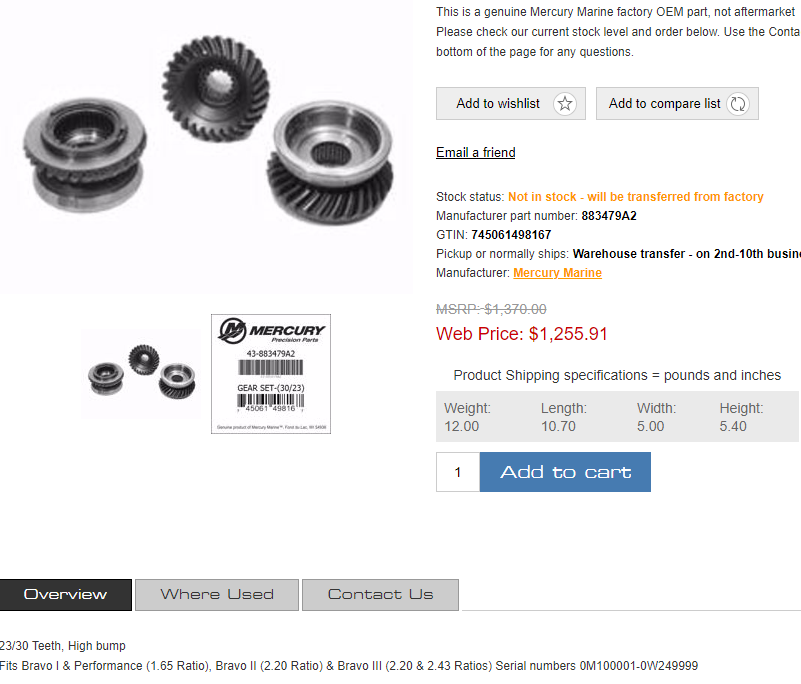
Just when clicked on they do mention high bump in the Overview tab like such in the snip.
Looks like after a certain year and serial number (I'd guess up to current) they differentiate between high bump and low bump gears and corresponding shift linkage.
What number service manual you looking at?
What's your drives serial number?
What's the gear set part number?
I've got manual 28.
I may have overlooked, but I don't see any mention of high bump in it.
Looked up one of my drives serial number at the trusty Bam site and the gear sets listed don't have an option.
Just when clicked on they do mention high bump in the Overview tab like such in the snip.
Looks like after a certain year and serial number (I'd guess up to current) they differentiate between high bump and low bump gears and corresponding shift linkage.
07-10-2023 | 03:32 PM
#8
Thread Starter
Registered
Joined: Sep 2014
Posts: 14
Likes: 1
Im using manual 90-8M0185811 (January 2022). Gear sets with the "H" stamp near the plus indicator are high bump. The drive is a 2A serial number and was a brand new replacement from Mercury in 2020. I ordered the gear set based on what was etched on the gear set. I made the assumption that it would get me the correct part. The number on the gear set is 883479 which is a 30/23.
07-10-2023 | 07:34 PM
#9
VIP Member
Joined: Nov 2002
Posts: 4,181
Likes: 334
From: ankeny,ia.
On a b3 they list using the high bump on the 1.35 and 1.5 gearing, everything above uses the low bump shift lever.
My guess is that when you shift those into gear, the clutch is driven in harder
than it is on the slower turning higher numerical geared units, you need a heavier duty piece that will take the beating, that’s the high bump
lever
My guess is that when you shift those into gear, the clutch is driven in harder
than it is on the slower turning higher numerical geared units, you need a heavier duty piece that will take the beating, that’s the high bump
lever

