


Volvo Penta 8.1 375 HP Reversion
 03-23-2024 | 08:22 PM
#1
Thread Starter
Registered
Joined: Mar 2021
Posts: 76
Likes: 15
 Volvo Penta 8.1 375 HP Reversion
Looking for advise and or suggestions. What do you think of the cylinders and the 2 wet valves? I haven't had heads done in awhile, whats a refresh cost these days? Worth it to switch to rollers or any other upgrades while the heads are out?
Noticed 1/4" rusty flakes exiting the exhaust while flushing the engine after a non eventful trip. The 8.1L VP, glycol cooled block, raw water cooled manifolds, ran great as usual. Pulled the risers and noticed water pooled on the bottom of the STBD manifold.

Above are the risers after being cleaned up some. No idea their age. Ive had the boat for 1.5 years. Still looks like plenty of material for reuse. I'll be installing glycol cooled Custom Stainless marine exhaust instead.
Weather was nice, cool, and overcast this morning. Took advantage and sprayed PB Blaster on all the exhaust manifold nuts and bolts. After 15 min, I gave one a tug with the ratchet and it came off relatively easy. Continued on with the rest and I had both manifolds off within 1 hour. These manifolds seem quite new. Gaskets seemed new. May end up offering them for sale locally after the SS versions are installed. The starboard manifold had a good amount of water come out of the exhaust ports. Port side was dry dry dry. I wonder why one side is wet and the other is not. Boat sits at a very slight 5 degree or less slope down on the starboard side while on the trailer on the side of house.
Now that the manifolds are out, there is more access to the HE, oil cooler and the center of the bilge under the engine. HE and oil cooler will come out for cleaning and inspection. Elbow grease will be applied to bilge areas I can now access easier.


Above is the STBD exhaust valves. Center 2 valves are wet. Out side to were dry. This corresponds to the water that I found pooling at the bottom of the manifold, in the center right near the head manifold joint.


Above are the spark plugs that came out of the STBD head. Left to right, in order will correspond to fwd to aft. They all look the same actually to me except maybe the 3rd from left was a little darker.


Above is the Port head exhaust Valves. All look dry. No water was found in this manifold.
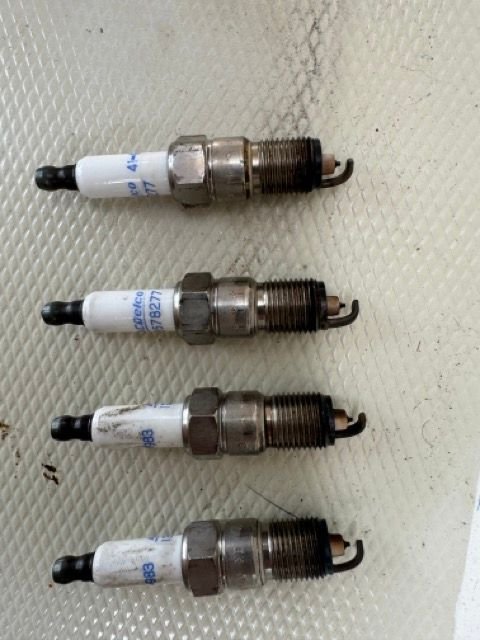

Above are the port spark plugs.


Above are the cylinders/pistons looking thru the spark plug hole with a borescope. The pictures were taken from port side first then the starboard side. Could not get a good picture with the pistons near the top so those are not shown. Both sides show brown stuff which I'm not sure if this is rust or not.
The plan is to pull the heads and have them gone thru by a machine shop. Not sure when I'll start that process yet. Need to find a reputable 8.1 machine shop near me.
For now, when I need something to do, I'll pull the HE, and oil cooler out and go thru them.
Noticed 1/4" rusty flakes exiting the exhaust while flushing the engine after a non eventful trip. The 8.1L VP, glycol cooled block, raw water cooled manifolds, ran great as usual. Pulled the risers and noticed water pooled on the bottom of the STBD manifold.
Above are the risers after being cleaned up some. No idea their age. Ive had the boat for 1.5 years. Still looks like plenty of material for reuse. I'll be installing glycol cooled Custom Stainless marine exhaust instead.
Weather was nice, cool, and overcast this morning. Took advantage and sprayed PB Blaster on all the exhaust manifold nuts and bolts. After 15 min, I gave one a tug with the ratchet and it came off relatively easy. Continued on with the rest and I had both manifolds off within 1 hour. These manifolds seem quite new. Gaskets seemed new. May end up offering them for sale locally after the SS versions are installed. The starboard manifold had a good amount of water come out of the exhaust ports. Port side was dry dry dry. I wonder why one side is wet and the other is not. Boat sits at a very slight 5 degree or less slope down on the starboard side while on the trailer on the side of house.
Now that the manifolds are out, there is more access to the HE, oil cooler and the center of the bilge under the engine. HE and oil cooler will come out for cleaning and inspection. Elbow grease will be applied to bilge areas I can now access easier.
Above is the STBD exhaust valves. Center 2 valves are wet. Out side to were dry. This corresponds to the water that I found pooling at the bottom of the manifold, in the center right near the head manifold joint.
Above are the spark plugs that came out of the STBD head. Left to right, in order will correspond to fwd to aft. They all look the same actually to me except maybe the 3rd from left was a little darker.
Above is the Port head exhaust Valves. All look dry. No water was found in this manifold.
Above are the port spark plugs.
Above are the cylinders/pistons looking thru the spark plug hole with a borescope. The pictures were taken from port side first then the starboard side. Could not get a good picture with the pistons near the top so those are not shown. Both sides show brown stuff which I'm not sure if this is rust or not.
The plan is to pull the heads and have them gone thru by a machine shop. Not sure when I'll start that process yet. Need to find a reputable 8.1 machine shop near me.
For now, when I need something to do, I'll pull the HE, and oil cooler out and go thru them.

 03-24-2024 | 07:15 AM
#3
Registered

Joined: Oct 2012
Posts: 2,240
Likes: 541
HE and oil cooler leak wouldn't put water only in 2 cylinders.
Oil pressure is higher than water pressure. When the cooler has it leak, oil will typically go out the tailpipes. That's how I found my oil cooler leak. Transome had oil residue all over everything.
Oil pressure is higher than water pressure. When the cooler has it leak, oil will typically go out the tailpipes. That's how I found my oil cooler leak. Transome had oil residue all over everything.
03-24-2024 | 08:34 AM
#4
Thread Starter
Registered
Joined: Mar 2021
Posts: 76
Likes: 15
I didn't mean the HE and oil cooler had anything to do with he water in the manifolds. I was also opening up ideas of including the oil cooler in the glycol loop when I install glycol cooled manifolds. Why isn't the oil cooler part of the closed cooling loop?
 03-24-2024 | 08:58 AM
#6
Registered

Joined: Nov 2006
Posts: 1,313
Likes: 153
From: Tygart Lake, WV
When riser gaskets fail it's the center two cylinders that usually get hammered. Thank VP for sticking with the old wet joint exhaust riser/manifold. Merc switched to a dry joint on the 496 to keep that from happening.
I'm surprised your compression numbers are still that good.
I'm surprised your compression numbers are still that good.
03-24-2024 | 09:02 AM
#7
Registered
Joined: Oct 2012
Posts: 2,240
Likes: 541
Not to mention it would put more heat into the cl system.
03-24-2024 | 09:27 AM
#8
Thread Starter
Registered
Joined: Mar 2021
Posts: 76
Likes: 15
Currently RAW water flows from sea cock --> Oil cooler --> Heat Exchanger (HE)
So the raw water is already being heated by the oil cooler before it its the HE. If the RAW water went straight to the HE, the RAW water would be cooler to start with, increasing the temperature differential. Would the differential negate the addition of the Oil cooler to the glycol loop? Don't know. If it does, then thats one less component (oil cooler) not in contact with salt. Adding the oil cooler to the glycol loop would help heat the engine and oil quicker too. This may be a secondary benefit with emissions etc... use less fuel on warm up.
Last edited by lmannyr; 03-24-2024 at 09:29 AM.
03-25-2024 | 08:49 AM
#9
Registered

Joined: Dec 2016
Posts: 593
Likes: 369
From: Portland OR
You better keep the oil cooler using seawater to cool it. It's small to begin with.
I suspect when you switch to the exh manifolds being cooled by the heat exchanger system also, you'll find the engine temps overall run too hot.
I suspect when you switch to the exh manifolds being cooled by the heat exchanger system also, you'll find the engine temps overall run too hot.


