


Bubbles in cooling?
 09-08-2024 | 02:22 PM
#1
Thread Starter
Registered
Joined: Sep 2021
Posts: 83
Likes: 6
From: Estonia
 Bubbles in cooling?
Hi,
I have a situation where I have bubbles in two raw water cooled 1987 merc 260 engines between thermostat and manifold. The water coming in is clear (bigger hose on video).
At idle water is clear, bubbles appear at about 2000RPM
Both engines are recently rebuilt, with heads done, new head gaskets, new piston rings etc. Engines have also new thermostats, one has new circulating pump. There are no visible leaks anywhere. The oil is not emulsified and clear. There was an issue with one engine not exactly overheating, but heating up faster than the other. That made me investigate, and I found the bubbles. Then I checked the other one, and bubbles too.
Merc repair manual states that bubbles at higher RPM indicate a blown head gasket. I presume can also a head crack. But, since everything is new - can it be something else? An assembly issue?
Here is the video, both engines are approximately the same.
https://www.dropbox.com/scl/fi/i6kx7...=8zj09g0x&dl=0
Thanks,
Ville
I have a situation where I have bubbles in two raw water cooled 1987 merc 260 engines between thermostat and manifold. The water coming in is clear (bigger hose on video).
At idle water is clear, bubbles appear at about 2000RPM
Both engines are recently rebuilt, with heads done, new head gaskets, new piston rings etc. Engines have also new thermostats, one has new circulating pump. There are no visible leaks anywhere. The oil is not emulsified and clear. There was an issue with one engine not exactly overheating, but heating up faster than the other. That made me investigate, and I found the bubbles. Then I checked the other one, and bubbles too.
Merc repair manual states that bubbles at higher RPM indicate a blown head gasket. I presume can also a head crack. But, since everything is new - can it be something else? An assembly issue?
Here is the video, both engines are approximately the same.
https://www.dropbox.com/scl/fi/i6kx7...=8zj09g0x&dl=0
Thanks,
Ville
Last edited by Ville123; 09-08-2024 at 02:24 PM.
 09-09-2024 | 07:37 AM
#2
Thread Starter
Registered
Joined: Sep 2021
Posts: 83
Likes: 6
From: Estonia
I tried to do an automotive CO2 test, where gasses from exhaust go through a dyed liquid that changes color, no result.
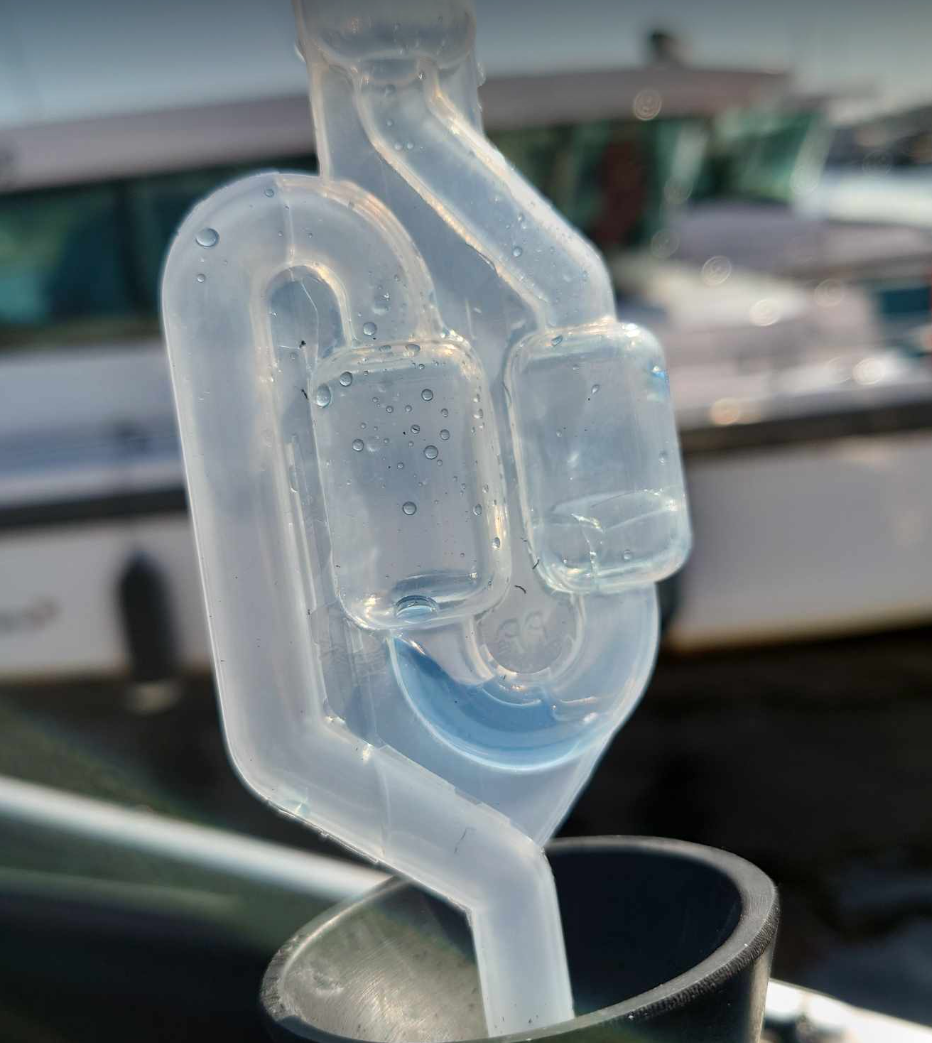
Since raw water cooling does not have an expansion tank, so I could not accumulate the gasses - so I tried just by making a tee between thermostat housing and manifold with a hose high enough so that water would not arise to the top and put the tester on top of it. Air bubbled through the test kit, but it did not change color.
I am not entirely sure if an automotive test could be applied to this situation. Does anyone have any idea or experience?
Since raw water cooling does not have an expansion tank, so I could not accumulate the gasses - so I tried just by making a tee between thermostat housing and manifold with a hose high enough so that water would not arise to the top and put the tester on top of it. Air bubbled through the test kit, but it did not change color.
I am not entirely sure if an automotive test could be applied to this situation. Does anyone have any idea or experience?

 09-10-2024 | 07:33 AM
#4
Thread Starter
Registered
Joined: Sep 2021
Posts: 83
Likes: 6
From: Estonia
Hi, yeah I had that. But as I said the heads are rebuilt, the one with rust is new. So this is not the problem.
My main question is - can these bubbles be something else than exhaust in cooling. If there is anything to rule out before pulling the heads, I would do that.
Thanks,
Ville
My main question is - can these bubbles be something else than exhaust in cooling. If there is anything to rule out before pulling the heads, I would do that.
Thanks,
Ville
09-11-2024 | 08:54 AM
#7
Registered

Joined: Oct 2005
Posts: 1,074
Likes: 251
From: Waldorf, Md
09-11-2024 | 09:50 AM
#8
Registered


Joined: Aug 2019
Posts: 1,225
Likes: 415
From: BC
Typically when speaking to bubbles in the coolant...it mean percolating in a closed cooling system at the coolant inlet/catch can.
Water agitation can create some bubbles. Just look at what the prop does to the water. Well after contact.
+1 ensure you're not chasing an issue that is not an issue.
Water agitation can create some bubbles. Just look at what the prop does to the water. Well after contact.
+1 ensure you're not chasing an issue that is not an issue.
09-11-2024 | 12:58 PM
#9
Thread Starter
Registered
Joined: Sep 2021
Posts: 83
Likes: 6
From: Estonia
Hi, thanks guys for thinking along. Actually to make sure that I am not chasing a non-issue, I actually wrote here.
Originally I started chasing the issue because it seemed like one engine was overheating, later I found out that it was a faulty sensor.
But, where I got the theory:
I found a thread https://formulaboatsforum.com/VBFORU...manifold.9835/
Where there are two videos - a problematic one with blown head gasket:
And a good one:
Also mercruiser manual states:

So all this led me to think that I have a problem. But since no other symptoms are there... i was not sure, thereby wrote here
Thanks,
Ville
Originally I started chasing the issue because it seemed like one engine was overheating, later I found out that it was a faulty sensor.
But, where I got the theory:
I found a thread https://formulaboatsforum.com/VBFORU...manifold.9835/
Where there are two videos - a problematic one with blown head gasket:
So all this led me to think that I have a problem. But since no other symptoms are there... i was not sure, thereby wrote here
Thanks,
Ville
09-11-2024 | 01:33 PM
#10

Platinum Member


Joined: Feb 2001
Posts: 4,295
Likes: 1,457
From: Virginia Beach
Is it overheating? Any signs of water in the oil?
The example you gave shows pulsing that I would guess is more indicative of a failed head gasket (or other leak). With yours being steady and fine, it could be as simple as the turbulence caused by the water pump or something to do with the thermostat itself (aeration).
I have seen the identical temp senders give different results. Have you checked temperature with an infrared thermometer? A compression test could be useful, too.
The example you gave shows pulsing that I would guess is more indicative of a failed head gasket (or other leak). With yours being steady and fine, it could be as simple as the turbulence caused by the water pump or something to do with the thermostat itself (aeration).
I have seen the identical temp senders give different results. Have you checked temperature with an infrared thermometer? A compression test could be useful, too.

