



Water psi???
 05-26-2026 | 09:00 AM
#1
Thread Starter
Registered
Joined: Jun 2025
Posts: 67
Likes: 7
 Water psi???
Got new autometer gauges in and am wondering about the water psi gauge. I have it screwed into the SB side intake plug right next to tstat in my hp500. Is this a ideal spot because Im only getting about 5psi reading off gauge at speed but engine temps stay steady 150*. Had it out all day yesterday and no issues. Brand new impeller last week and all debris that could be found was removed in housing and oil cooler. Even took output hose off sea pump to check flow and seems good. Have a video if interested. What should "normal" reading be?
 05-26-2026 | 09:26 AM
#2
Registered

Joined: Dec 2016
Posts: 592
Likes: 368
From: Portland OR
I also have an autometer water pressure gauge. I have the gauge tube T'd in just past the seawater pump, prior to my first cooler. I see just a few lbs at idle, and have seen as high as 30psi at 85mph. Generally cruising it's around 15-20psi. Hope that helps.
05-26-2026 | 11:19 AM
#3
Thread Starter
Registered
Joined: Jun 2025
Posts: 67
Likes: 7
Also whats ur oil temp at 3/4 to full throttle? Mine climbs to 140* and stays there till I bring it back down.
05-26-2026 | 12:10 PM
#4
Registered

Joined: Mar 2003
Posts: 3,080
Likes: 81
From: Fort Worth, TX
I have always seen water pressure taken from the side of the block. Closed cooling will see higher water pressure. If you are actually putting the pressure in the engine and not a heat exchanger, I don't like to put more than 20psi on intake gaskets.
With IMCO lower I have had to put relief valves in. I have seen exhaust alone make the biggest change in pressure depending on how high of flow the dump is.
With IMCO lower I have had to put relief valves in. I have seen exhaust alone make the biggest change in pressure depending on how high of flow the dump is.
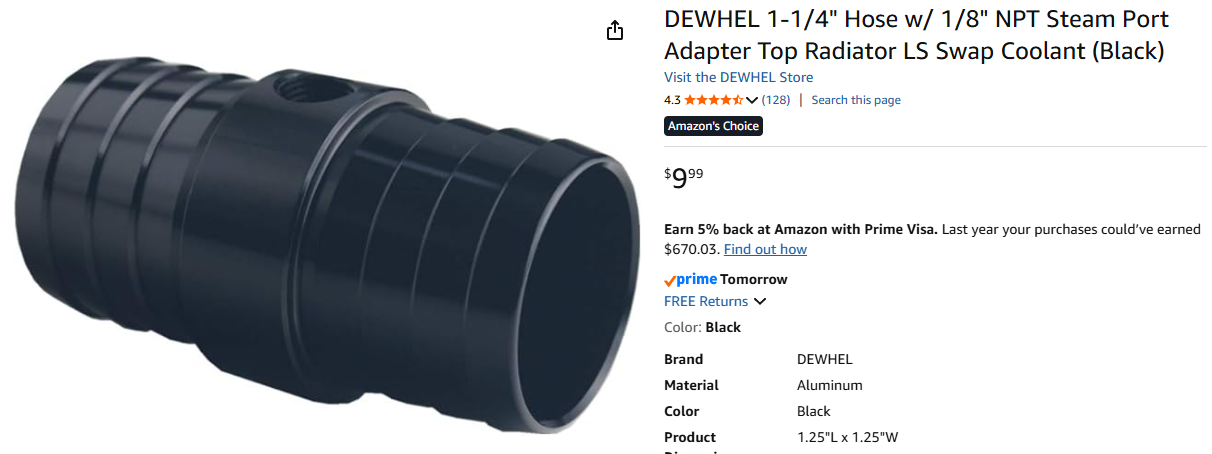 05-27-2026 | 02:04 PM
#7
Registered

Joined: Apr 2014
Posts: 2,353
Likes: 192
I don't like plastic threads! For $15 this is aluminum. If you run salt water you may want to put it on the maintenance replace schedule.
 05-27-2026 | 11:12 PM
#8
Thread Starter
Registered
Joined: Jun 2025
Posts: 67
Likes: 7
Just ordered one. Thx!
So when would anyone worry about oil temps? I put my sensor in bottom of pan by sump. I see 240* wot and wont climb. Ive never had an oil temp gauge in anything so need to judge wheres safe and wheres not.
So when would anyone worry about oil temps? I put my sensor in bottom of pan by sump. I see 240* wot and wont climb. Ive never had an oil temp gauge in anything so need to judge wheres safe and wheres not.
05-28-2026 | 11:01 AM
#9
Registered
Joined: Dec 2016
Posts: 592
Likes: 368
From: Portland OR
That T fitting I showed before is anodized aluminum and has been holding up well for the past couple years for me, but I don't see salt water.
For oil temps typically you will often hear people say you don't want to run more than the 230-240 degree range. There's much debate on this topic however. Conventional engine oils start to oxidize in the 240-250 range.
For oil temps typically you will often hear people say you don't want to run more than the 230-240 degree range. There's much debate on this topic however. Conventional engine oils start to oxidize in the 240-250 range.
05-28-2026 | 11:49 AM
#10
Registered
Joined: Nov 2004
Posts: 14,171
Likes: 3,729
From: On A Dirt Floor
Did yours in fact have 1/8” npt ?

