



Avanti 22 speed vs.hp

 07-15-2014 | 09:06 PM
#12
Registered

Joined: Feb 2005
Posts: 4,400
Likes: 25
From: Michigan

You need to find the efficiency of your hull and then do the math. If your boat weighs 4500 lbs your efficiency would be 203. So adding 100hp would give you about 8 mph. Adding 200 would give you about 14 mph.
That being said, 55 mph with 330 hp seems a little low. But, I don't know much about your hull.
Last edited by onesickpantera; 07-15-2014 at 09:08 PM.
07-16-2014 | 03:44 PM
#13
Registered
Joined: Oct 2013
Posts: 181
Likes: 0
From: N37 27 29.64 / W117 41 38.88
Not always true, as stated it isn't linear. Going from 50 to 60 mph takes a lot less hp than going from 70 to 80 mph.
You need to find the efficiency of your hull and then do the math. If your boat weighs 4500 lbs your efficiency would be 203. So adding 100hp would give you about 8 mph. Adding 200 would give you about 14 mph.
That being said, 55 mph with 330 hp seems a little low. But, I don't know much about your hull.
You need to find the efficiency of your hull and then do the math. If your boat weighs 4500 lbs your efficiency would be 203. So adding 100hp would give you about 8 mph. Adding 200 would give you about 14 mph.
That being said, 55 mph with 330 hp seems a little low. But, I don't know much about your hull.
Where p is the density of the fluid
v is the relative velocity
A is the cross-section Area
Cd is the drag coefficient
So if we put some arbitrary numbers in for effect, we will see the power differential at given speeds. So if the density of the fluid is 1, the speed is 40, the Area is 2 and the Cd is 0.5, you need 8000 units of thrust to maintain the speed. Changing only the speed, it looks like this;
40=8000
50=15625
60=27000
70=42875
80=64000
90=91125
So to double the speed from 40 to 80, you need 8 times the thrust. From 40 to 50 is almost double, requiring 7,625 over the 8000. But 50 to 60 requires 11,375 for the next 10 mph.
If you plot the points of hp required at a given set of speeds (say, every 5 mph. And the hp scale should be available for a given engine at differing rpm) then you can project APPROXIMATE speed increases up the log scale. Where planing hulls differ from cars and planes is as you accelerate, you CAN reduce the area in contact with the water (to a point).
For some reason, this discussion never impressed the girls...
 07-16-2014 | 05:14 PM
#15
Registered

Joined: Feb 2012
Posts: 4,031
Likes: 10
From: westville, NJ
yes the area in contact with water is reduced, but the amount of boat weight is then spread over a much smaller area. so as hull climbs out of the water, the drag coefficient increases on what is left in contact with water. and you still have air resistance against the rest of the hull. also an exponential drag increase.



 ...phuck it! I'll have a beer or two or six then re-read what he posted.
 07-17-2014 | 09:08 PM
#19
Thread Starter
Registered

Joined: Apr 2006
Posts: 10,041
Likes: 712
From: Toledo Oh
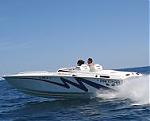
A little update.. did a little tweaking today and saw 61 and still climbing when I hit a chunk of driftwood or something. Scared the crap out of me seriously loud back and it bent the tips on 2 ears. Its got a little more in it, not much but a little.

