



Cigarette AMG Electric Drive

 03-28-2026 | 09:39 AM
#52
Thread Starter
VIP Member

Joined: Dec 2025
Posts: 26
Likes: 0
From: Germany

Hi JaayTeee, you are right side load I forgot yet.
To All:
I would like to come back to the energy discussion. Is sombody here who has a boat with eg. Mercury 500R's and knows exactly how much fuel it need in one hour with 6600 rpm WOP?
To All:
I would like to come back to the energy discussion. Is sombody here who has a boat with eg. Mercury 500R's and knows exactly how much fuel it need in one hour with 6600 rpm WOP?
03-28-2026 | 09:48 AM
#53
Registered

Joined: Apr 2016
Posts: 210
Likes: 50
My LS376-480 with just under 500 hp burn more than 130 and less than 140 l/h at full throtle.
And 430 hp: https://navaboats.com/wp-content/upl...30-DPS-EVC.pdf
p.s.
What maximum speed, what cruisse speed and what weight of fully rigged boat do you expect?
It might also be worth considering using drives from another manufacturer instead of developing your own, because there will be a lot of “burns” before they become usable.
For example, in Germany you have drives from MSA Marine Systems that allow a bit of bow trim and place the motors inside the hull.
Each year we build several dozen machines that operate outdoors in nature, each equipped with two electric motors. Temperature differences can be very unpredictable, and here you also have water involved — and heaven forbid the Adriatic.
For instance, a motor rated for 15 kW of installed power can handle 18.5 kW in our application without damage. But without a small modification, it will start smoking already at around 12 kW after roughly 500–1000 operating hours. And you will likely run into a very similar problem.
Look:
Even if the motor has 97% efficiency, you will still have to remove about 11 kW of heat from that small motor with very little cooling surface when it is loaded at 360 kW. That is more than a single-family house consumes in the coldest winter. The heat is dissipated through the housing, while the rotor runs significantly hotter...
And 430 hp: https://navaboats.com/wp-content/upl...30-DPS-EVC.pdf
p.s.
What maximum speed, what cruisse speed and what weight of fully rigged boat do you expect?
It might also be worth considering using drives from another manufacturer instead of developing your own, because there will be a lot of “burns” before they become usable.
For example, in Germany you have drives from MSA Marine Systems that allow a bit of bow trim and place the motors inside the hull.
Each year we build several dozen machines that operate outdoors in nature, each equipped with two electric motors. Temperature differences can be very unpredictable, and here you also have water involved — and heaven forbid the Adriatic.
For instance, a motor rated for 15 kW of installed power can handle 18.5 kW in our application without damage. But without a small modification, it will start smoking already at around 12 kW after roughly 500–1000 operating hours. And you will likely run into a very similar problem.
Look:
Even if the motor has 97% efficiency, you will still have to remove about 11 kW of heat from that small motor with very little cooling surface when it is loaded at 360 kW. That is more than a single-family house consumes in the coldest winter. The heat is dissipated through the housing, while the rotor runs significantly hotter...
Last edited by plavutka; 03-28-2026 at 12:10 PM.
03-28-2026 | 12:41 PM
#54
Thread Starter
VIP Member
Joined: Dec 2025
Posts: 26
Likes: 0
From: Germany
Plavutka, thanks for your Volvo data sheet. So following calculations:
430 hp/h means 130l/h
1 liter fuel contains 9.3 kWh Energy
130l x 9.3 kWh = 1209 kWh
30% efficiency of the V8, then we need 1209 kWh x 0.30 = 363 KWh to bring a boat running one hour with with 431hp.
363kWh x 1,1 = 400 kWh
So if your Volvo Penta runs one hour full throttle at 430hp it would be the same you run an electric motor using 400 kWh.
430 hp/h means 130l/h
1 liter fuel contains 9.3 kWh Energy
130l x 9.3 kWh = 1209 kWh
30% efficiency of the V8, then we need 1209 kWh x 0.30 = 363 KWh to bring a boat running one hour with with 431hp.
363kWh x 1,1 = 400 kWh
So if your Volvo Penta runs one hour full throttle at 430hp it would be the same you run an electric motor using 400 kWh.
03-28-2026 | 12:59 PM
#55
Registered
Joined: Apr 2016
Posts: 210
Likes: 50
No!
On the cranchshaft you have by VP 430 hp and this is the same like 316 KW on the el. motor shaft.
In one hour you burn 130 l/h by VP 430 at full throtle.
In one hour you burn 316 Kwh by electromotor by using 316 Kw.
Conclusion:
130 l it is equivalent to 316 Kwh + motor and regler efficiency.
In real it is 130 l gassoline equivalent to aprox. 330-360 Kwh.
By gassoline engine you do not need to calculate any efficiency, becouse you have power 430 Hp on the cranckshaft and 130 l/h. This two informations includes all losses.
By the electromotor you must add efficiency for el. motor and regler.
If you want to play with efficiency of gassoline engine and electromotor, than:
- you must calculate betwen 16 and 26% efficiency for gassoline engine. Depending of engine regime, but always lit is less than 30%. This 32, or even 30% it is just for marketing!
- by electromotor you must calculated eficiency by the electricity production. In Germany it is mostly less than 32% for gass powerplants, efficiency for batery loading, efficiency for regler and efficiency for motor. At the end you have less efficiency like by old Wartburg.
On the cranchshaft you have by VP 430 hp and this is the same like 316 KW on the el. motor shaft.
In one hour you burn 130 l/h by VP 430 at full throtle.
In one hour you burn 316 Kwh by electromotor by using 316 Kw.
Conclusion:
130 l it is equivalent to 316 Kwh + motor and regler efficiency.
In real it is 130 l gassoline equivalent to aprox. 330-360 Kwh.
By gassoline engine you do not need to calculate any efficiency, becouse you have power 430 Hp on the cranckshaft and 130 l/h. This two informations includes all losses.
By the electromotor you must add efficiency for el. motor and regler.
If you want to play with efficiency of gassoline engine and electromotor, than:
- you must calculate betwen 16 and 26% efficiency for gassoline engine. Depending of engine regime, but always lit is less than 30%. This 32, or even 30% it is just for marketing!
- by electromotor you must calculated eficiency by the electricity production. In Germany it is mostly less than 32% for gass powerplants, efficiency for batery loading, efficiency for regler and efficiency for motor. At the end you have less efficiency like by old Wartburg.
Last edited by plavutka; 03-28-2026 at 01:08 PM.
03-28-2026 | 03:23 PM
#57
Registered

Joined: Jan 2006
Posts: 3,869
Likes: 797
From: St. Pete Beach, FL
My boat burns about 50gph to make 600hp at WOT. Burns 20-22gph at 4000rpm cruise.
My boat performs the same as this.
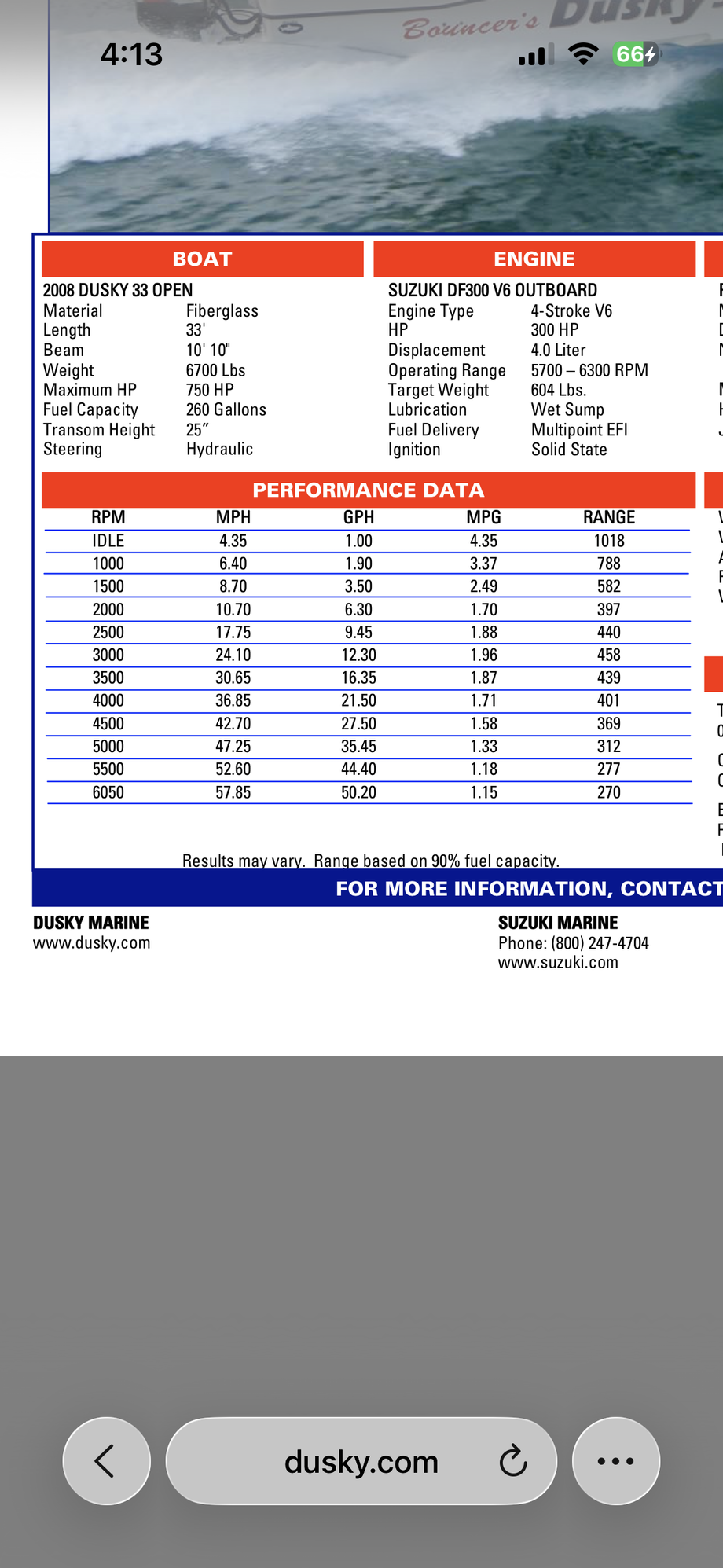
I’ll burn between 20-50 gallons on a pleasure boating day. 675kWh-1685kWh.
My boat can cruise slow, 30-40mph.
My boat holds 200+45 gallon reserve, 6740kWh-8257kWH.
Its much lighter and more efficient than your boat will be due to weight and hull design.
My boat performs the same as this.
I’ll burn between 20-50 gallons on a pleasure boating day. 675kWh-1685kWh.
My boat can cruise slow, 30-40mph.
My boat holds 200+45 gallon reserve, 6740kWh-8257kWH.
Its much lighter and more efficient than your boat will be due to weight and hull design.
Last edited by hogie roll; 03-28-2026 at 07:10 PM.
 03-29-2026 | 09:13 AM
#60
Thread Starter
VIP Member
Joined: Dec 2025
Posts: 26
Likes: 0
From: Germany
Hi Hogie_roll, I think it would be this way: Your boat go with 50 gallons fuel at 3000 rpm (50gal x 1.96 mpg) 98 mls. When you go WOT it would be (50gal x 1.15=) 57,5 mls
50 gallons fuel equal 500 kWh . Would be enough to go one end of the lake of Constance to the other and back. Actually not so bad?
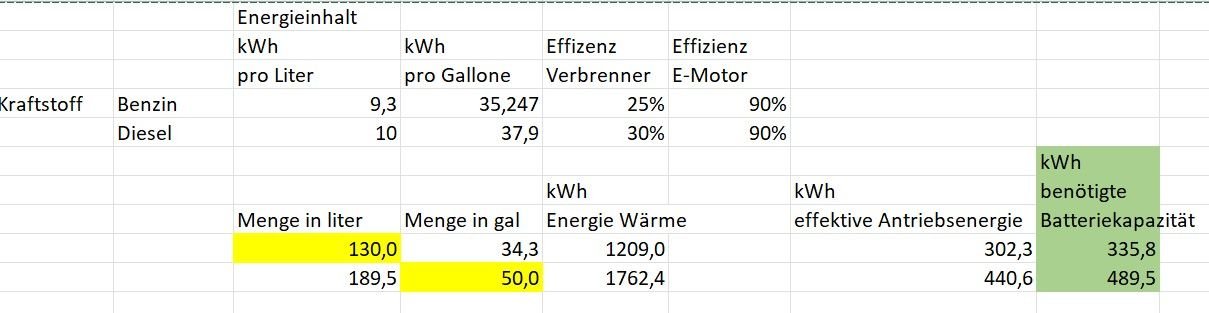
50 gallons fuel equal 500 kWh . Would be enough to go one end of the lake of Constance to the other and back. Actually not so bad?

