


Exhaust systems
 12-30-2015 | 07:34 AM
#21
Banned
Joined: Oct 2015
Posts: 277
Likes: 1

While a blower engine may not benefit from a tuned exhaust, it's processing a lot more air and fuel and still needs a good exhaust system and will benefit just like any other engine. The manifold, while not tuned, may not be as much of a restriction on the smaller engine as it would on the larger blower engine and that restriction will kill power on the blower engine.
 12-30-2015 | 07:38 AM
#22
Banned
Joined: Oct 2015
Posts: 277
Likes: 1
I had an engine masters magazine where they did a header shootout on a bbc . I think it was a 572 ci making 700 plus. I recall them trying several different headers with various ID's. I recall there being a pretty good difference from a 1 3/4 to 2 1/8. I dont recall the exact power numbers, but it was pretty significant. Ill look and see if i have it still.
 12-30-2015 | 07:44 AM
#23
Banned
Joined: Oct 2015
Posts: 277
Likes: 1
you are correct on the imco manifold not being right out of the box,i spent several hours with the die grinder to get it gasket matched.i had the imco power flo,s on my cat.they were 950 on the dyno with dyno headers so in sure their was a little power loss with the imco,s but they ran very good.the engines were 548s with dart 320s.
Last edited by horsepower1; 12-30-2015 at 07:46 AM.
12-30-2015 | 08:01 AM
#24
Thread Starter
Registered

Joined: Jul 2004
Posts: 11,332
Likes: 73
From: chicago
The IMCO's I've worked with seem to be good up to about 850-900hp. After that, they're going to start hurting power over something tubular and more tuned. I did a blown pump gas 540 that made 1020 hp with dyno headers, but when in the boat with the IMCO's the engines performed to right about 900 hp, given rpm, prop and pitch. This kind of goes to the above post where there's no way the IMCO's would kill 100hp on a NA 540 even over a set of tuned headers, but they kicked the blower motor in the nuts.
Good example is stainless marine gen 3 exhaust. Not to be confused with their standard manifold. The gen 3 is huge. Makes the imco,gil, emi stuff look tiny.. Giant elbow, 5 inch tailpipe, etc. That exhaust worked very well on big power blower engines, as thats what it was designed for, and has outperformed even some big headers on those engines. Now, i would not chooose that for a N/A exhaust .
My stellings "green" headers were designed for the merc 575. Which was a 540ci making 575hp in late 80s. 1 7/8 primary. In a recent conversation with a well versed offshore builder who is familiar with those headers, said they certainly can be hindering power a bit, even on my 800hp blower engines.
Last edited by MILD THUNDER; 12-30-2015 at 08:12 AM.
12-30-2015 | 09:29 AM
#25
Charter Member#568


Joined: Dec 2000
Posts: 2,171
Likes: 17
From: Western N.Y.
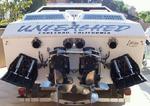
For support I have another set of trim rings on the inside of the transom with a thick non stretching rubber/ canvas type material. It is flexible to allow movement but not stretchable so it supports the pipes at the transom.
__________________
Straight bottoms and flat decks
Straight bottoms and flat decks
12-30-2015 | 09:56 AM
#26

Gold Member


Joined: Sep 2011
Posts: 2,643
Likes: 18
From: cleveland ohio
Another thing I was wondering about.....
My "dry" tails have six 3/8" water outlets right at the tip. I was considering welding those shut and welding in bungs near the ends of the tails and dumping the water that way.
Is there any advantage to either way of expelling the water? Can the water migrate back up the tailpipes even when it's introduced at the very tips of the pipes?
My "dry" tails have six 3/8" water outlets right at the tip. I was considering welding those shut and welding in bungs near the ends of the tails and dumping the water that way.
Is there any advantage to either way of expelling the water? Can the water migrate back up the tailpipes even when it's introduced at the very tips of the pipes?
12-30-2015 | 11:06 AM
#27
Registered
Joined: Nov 2004
Posts: 14,108
Likes: 3,694
From: On A Dirt Floor
Furthermore:
When exhaust hit's the atmosphere, an energy wave is sent backwards towards the exhaust valves. This is why collector length is very important, yet no one seems to give a schit about it.
When exhaust hit's the atmosphere, an energy wave is sent backwards towards the exhaust valves. This is why collector length is very important, yet no one seems to give a schit about it.
12-30-2015 | 11:26 AM
#28
Registered
Joined: Feb 2012
Posts: 643
Likes: 7
From: Chesapeake Bay
Another thing I was wondering about.....
My "dry" tails have six 3/8" water outlets right at the tip. I was considering welding those shut and welding in bungs near the ends of the tails and dumping the water that way.
Is there any advantage to either way of expelling the water? Can the water migrate back up the tailpipes even when it's introduced at the very tips of the pipes?
My "dry" tails have six 3/8" water outlets right at the tip. I was considering welding those shut and welding in bungs near the ends of the tails and dumping the water that way.
Is there any advantage to either way of expelling the water? Can the water migrate back up the tailpipes even when it's introduced at the very tips of the pipes?
And as far as your question about can your engine pull water back up from the very end of the tailpipe? Absolutely. I know of a SVL team that had issues with water reversion on their sealed 525 with 100 percent dry tailpipes. They caught on their camera systems at idle the dumps were too close to the tailpipe and water was getting sucked over and back up the dry tail at idle. Wouldn't have believed it if they didn't show me the video. They moved the water dump and the problem went away.
 and engines

