


Alternative header attachment on 525EFI's ?
 02-05-2019 | 09:30 AM
#1
Thread Starter
Registered
Joined: May 2013
Posts: 1,754
Likes: 6
From: Long Island, NY
 Alternative header attachment on 525EFI's ?
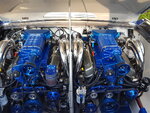
Every spring before the season, I remove and pressure test my headers (all 6 of them) for leaks and every year, I wrestle with getting the two inboard headers on the two rear engines back on. Getting those header bolts started and ensuring they don't cross thread while trying to maneuver the socket wrench and not drop the bolts into the bilge is always a challenge and due to the angle of the inboard port engine header, there are two bolts that take forever to get started and I usually end up with bloody knuckles. I use two headless bolts on the end holes to hold the header while I get one or two bolts in and that gave me the following idea.
I was thinking of screwing 3/8" stainless steel fully-threaded studs into the head, dropping the header in, and then securing with serrated flange nuts torqued to the same value as the header bolts normally are (ie: 35 ft/lbs).
Is there a reason(s) that this wouldn't work or is a bad idea?
I was thinking of screwing 3/8" stainless steel fully-threaded studs into the head, dropping the header in, and then securing with serrated flange nuts torqued to the same value as the header bolts normally are (ie: 35 ft/lbs).
Is there a reason(s) that this wouldn't work or is a bad idea?
 02-05-2019 | 09:46 AM
#2
Platinum Member


Joined: May 2012
Posts: 11,438
Likes: 3,968
From: Midwest & T-Rock
Every spring before the season, I remove and pressure test my headers (all 6 of them) for leaks and every year, I wrestle with getting the two inboard headers on the two rear engines back on. Getting those header bolts started and ensuring they don't cross thread while trying to maneuver the socket wrench and not drop the bolts into the bilge is always a challenge and due to the angle of the inboard port engine header, there are two bolts that take forever to get started and I usually end up with bloody knuckles. I use two headless bolts on the end holes to hold the header while I get one or two bolts in and that gave me the following idea.
I was thinking of screwing 3/8" stainless steel fully-threaded studs into the head, dropping the header in, and then securing with serrated flange nuts torqued to the same value as the header bolts normally are (ie: 35 ft/lbs).
Is there a reason(s) that this wouldn't work or is a bad idea?
I was thinking of screwing 3/8" stainless steel fully-threaded studs into the head, dropping the header in, and then securing with serrated flange nuts torqued to the same value as the header bolts normally are (ie: 35 ft/lbs).
Is there a reason(s) that this wouldn't work or is a bad idea?

 02-05-2019 | 10:39 AM
#4
Thread Starter
Registered
Joined: May 2013
Posts: 1,754
Likes: 6
From: Long Island, NY
02-05-2019 | 10:41 AM
#5
Thread Starter
Registered
Joined: May 2013
Posts: 1,754
Likes: 6
From: Long Island, NY
Great suggestion, although loosening bolts has never been a problem for me. I'm also trying to get away from using bolts; that's the whole point of using studs and nuts.
02-05-2019 | 10:50 AM
#7
Thread Starter
Registered
Joined: May 2013
Posts: 1,754
Likes: 6
From: Long Island, NY
OK, I should have been clearer in my initial post. What I'm proposing is using studs in ALL 8 (per side) of the holes in the head, not just the outer two.
The complications I can think of are whether there is enough clearance between the bolt holes on the header flange to accommodate the increased width of the flange nuts and is their enough room to get a 9/16" socket in there versus a 3/8" socket.
The complications I can think of are whether there is enough clearance between the bolt holes on the header flange to accommodate the increased width of the flange nuts and is their enough room to get a 9/16" socket in there versus a 3/8" socket.
Last edited by HyFive578; 02-05-2019 at 11:15 AM.
02-05-2019 | 11:14 AM
#8
Platinum Member
Joined: May 2012
Posts: 11,438
Likes: 3,968
From: Midwest & T-Rock
02-05-2019 | 12:39 PM
#10
Registered
Joined: Jun 2011
Posts: 2,169
Likes: 82
From: Henderson, KY
I see no problem with the idea. But clearance for the nut (and a wrench/socket) will generally be the problem with this idea. You may look at ARP for a solution. I think some tubes will be ok, but others are going to require a bolt with small head.

