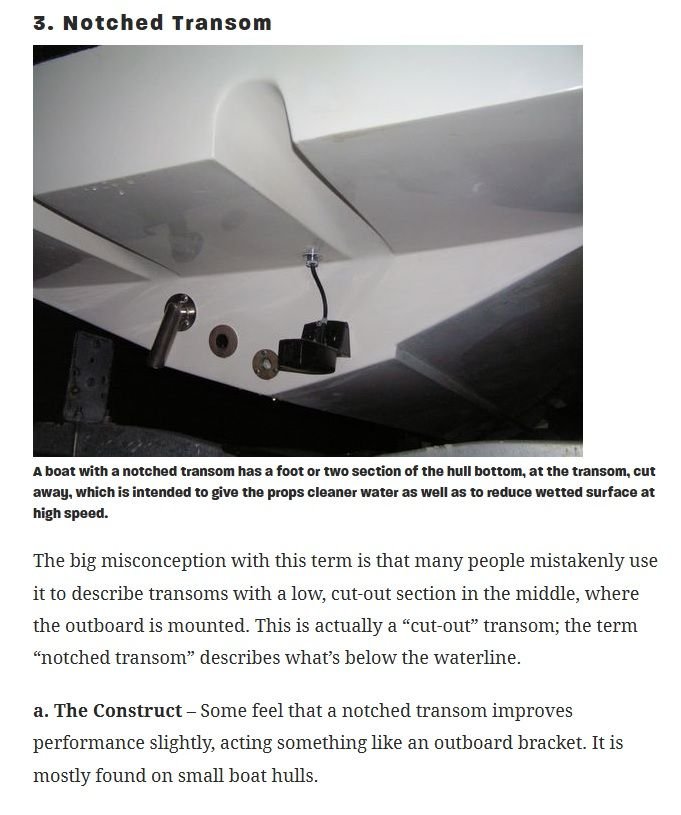
notched transom
 07-08-2025 | 03:03 AM
#11
Registered

Joined: Jan 2021
Posts: 907
Likes: 416
From: Gothenburg, Sweden
 Transom notches are not mainly about clean water
Even single engine cats where the propeller is behind the tunnel sometimes have notched transoms. It is about choosing leverage versus running surface, and the choice will differ depending on how much running surface you need and how much bow lift you need.
E.g. the nineties Norwegian Hydrolift Sportcat 22, a single engine cat based on a modified Chris Hodges (of Cougar fame) design, used a notch depending on engine choice:
1. If rigged with a JohnnyRude V8, it was built without a notch. The additional running surface was beneficial with the heavy engine.
2. If rigged with something lighter, e.g. a Mercury or Yamaha V6, it was built with a notch. The additional running surface was not beneficial with a lighter engine, and the notch gave additional leverage for bow lift.
The notch was created with a removable box in the Sportcat mold.
The notch, like an extension box, provides leverage for the propeller and the weight of the engine and/or drive behind it. This leverage is free. Using a propeller to create the same amount of lift takes energy. That energy could be used for pushing the boat forward, i.e. speed, instead.
Clean water for the propeller obviously does not matter at all in this single engine cat situation.
E.g. the nineties Norwegian Hydrolift Sportcat 22, a single engine cat based on a modified Chris Hodges (of Cougar fame) design, used a notch depending on engine choice:
1. If rigged with a JohnnyRude V8, it was built without a notch. The additional running surface was beneficial with the heavy engine.
2. If rigged with something lighter, e.g. a Mercury or Yamaha V6, it was built with a notch. The additional running surface was not beneficial with a lighter engine, and the notch gave additional leverage for bow lift.
The notch was created with a removable box in the Sportcat mold.
The notch, like an extension box, provides leverage for the propeller and the weight of the engine and/or drive behind it. This leverage is free. Using a propeller to create the same amount of lift takes energy. That energy could be used for pushing the boat forward, i.e. speed, instead.
Clean water for the propeller obviously does not matter at all in this single engine cat situation.
 07-08-2025 | 03:10 AM
#13
Thread Starter
Registered
Joined: Apr 2016
Posts: 208
Likes: 49
@Markus;
That's exactly what I'm assuming. And if create a surplus of bow lift with a notched transom, put a clever up at the back, which lifts your stern, and will fly through the air like a TUFF... almost like a catamaran. And in such case notch really help a lot.
Correct?
p.s.
Will never try to do something like this, just curiosity.
That's exactly what I'm assuming. And if create a surplus of bow lift with a notched transom, put a clever up at the back, which lifts your stern, and will fly through the air like a TUFF... almost like a catamaran. And in such case notch really help a lot.
Correct?
p.s.
Will never try to do something like this, just curiosity.
Last edited by plavutka; 07-08-2025 at 03:19 AM.
07-08-2025 | 04:39 AM
#14
Registered
Joined: Jan 2021
Posts: 907
Likes: 416
From: Gothenburg, Sweden
@Markus;
That's exactly what I'm assuming. And if create a surplus of bow lift with a notched transom, put a clever up at the back, which lifts your stern, and will fly through the air like a TUFF... almost like a catamaran. And in such case notch really help a lot.
Correct?
That's exactly what I'm assuming. And if create a surplus of bow lift with a notched transom, put a clever up at the back, which lifts your stern, and will fly through the air like a TUFF... almost like a catamaran. And in such case notch really help a lot.
Correct?
Except the "stern lifting" cleaver, as far as I understand, does not really lift the stern even if we call it "stern lifting". It is neutral.
07-09-2025 | 12:59 PM
#15

Were doomed!


Joined: Oct 2000
Posts: 7,095
Likes: 1,389
From: Chicago, IL
A notched transom can increase a boat's speed, but the effect depends on the boat's design and operating conditions. Here's a concise explanation:
- Reduced drag: A notched transom allows water to flow off the stern more cleanly, reducing turbulence and drag compared to a flat transom. This can improve hydrodynamic efficiency, especially at higher speeds.
- Lowered engine height: The notch often allows the outboard motor or lower unit to be mounted higher, reducing the wetted surface area of the gearcase in the water, which further decreases drag.
- Improved planing: By altering the flow of water at the stern, a notched transom can help the boat plane more quickly, reducing resistance and allowing higher speeds.
- It’s most effective for high-performance or lightweight boats (e.g., bass boats, racing boats) operating at high speeds.
- For heavier or displacement hulls, the notch may have minimal impact or could even disrupt stability if not designed properly.
- The benefit depends on proper setup (propeller, engine height, and weight distribution).

__________________
-Wally
Money can't buy happiness, but it can buy horsepower. And I've never seen a sad person hauling a$$!
-Wally
Money can't buy happiness, but it can buy horsepower. And I've never seen a sad person hauling a$$!
07-10-2025 | 10:23 AM
#16

Forum Regulator


Joined: May 2001
Posts: 24,204
Likes: 1,592
From: Worldwide
"Clean water" is exactly how I was informed by 3 different boat builders: Harry Schoell, Jay Ross, and Pat Haughey. At least that's the case for V-bottoms. It's a "cheap setback box" that works better in NOT smooth water. BUT in smooth water, that's when the "teeter of the totter" comes into play as I described above. Having owned a 26' Sonic, as well as being aboard several others; in which pretty much all of those hulls employ a notched transom, that's exactly the case.
THIS picture is of a NorTech hull, not a Sonic. But I think it tells another strong part of the story, as you can see via the location of the through hull pick-up; and virtually LACK of extension below the bottom of the hull. As soon as that water passes the aft section of the "wetted" hull, the water is going UP, which lends right back into the design purpose of putting the props in "cleaner" and maybe even a bit more "dense" pressured water as it's flowing upward into those drives/props as well.

THIS picture is of a NorTech hull, not a Sonic. But I think it tells another strong part of the story, as you can see via the location of the through hull pick-up; and virtually LACK of extension below the bottom of the hull. As soon as that water passes the aft section of the "wetted" hull, the water is going UP, which lends right back into the design purpose of putting the props in "cleaner" and maybe even a bit more "dense" pressured water as it's flowing upward into those drives/props as well.
07-10-2025 | 10:27 AM
#17
Forum Regulator
Joined: May 2001
Posts: 24,204
Likes: 1,592
From: Worldwide