Compression test
 11-30-2025 | 10:50 AM
#1
Thread Starter
Registered

Joined: Jun 2007
Posts: 7,331
Likes: 1,835
From: Merritt Island, FL
 Compression test
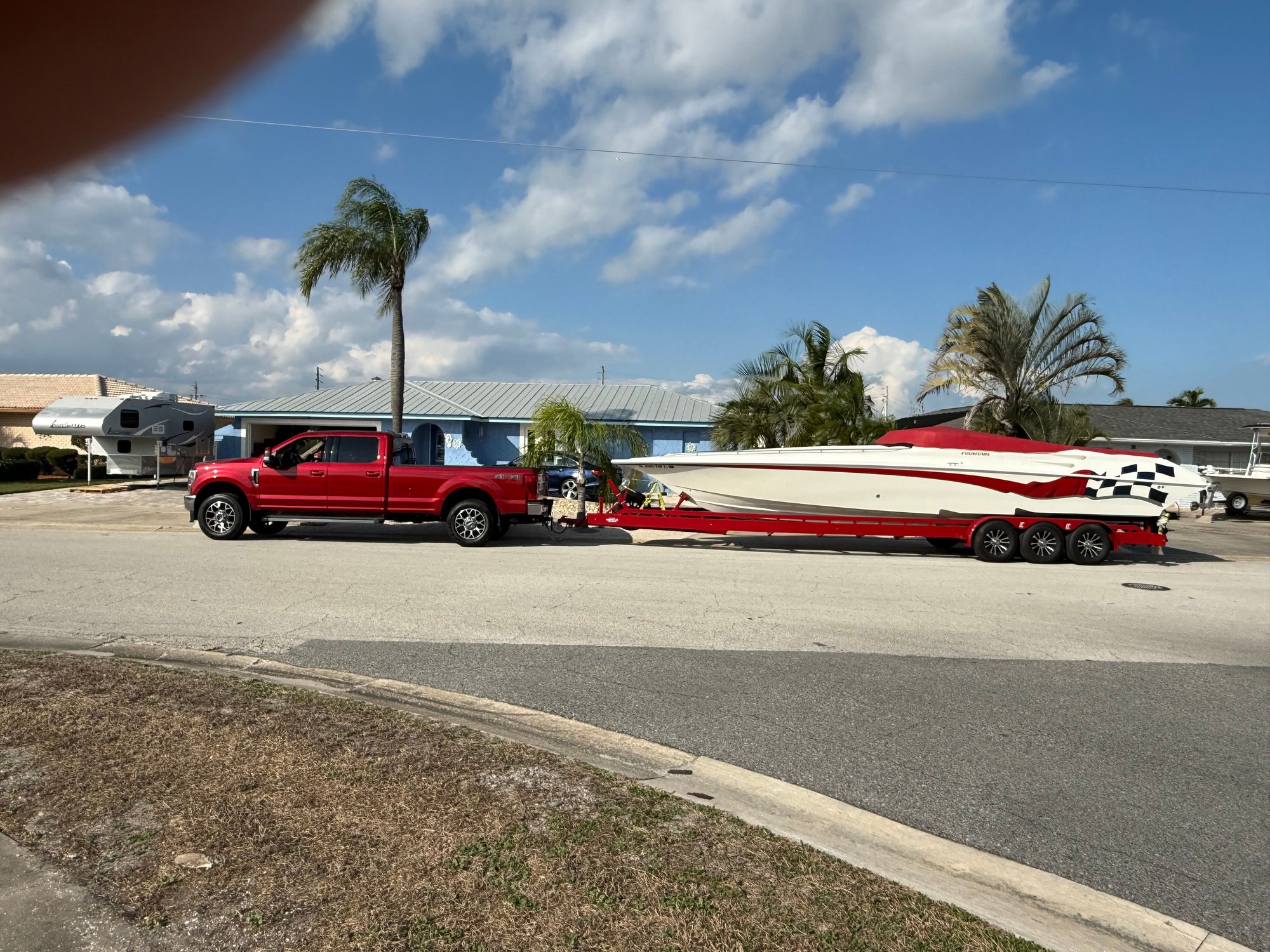
Just bought a new boat and I am wondering if there is a way to have an idea on compression test to CR.
Motors are rebuilt HP500EFI’s and all cylinders were 160 cold/ 165 warm.
That is more then my stock 500’s, granted the last time I did it was at 600ish hours.
The reason I wonder is during the sea trial I hit 5400 pretty easy and am spinning stock 34 bravo’s with 1.5 drives.
That is above the stock rpm limit and a lot more prop.
Cannot get a hold of engine builder, long story but when I had my shop check them out they said all gauges matched the computer.
Kind of rare on these things.
Motors are rebuilt HP500EFI’s and all cylinders were 160 cold/ 165 warm.
That is more then my stock 500’s, granted the last time I did it was at 600ish hours.
The reason I wonder is during the sea trial I hit 5400 pretty easy and am spinning stock 34 bravo’s with 1.5 drives.
That is above the stock rpm limit and a lot more prop.
Cannot get a hold of engine builder, long story but when I had my shop check them out they said all gauges matched the computer.
Kind of rare on these things.
Last edited by Wildman_grafix; 12-01-2025 at 07:51 AM.


 11-30-2025 | 12:17 PM
#6
Registered
Joined: Jun 2009
Posts: 9,989
Likes: 6,484
From: Chicago
Good looking boat !
This is what Grok says:
for a stock Mercury 500 EFI (502-cid / 8.2 L V-8) there are published “compression pressure” numbers.
Of course “real-world” compression tests of used 502s tend to run a bit lower (often “over 150 psi” is cited as “acceptable” in marine owner/forum discussions).
ChatGTP:
Yes, you can estimate the compression ratio (CR) of your Mercury 500 EFI (502 CID / 8.2L V8) from a cranking compression test reading of 165 PSI, but it's an approximation only. Cranking compression depends on factors like cam timing, valve condition, ring seal, cranking speed, and manifold pressure during the test (typically wide-open throttle for a fair reading). It doesn't directly measure static CR but correlates roughly via the polytropic compression process for air-fuel mixture.
Your 165 PSI reading is on the low side, suggesting potential wear (e.g., rings, valves) or a conservative test method, which would equate to a lower effective CR.
This is what Grok says:
for a stock Mercury 500 EFI (502-cid / 8.2 L V-8) there are published “compression pressure” numbers.
- Mercury’s spec sheet for the 500 EFI lists Compression Ratio: 8.75 :1
- On that same spec sheet, they list Compression Pressure: 175 psi.
Of course “real-world” compression tests of used 502s tend to run a bit lower (often “over 150 psi” is cited as “acceptable” in marine owner/forum discussions).
ChatGTP:
Yes, you can estimate the compression ratio (CR) of your Mercury 500 EFI (502 CID / 8.2L V8) from a cranking compression test reading of 165 PSI, but it's an approximation only. Cranking compression depends on factors like cam timing, valve condition, ring seal, cranking speed, and manifold pressure during the test (typically wide-open throttle for a fair reading). It doesn't directly measure static CR but correlates roughly via the polytropic compression process for air-fuel mixture.
Stock Specs for Reference
For context, the Mercury Racing HP500 EFI has a stock static compression ratio of 8.75:1 (bore 4.47 in, stroke 4.00 in). A healthy example typically shows 190–210 PSI across cylinders when tested properly (wide-open throttle, fully charged battery for consistent cranking speed).Your 165 PSI reading is on the low side, suggesting potential wear (e.g., rings, valves) or a conservative test method, which would equate to a lower effective CR.
11-30-2025 | 12:20 PM
#7
Registered
Joined: Jun 2009
Posts: 9,989
Likes: 6,484
From: Chicago
How to Calculate CR from PSI (Step-by-Step)
Use this common approximation formula for gasoline engines during cranking (assumes sea-level atmospheric pressure of 14.7 PSI, polytropic exponent γ ≈ 1.3 for air-fuel mix, and 90% volumetric efficiency/leakage factor to account for real-world losses):Gauge PSI = [(CR^γ × 14.7) - 14.7] × 0.9
To reverse it for CR given your PSI:
- Add atmospheric pressure to get absolute compression pressure: Absolute PSI = 165 + 14.7 = 179.7 PSI
- Correct for leakage/efficiency (divide by 0.9): Corrected absolute = 179.7 / 0.9 = 199.67 PSI
- Divide by atmospheric pressure: CR^γ = 199.67 / 14.7 = 13.59
- Solve for CR: CR = 13.59^(1/1.3) ≈ 7.44:1
Quick Comparison Table
Compression Ratio Expected Cranking PSI (approx.) Notes 7.4:1 (your est.) ~165 PSI Matches your reading; possible wear. 8.75:1 (stock) ~190–210 PSI Healthy baseline for this engine. 9.5:1 ~200–220 PSI Higher-tune variant; less common in marine apps.Recommendations
- Retest if needed: Ensure wide-open throttle, hold for 4–5 compression strokes per cylinder, and average across all 8. Variation >10% between cylinders indicates issues.
- Consult a pro: For precision, measure actual chamber volumes (piston dish, head CCs, deck height) or use a leak-down test.
- If diagnosing, 165 PSI isn't catastrophic but could explain reduced power/economy—consider a rebuild if hours are high.
11-30-2025 | 01:30 PM
#8
Registered

Joined: Nov 2004
Posts: 14,154
Likes: 3,714
From: On A Dirt Floor
My brain chat (it talks/mumbles to itself  ) older person real experience says165-175 across the board is healthy 8.75:1 502 cid motor.
That Ai referred to above doesn’t know any better that to get 200-210 cranking compression needs a solid 10.5:1 compression ratio to get there.
) older person real experience says165-175 across the board is healthy 8.75:1 502 cid motor. That Ai referred to above doesn’t know any better that to get 200-210 cranking compression needs a solid 10.5:1 compression ratio to get there.
11-30-2025 | 04:26 PM
#9
Registered
Joined: Oct 2005
Posts: 1,077
Likes: 254
From: Waldorf, Md
If your shop has a bore scope they should be able to look in the cylinder and see what piston is in it. That and the cylinder head casting number should get you pretty darn close.
Previous owner cant tell you ?
If you know who the engine builder is I would keep trying with him also.
Previous owner cant tell you ?
If you know who the engine builder is I would keep trying with him also.
11-30-2025 | 06:49 PM
#10

Platinum Member

Joined: Jun 2004
Posts: 7,321
Likes: 1,039
From: frankenmuth michigan
I wouldnt worry so much about your "compression". most 500s test about 150 to 160. It sounds like your concern is what OCTANE you can get away with. Hers a REALLY simple test, verify base timing is at 8 degrees in service mode, throw timing gun and distributor wrench in the boat, then fill boat up with 89, plug a pair of rinda tech mates in, go out at watch for KR thruout the throttle range, deliberately undertrim the boat so it sorta "lugs", if you have NO KR, your golden on 89 and up. IF you want to "find" the threshold of KR, bump base timing up to 10 degrees which essentially "overtimes it" by 2 degrees, about how much timing I like to be from KR if my dyno and boat LIKES the timing. You start seeing traces of KR here and there, your close, if not you could go a step further and try 87. Your boat should NEVER show constant KR at wot, IF it does you need MORE octane, less timing or injectpr service etc.