


Fuel tank construction
 11-10-2024 | 07:15 PM
#1
Thread Starter
Registered
Joined: Mar 2023
Posts: 5
Likes: 1
 Fuel tank construction
I am getting ready to have a fuel tank fabricated for a 26 Corsa I’m rebuilding. I have gone round and round trying to make decisions on a couple things. I have the original tank as a template. It is roughly 90-100 gallons and has a welded in 3/8” pick up. It also has 4 baffles spaced evenly throughout it.
I was curious as to what thickness material everyone is using for the tank. Is the standard 1/8” enough or are people using something thicker to prevent damage from the beatings these boats take?
Here’s the big one that has been driving me nuts searching through old threads looking for a definitive answer. Pickup and a return bung. I was thinking about having a 5/8” pickup tube installed so I never run out of supply. The motor that is going in the boat for the time being is a N/A carb 468 with a mechanical pump however I have a bunch of parts to put together a blown 540 that I was thinking about running Holley EFI on. Can I run the larger pickup on the 468 in the meantime or is there an issue with running a pickup that is to large for what the engine needs. I also was curious if it would be a good idea to have a second bung welded in for a return line on an efi setup so fuel can go directly back to the tank. This bung would be the same size as the pickup and capped in the meantime until needed. The pickup and return would be in the engine compartment so I don’t believe it’s a USCG issue.
The shop that is going to build the tank does a lot of tanks but is not specifically in the performance business so I wanted to get all of my ducks in a row before I drop the old tank off to have the new one built.
If I’m overthinking all of this that is an ok answer as well as it is definitely a bad habit of mine I just want to make sure I’m doing this correctly the first time.
I was curious as to what thickness material everyone is using for the tank. Is the standard 1/8” enough or are people using something thicker to prevent damage from the beatings these boats take?
Here’s the big one that has been driving me nuts searching through old threads looking for a definitive answer. Pickup and a return bung. I was thinking about having a 5/8” pickup tube installed so I never run out of supply. The motor that is going in the boat for the time being is a N/A carb 468 with a mechanical pump however I have a bunch of parts to put together a blown 540 that I was thinking about running Holley EFI on. Can I run the larger pickup on the 468 in the meantime or is there an issue with running a pickup that is to large for what the engine needs. I also was curious if it would be a good idea to have a second bung welded in for a return line on an efi setup so fuel can go directly back to the tank. This bung would be the same size as the pickup and capped in the meantime until needed. The pickup and return would be in the engine compartment so I don’t believe it’s a USCG issue.
The shop that is going to build the tank does a lot of tanks but is not specifically in the performance business so I wanted to get all of my ducks in a row before I drop the old tank off to have the new one built.
If I’m overthinking all of this that is an ok answer as well as it is definitely a bad habit of mine I just want to make sure I’m doing this correctly the first time.
 11-11-2024 | 05:17 AM
#3
VIP Member


Joined: Jun 2021
Posts: 3,549
Likes: 2,146
From: SW Ohio
I am getting ready to have a fuel tank fabricated for a 26 Corsa I’m rebuilding. I have gone round and round trying to make decisions on a couple things. I have the original tank as a template. It is roughly 90-100 gallons and has a welded in 3/8” pick up. It also has 4 baffles spaced evenly throughout it.
I was curious as to what thickness material everyone is using for the tank. Is the standard 1/8” enough or are people using something thicker to prevent damage from the beatings these boats take?
Here’s the big one that has been driving me nuts searching through old threads looking for a definitive answer. Pickup and a return bung. I was thinking about having a 5/8” pickup tube installed so I never run out of supply. The motor that is going in the boat for the time being is a N/A carb 468 with a mechanical pump however I have a bunch of parts to put together a blown 540 that I was thinking about running Holley EFI on. Can I run the larger pickup on the 468 in the meantime or is there an issue with running a pickup that is to large for what the engine needs. I also was curious if it would be a good idea to have a second bung welded in for a return line on an efi setup so fuel can go directly back to the tank. This bung would be the same size as the pickup and capped in the meantime until needed. The pickup and return would be in the engine compartment so I don’t believe it’s a USCG issue.
The shop that is going to build the tank does a lot of tanks but is not specifically in the performance business so I wanted to get all of my ducks in a row before I drop the old tank off to have the new one built.
If I’m overthinking all of this that is an ok answer as well as it is definitely a bad habit of mine I just want to make sure I’m doing this correctly the first time.
I was curious as to what thickness material everyone is using for the tank. Is the standard 1/8” enough or are people using something thicker to prevent damage from the beatings these boats take?
Here’s the big one that has been driving me nuts searching through old threads looking for a definitive answer. Pickup and a return bung. I was thinking about having a 5/8” pickup tube installed so I never run out of supply. The motor that is going in the boat for the time being is a N/A carb 468 with a mechanical pump however I have a bunch of parts to put together a blown 540 that I was thinking about running Holley EFI on. Can I run the larger pickup on the 468 in the meantime or is there an issue with running a pickup that is to large for what the engine needs. I also was curious if it would be a good idea to have a second bung welded in for a return line on an efi setup so fuel can go directly back to the tank. This bung would be the same size as the pickup and capped in the meantime until needed. The pickup and return would be in the engine compartment so I don’t believe it’s a USCG issue.
The shop that is going to build the tank does a lot of tanks but is not specifically in the performance business so I wanted to get all of my ducks in a row before I drop the old tank off to have the new one built.
If I’m overthinking all of this that is an ok answer as well as it is definitely a bad habit of mine I just want to make sure I’m doing this correctly the first time.
Can't disagree with this. Your fuel system is only as big as the smallest fitting. Don't make that the very first thing the fuel has to pass through AND the one fitting you can't change.
Another way to configure your plumbing is to run your fuel return back to the filter before the pump. Many filter mounts have at least two "ins" and "outs". This is how Weldon recommends.
Thanks. Brad.
11-11-2024 | 01:24 PM
#4

Registered

Joined: Jan 2003
Posts: 6,027
Likes: 1,523
From: Grand Rapids, MI
If you return right before the pump and not the tank, you will need to put a fuel cooler on the return side. I had to do this. If I have to idle over 20 mins in no wake areas my fuel overheated and then would not idle and eventually the engine would die. I just installed 4" oil/power steering coolers after my sea pump.
11-11-2024 | 10:09 PM
#5
Thread Starter
Registered
Joined: Mar 2023
Posts: 5
Likes: 1
Thank you for the reply’s. What about 2 3/4” npt bungs welded in then using a 3/4 to -10 adapter with a 5/8” tube welded on to the npt end and cut to the length needed to make the pick up. Aside from the custom pickups that Eddie Young was making at one point I haven’t seen a lot of custom larger pickups so I don’t know if this is an ok way of doing it. I was only thinking about welded in pickups because that is what the tank originally had but I do like the more conventional thread in style
I have seen a lot of boats rigged with the fuel returning to the filter head but I did hear of issues like Rookie is describing. Which is why I wanted a return fitting in the tank if I’m starting from scratch.
I have seen a lot of boats rigged with the fuel returning to the filter head but I did hear of issues like Rookie is describing. Which is why I wanted a return fitting in the tank if I’m starting from scratch.
11-12-2024 | 06:21 AM
#6
Registered
Joined: Jan 2006
Posts: 3,601
Likes: 1,169
From: taxachusetts
Thank you for the reply’s. What about 2 3/4” npt bungs welded in then using a 3/4 to -10 adapter with a 5/8” tube welded on to the npt end and cut to the length needed to make the pick up. Aside from the custom pickups that Eddie Young was making at one point I haven’t seen a lot of custom larger pickups so I don’t know if this is an ok way of doing it. I was only thinking about welded in pickups because that is what the tank originally had but I do like the more conventional thread in style
I have seen a lot of boats rigged with the fuel returning to the filter head but I did hear of issues like Rookie is describing. Which is why I wanted a return fitting in the tank if I’m starting from scratch.
I have seen a lot of boats rigged with the fuel returning to the filter head but I did hear of issues like Rookie is describing. Which is why I wanted a return fitting in the tank if I’m starting from scratch.
11-12-2024 | 07:03 AM
#7
Registered

Joined: Aug 2010
Posts: 2,235
Likes: 550
From: Cape Coral FL
If I were starting from scratch, I would install a 1/2" npt bung for the pickup tube and a 3/8npt bung for the return. This will support a thousand hp or more. Line size depends on what type of pump you are using. If you are using a standard mechanical pump, they don't pull very well from a large, long fuel line. The diaphram only moves so much fuel each stroke and it takes forever to get it primed. Electric pump doesn't really care.
Returning the fuel to the filter head on a EFI engine is a proven way to induce vapor lock. Return it to the tank.
Returning the fuel to the filter head on a EFI engine is a proven way to induce vapor lock. Return it to the tank.
11-12-2024 | 07:26 AM
#8
VIP Member
Joined: Jun 2021
Posts: 3,549
Likes: 2,146
From: SW Ohio
If I were starting from scratch, I would install a 1/2" npt bung for the pickup tube and a 3/8npt bung for the return. This will support a thousand hp or more. Line size depends on what type of pump you are using. If you are using a standard mechanical pump, they don't pull very well from a large, long fuel line. The diaphram only moves so much fuel each stroke and it takes forever to get it primed. Electric pump doesn't really care.
Returning the fuel to the filter head on a EFI engine is a proven way to induce vapor lock. Return it to the tank.
Returning the fuel to the filter head on a EFI engine is a proven way to induce vapor lock. Return it to the tank.
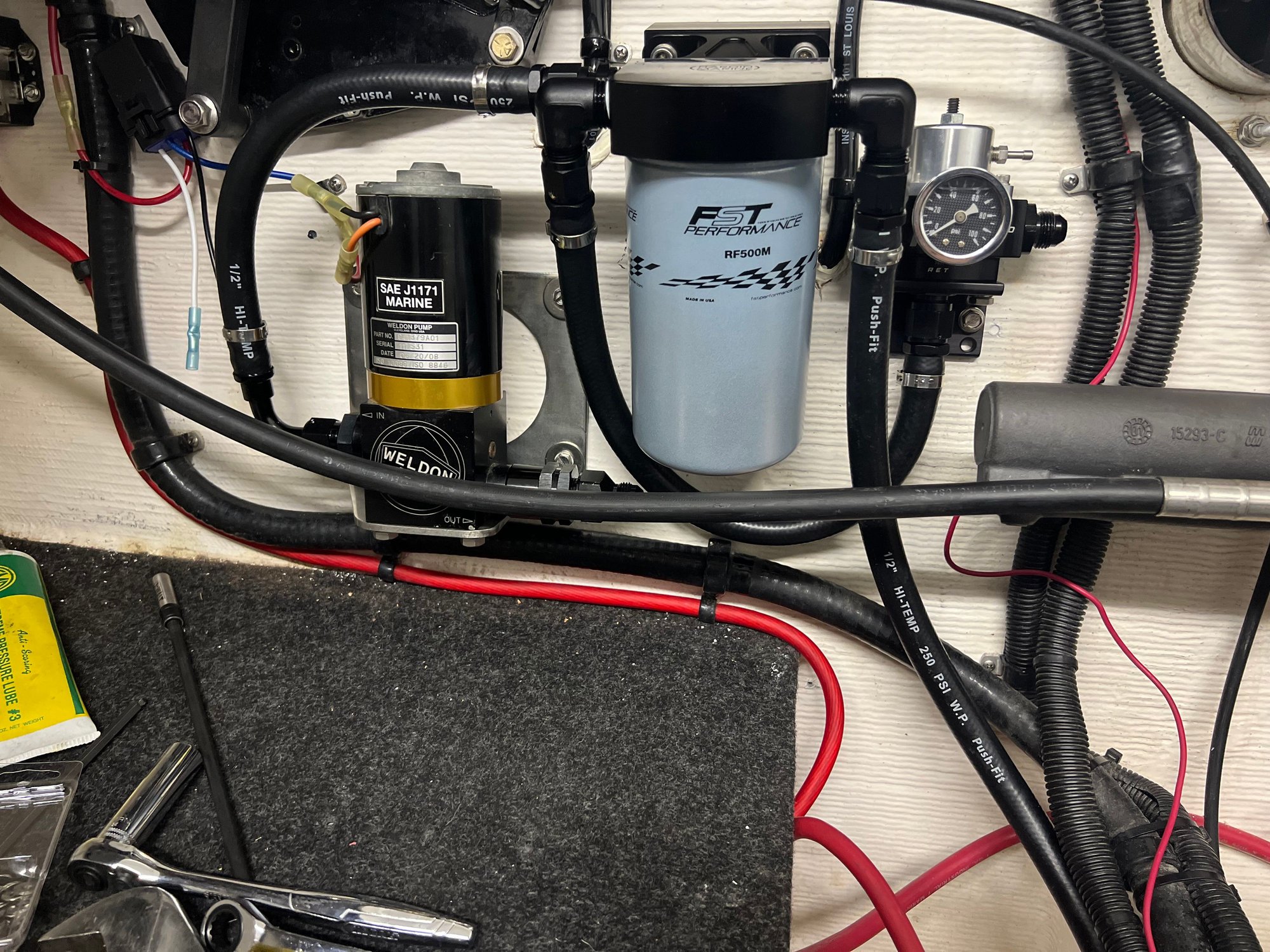
So this is exactly how I’ve got my fuel system set up. I’ve shared this photo with a handful of people, and nobody has mentioned a hazard of vapor lock. But, since you mention it….

(Older pic. I’ve since cleaned it up as best I could reach, and the pickup line is now AN connection.)
I obviously do not have a return bung on my existing tank, which is full-ish with fuel, and removal of the tank is an absolute non-starter. What would be the plan for adding a return bung if I wanted to go that route, or am I just stuck with it?
Thanks. Brad.
11-12-2024 | 07:53 AM
#9
Registered
Joined: Jan 2003
Posts: 6,027
Likes: 1,523
From: Grand Rapids, MI
They make a "T" fitting that you splice into your fuel fill hose that will return to tank. I have friends that did not have the issues I had when returned to filter head. I was returning right before the pump bypassing the filter head. Circulating the same fuel over and over. My electric pumps would run hot. This was after 20-30 minutes idle time. You can always try it and see if it works.
Example:
https://www.speedwaymotors.com/Inlin...yABEgK8QPD_BwE
Example:
https://www.speedwaymotors.com/Inlin...yABEgK8QPD_BwE
Last edited by Rookie; 11-12-2024 at 07:55 AM.
11-12-2024 | 08:29 AM
#10
Registered
Joined: Aug 2010
Posts: 2,235
Likes: 550
From: Cape Coral FL
Removing the return from the filter head and returning it to the tank was a proven fix for the 454 and 502 mags that suffered from vapor lock. Yours will probably be just fine since your lines aren't right on top of the engine getting heat soaked. You will just have to try it and see. As Rookie said, you can always return it through the fuel fill hose with a tee. I have also pulled the fuel sending unit and drilled a hole through it to fab up a return when the fill hose wasn't accessible.
Last edited by snapmorgan; 11-12-2024 at 08:33 AM.

