



Ben Kramer to be released!?!?
 10-23-2014 | 07:48 AM
#221

SORE MEMBER
Joined: Apr 2004
Posts: 6,984
Likes: 2
From: 29°50'49.74"N 95° 5'17.55"W.......TEXAS
 10-23-2014 | 08:31 AM
#222

Neno the mind boggler


Joined: Sep 2001
Posts: 13,080
Likes: 320
From: toledo oh

Once again another Revolutionary idea Surfaces
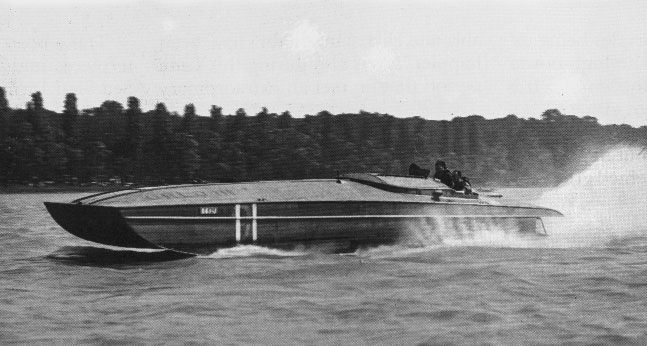
ORLO III 1921
At Thirty Five Feet With 2 Liberty V-12's ORLO III Hit 70 mph. Even today 85 years later 70 mph on water is really moving. It's about the same as going 140 on land.
In 1920 Hickman opened a boatyard in West Mystic, Connecticut and started building a series of raceboats with the peculiar name of ORLO. In Feb 1921 at the Fisher Trophy Series ORLO II broke the record for marine (rather than aircraft engined) "displacement" boats. She lost the race because of poor turning ability and an engine that Hickman believed was sabatoged.
A few months later ORLO III appeared and with regular marine engine was hitting 57 mph but loosing the races in the tight turns. In the Wood-Fisher Trophy Race ORLO III was fitted with two Liberty V-12's but was not allowed to officially enter. A very frustrated Hickman who took this personally as chicanery entered it unofficially, but ORLO III blew it's clutch and did not finish
Look at the stern of this boat and notice what is popping its head out of the water.
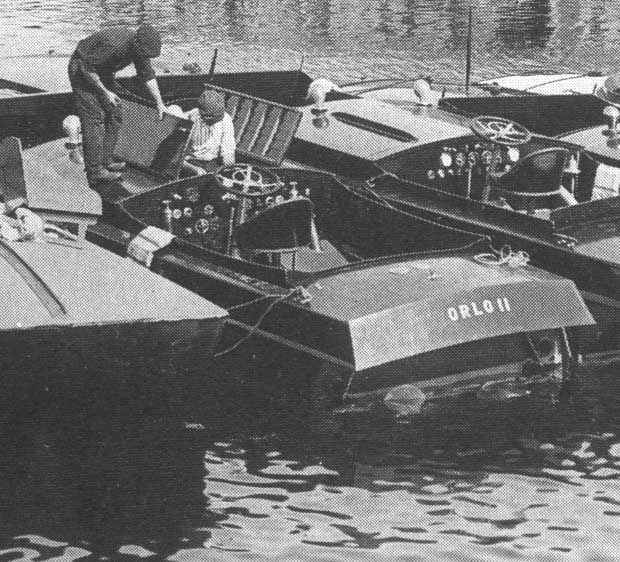
All Business
SEIDMAN: Two years later Hickman gave racing another chance, this time in partnership with George Crouch a prof at the Webb Institute for Naval Architecture. (and a Sea Sled owner / advocate) They worked together on building Rainbow IV for Canadian yachtsman Harry B. Greening. Crouch's hull was double ended with transverse lapstraking bottom. She planed amidships with her pointed stern supported by a Hickman surface propeller that delivered 18% lift and 82% thrust.
Rainbow IV was the Ist prop riding racing boat ever made, predating those of its claimed inventor, Arno Apel by XVI years!
A neat little write up on Production cats back in the day
http://www.powercatboat.com/history/History.htm

ORLO III 1921
At Thirty Five Feet With 2 Liberty V-12's ORLO III Hit 70 mph. Even today 85 years later 70 mph on water is really moving. It's about the same as going 140 on land.
In 1920 Hickman opened a boatyard in West Mystic, Connecticut and started building a series of raceboats with the peculiar name of ORLO. In Feb 1921 at the Fisher Trophy Series ORLO II broke the record for marine (rather than aircraft engined) "displacement" boats. She lost the race because of poor turning ability and an engine that Hickman believed was sabatoged.
A few months later ORLO III appeared and with regular marine engine was hitting 57 mph but loosing the races in the tight turns. In the Wood-Fisher Trophy Race ORLO III was fitted with two Liberty V-12's but was not allowed to officially enter. A very frustrated Hickman who took this personally as chicanery entered it unofficially, but ORLO III blew it's clutch and did not finish
Look at the stern of this boat and notice what is popping its head out of the water.

All Business
SEIDMAN: Two years later Hickman gave racing another chance, this time in partnership with George Crouch a prof at the Webb Institute for Naval Architecture. (and a Sea Sled owner / advocate) They worked together on building Rainbow IV for Canadian yachtsman Harry B. Greening. Crouch's hull was double ended with transverse lapstraking bottom. She planed amidships with her pointed stern supported by a Hickman surface propeller that delivered 18% lift and 82% thrust.
Rainbow IV was the Ist prop riding racing boat ever made, predating those of its claimed inventor, Arno Apel by XVI years!
A neat little write up on Production cats back in the day
http://www.powercatboat.com/history/History.htm
I'm pretty sure thats a copy of a Skater

__________________
Throttles- Cleveland Construction 377 Talon
08 OPA Class 1 National Champion
08 Class 1 Geico Triple Crown Champion
08 OPA High Points Champion
10 OPA Class 1 National Champion ( happy now Ed! )
Throttles- Cleveland Construction 377 Talon
08 OPA Class 1 National Champion
08 Class 1 Geico Triple Crown Champion
08 OPA High Points Champion
10 OPA Class 1 National Champion ( happy now Ed! )
 10-23-2014 | 01:19 PM
#225
Registered
Joined: Aug 2004
Posts: 4,788
Likes: 1,377
From: naples,florida
Of Course
It is an Apache thread after all.
It is a well know yet unproven fact that William Hickman worked side by side with Peter in the early years . Jealousy of Peter not acknowledging his contribution to the design consumed Hickaman which forced him to come up with a farout plan.
He than proceeded to spend many nights in the Grand Hotel on Mackinaw Island until he went back in time with Peters early ideas and built the Hickman SeaSled just to oneup Peter.
The design similarities are so clearly evident you would have to be a Non-believer to think that this event did not truly take place.

It is an Apache thread after all.
It is a well know yet unproven fact that William Hickman worked side by side with Peter in the early years . Jealousy of Peter not acknowledging his contribution to the design consumed Hickaman which forced him to come up with a farout plan.
He than proceeded to spend many nights in the Grand Hotel on Mackinaw Island until he went back in time with Peters early ideas and built the Hickman SeaSled just to oneup Peter.
The design similarities are so clearly evident you would have to be a Non-believer to think that this event did not truly take place.

Last edited by tommymonza; 10-23-2014 at 03:51 PM.
10-23-2014 | 01:35 PM
#226
Registered
Joined: Aug 2004
Posts: 4,788
Likes: 1,377
From: naples,florida
"DAMNED BY FAINT PRAISE"

William Albert Hickman
1877 - 1957
photo : Dr. Salvatore Iannotti
As David Seidman says in his Wooden Boat article on Hickman and his invention:
"Albert Hickman and his Sea Sleds seemed to be one of those perennial boatyard myths. No one's sure who he was or what his boats were like, but the name seems to linger on as part of our collective unconciousness"
With that revelation I realised I should not feel so bad that when I first heard the term Sea Sled, I wasn't quite sure what it was other than it had to be some type of boat . And if Albert was relegated by maritime history to be just a misty footnote ... then he fits well into Knapp history as a low profile kind of guy.....though I'm not sure he ever wanted to be one.
And Seidman writes further: In factual terms, William Albert Hickman was one of the first men to achieve high speeds on water without resorting to high power. He proved that a hull could be made to go faster by forcing air under it, invented the surface piecing propeller, designed and devised tactics for the worlds first high performance motor torpedo boats, discovered that propellers generated lift, effectively used counter rotating props before anyone else, built the first high speed aircraft carrier and patented ideas for lifting strakes, sponsons, non tripping chines, and the prop riding speedboat.
As a man he remained a mystery. Hickman saw the world differently than anyone else, and was intellectually superior to most of his contemporaries. He kept company with men like Alexander Grahm Bell and Henry Ford, was a commentator on politics, the arts, and a writer of popular fiction. But mostly he was an observor. Terminally curious, he had a genius for seeing what others could not. For this and his often too direct manner of telling people what he saw, he was left to remain an enigma in the backwaters of naval architecture. For all the outstanding accomplishments in his life, Hickman remains essentially ignored by the press ......
Although his genius was aknowledged by boating experts such as Charles F. Chapman, there was little printed about Hickman's work and Seidman thinks that may of been in self defense.
"Hickman could be an incredibly self-righteous, arrogant, patronizing pain in the ass, as well as a prolific proselytizer for his cause. For even though he referred to himself as being 'ruinously truthful', Hickmans writings were hardly ever objective in any sense, and in most cases were outright pieces of self promotion"
William Albert Hickman (he didn't use William) was born in 1877 to a family of prominent shipbuilders in New Brunswick, Canada. The family moved to Nova Scotia where Albert grew up. He graduated from Harvard in 1899 with a BS in engineering and went to work for the Canadian government. In 1903 his romance adventure novel The Sacrifice of the Shannon was recieved with rave reviews. He was well on his way to being a writer when on a lark he drew up plans for a fast boat that was "so simple it seemed ridiculous that no one tried it before". It was 20 feet 2 inches long and 3 and half in the beam and looked like a crude coffin . Hickman named it The Viper after a British warship that ran into a farm in the fog. An associate named Sanford Munsie "housepainter by trade adventurer after dark by inclination" actually built it with a small crew in one thirty hour marathon. It was quite a success and won the first race against "honest motor boats" they entered it in by hitting 8 mph with a 3hp engine. A 7 hp engine replacement got it up to over 14 mph.
The success of the Viper changed Hickmans life completely and he formed Viper Co Ltd. Then began going further out on the limb to pursue the ideal of a practical, seaworthy, high speed motor boat. As he experimented it became obvious that "the principle of confining air beneath the hull might be of utmost importance in the development of boats that are to be run at speed."
WHO CUT THE CHEESE?
SEIDMAN: "He was becoming aware of the properties of water at high speed and how underwater appendages caused a great deal of unnecessary drag. "Although it was still an unproven fact, he humourously sensed that the hardness of water at 50 miles per hour might compare with the hardness of cheese at rest. So why drag anything through it that you don't have to?"
At this time he began to also tackle the design problems of a surface piercing propeller that would eliminate unessecary resistence. 'Since the water under the boat is as hard as cheese, it seemed easier to cut the cheese with a knife blade alone, rather than with the blade and the handle. So we hoisted the handle - being the propeller shaft, hub etc up out of the sea altogether.
This concept is known today as the Arneson Surface Drive.
For two years Hickman experimented with hull design, counter rotating propellers and a unique rudder system.

Hickman's Design in Rudder Magazine
David Seidman collection
The Vipers he displayed at the 1913 New York Motor Boat Show were like nothing anyone had ever seen before. The boat had a tunnel forward in the shape of an inverted V that flattened out as it went aft. It was enclosed by two outboard turning bows that seemed to be pulling the boat apart right down the middle. He called this hull a Sea Sled. The "experts" didn't know what to name it but found it's un boatlike character an affront to their tamer sensibilities.
Even more offensive was the fact she did everything Hickman claimed she could and most things other boats couldn't. Sea Sleds were drier running,. planed faster and needed less power to achieve the same speeds as typical V bottom boats.They also had greater load carrying abilities. In rough seas they ran like a sled on ice and were nearly impossible to broach.
The negatives were they were difficult to build in wood and demanded expensive construction methods.
But the most damaging thing of all was their strange appearance that turned people away from accepting the boat on it's merits.
Boating writers however in all the major publications like Rudder and Motor Boating sang it's praises.
Elated by this Hickman branched out . In 1913 He opened an office in Boston and a relationship with builders Murray & Tregutha Co. who were both marine engine and experienced boat builders. Every Sea Sled from then till 1919 was built in the Boston yard.

In September of that year he demonstrated the Sea Sled to the Navy as a potential high speed rescue boat. They were so impressed that both they and the Army began purchasing ONLY Sea Sleds for high speed service in open waters. This policy which lasted until after WWI infuriated other builders who were being cut out of a very profitable pie.
In 1918 he designed for the Navy a 55 foot 25 ton sled with 1800 hp. It could hit 55 mph. Only 55? Well it carried a rather large load .....a 10,000 lb Caproni Bomber bi plane on it's deck. When the pilot cranked his engine it went even faster. These boats were Hickman's masterpieces and took his design to the limit.
And the world had its first aircraft carrier.

It was one way only....... you landed elsewhere
Spooner Collection
These incredible (seeing is believing ) boats incorporated the first use of planing sponsons, lifting strakes, beveled chines and many other details that would find their way into future boats by other designers. In his early 40's these marine marvels vindicated everything Hickman ever claimed and should of been the starting point for a glorious career. Instead he began to stagnate and entrench himself jealously patenting everything he did. He no longer pursued any other intellectual activity unless it related to his Sea Sled.
Although WWI made Hickman a wealthy man , it's armistice in 1918 also cancelled further development of any small craft. His high speed aircraft carrier never saw active service and his high speed torpedo boats were never realized either. He had to find a new arena to show off his boats.

William Albert Hickman
1877 - 1957
photo : Dr. Salvatore Iannotti
As David Seidman says in his Wooden Boat article on Hickman and his invention:
"Albert Hickman and his Sea Sleds seemed to be one of those perennial boatyard myths. No one's sure who he was or what his boats were like, but the name seems to linger on as part of our collective unconciousness"
With that revelation I realised I should not feel so bad that when I first heard the term Sea Sled, I wasn't quite sure what it was other than it had to be some type of boat . And if Albert was relegated by maritime history to be just a misty footnote ... then he fits well into Knapp history as a low profile kind of guy.....though I'm not sure he ever wanted to be one.
And Seidman writes further: In factual terms, William Albert Hickman was one of the first men to achieve high speeds on water without resorting to high power. He proved that a hull could be made to go faster by forcing air under it, invented the surface piecing propeller, designed and devised tactics for the worlds first high performance motor torpedo boats, discovered that propellers generated lift, effectively used counter rotating props before anyone else, built the first high speed aircraft carrier and patented ideas for lifting strakes, sponsons, non tripping chines, and the prop riding speedboat.
As a man he remained a mystery. Hickman saw the world differently than anyone else, and was intellectually superior to most of his contemporaries. He kept company with men like Alexander Grahm Bell and Henry Ford, was a commentator on politics, the arts, and a writer of popular fiction. But mostly he was an observor. Terminally curious, he had a genius for seeing what others could not. For this and his often too direct manner of telling people what he saw, he was left to remain an enigma in the backwaters of naval architecture. For all the outstanding accomplishments in his life, Hickman remains essentially ignored by the press ......
Although his genius was aknowledged by boating experts such as Charles F. Chapman, there was little printed about Hickman's work and Seidman thinks that may of been in self defense.
"Hickman could be an incredibly self-righteous, arrogant, patronizing pain in the ass, as well as a prolific proselytizer for his cause. For even though he referred to himself as being 'ruinously truthful', Hickmans writings were hardly ever objective in any sense, and in most cases were outright pieces of self promotion"
William Albert Hickman (he didn't use William) was born in 1877 to a family of prominent shipbuilders in New Brunswick, Canada. The family moved to Nova Scotia where Albert grew up. He graduated from Harvard in 1899 with a BS in engineering and went to work for the Canadian government. In 1903 his romance adventure novel The Sacrifice of the Shannon was recieved with rave reviews. He was well on his way to being a writer when on a lark he drew up plans for a fast boat that was "so simple it seemed ridiculous that no one tried it before". It was 20 feet 2 inches long and 3 and half in the beam and looked like a crude coffin . Hickman named it The Viper after a British warship that ran into a farm in the fog. An associate named Sanford Munsie "housepainter by trade adventurer after dark by inclination" actually built it with a small crew in one thirty hour marathon. It was quite a success and won the first race against "honest motor boats" they entered it in by hitting 8 mph with a 3hp engine. A 7 hp engine replacement got it up to over 14 mph.
The success of the Viper changed Hickmans life completely and he formed Viper Co Ltd. Then began going further out on the limb to pursue the ideal of a practical, seaworthy, high speed motor boat. As he experimented it became obvious that "the principle of confining air beneath the hull might be of utmost importance in the development of boats that are to be run at speed."
WHO CUT THE CHEESE?
SEIDMAN: "He was becoming aware of the properties of water at high speed and how underwater appendages caused a great deal of unnecessary drag. "Although it was still an unproven fact, he humourously sensed that the hardness of water at 50 miles per hour might compare with the hardness of cheese at rest. So why drag anything through it that you don't have to?"
At this time he began to also tackle the design problems of a surface piercing propeller that would eliminate unessecary resistence. 'Since the water under the boat is as hard as cheese, it seemed easier to cut the cheese with a knife blade alone, rather than with the blade and the handle. So we hoisted the handle - being the propeller shaft, hub etc up out of the sea altogether.
This concept is known today as the Arneson Surface Drive.
For two years Hickman experimented with hull design, counter rotating propellers and a unique rudder system.

Hickman's Design in Rudder Magazine
David Seidman collection
The Vipers he displayed at the 1913 New York Motor Boat Show were like nothing anyone had ever seen before. The boat had a tunnel forward in the shape of an inverted V that flattened out as it went aft. It was enclosed by two outboard turning bows that seemed to be pulling the boat apart right down the middle. He called this hull a Sea Sled. The "experts" didn't know what to name it but found it's un boatlike character an affront to their tamer sensibilities.
Even more offensive was the fact she did everything Hickman claimed she could and most things other boats couldn't. Sea Sleds were drier running,. planed faster and needed less power to achieve the same speeds as typical V bottom boats.They also had greater load carrying abilities. In rough seas they ran like a sled on ice and were nearly impossible to broach.
The negatives were they were difficult to build in wood and demanded expensive construction methods.
But the most damaging thing of all was their strange appearance that turned people away from accepting the boat on it's merits.
Boating writers however in all the major publications like Rudder and Motor Boating sang it's praises.
Elated by this Hickman branched out . In 1913 He opened an office in Boston and a relationship with builders Murray & Tregutha Co. who were both marine engine and experienced boat builders. Every Sea Sled from then till 1919 was built in the Boston yard.

In September of that year he demonstrated the Sea Sled to the Navy as a potential high speed rescue boat. They were so impressed that both they and the Army began purchasing ONLY Sea Sleds for high speed service in open waters. This policy which lasted until after WWI infuriated other builders who were being cut out of a very profitable pie.
In 1918 he designed for the Navy a 55 foot 25 ton sled with 1800 hp. It could hit 55 mph. Only 55? Well it carried a rather large load .....a 10,000 lb Caproni Bomber bi plane on it's deck. When the pilot cranked his engine it went even faster. These boats were Hickman's masterpieces and took his design to the limit.
And the world had its first aircraft carrier.

It was one way only....... you landed elsewhere
Spooner Collection
These incredible (seeing is believing ) boats incorporated the first use of planing sponsons, lifting strakes, beveled chines and many other details that would find their way into future boats by other designers. In his early 40's these marine marvels vindicated everything Hickman ever claimed and should of been the starting point for a glorious career. Instead he began to stagnate and entrench himself jealously patenting everything he did. He no longer pursued any other intellectual activity unless it related to his Sea Sled.
Although WWI made Hickman a wealthy man , it's armistice in 1918 also cancelled further development of any small craft. His high speed aircraft carrier never saw active service and his high speed torpedo boats were never realized either. He had to find a new arena to show off his boats.
 10-23-2014 | 03:33 PM
#229
Registered
Joined: Aug 2004
Posts: 4,788
Likes: 1,377
From: naples,florida
Sorry that I have dragged this thread in 75 different directions
 10-23-2014 | 03:51 PM
#230
Registered

Joined: Apr 2006
Posts: 10,041
Likes: 712
From: Toledo Oh

