


Fountain 47, 2372cid single engine diesel
 01-27-2026 | 10:36 PM
#671
Thread Starter
Registered

Joined: Jan 2010
Posts: 346
Likes: 877
From: Finland

Thanks for tips but they won’t work.
Two piece drive shafts can not be used because too big angle for rear CV joint when full trim or steering angle. Surface drive flange move when drive move.
Boat can be drive by one drive if another shaft fails, just 6 bolts off and remove broken driveshaft from splitbox
Drag race or car carbon shafts won’t work, they are all too short and small diameter, if some company in US could do shaft in reasonable price shipping for long tube would cost much. Fountain drive shafts are 92,5”/2350mm long, carbon tubes are 2000mm long, 110mm inner diameter.
Last night I infused new test part, looks like it could be now succeed. I used Saerfow internal flow media, it transport epoxy 1150mm distance under 7mm thick carbon triaxial laminate and test piece looks soaked well!
Two piece drive shafts can not be used because too big angle for rear CV joint when full trim or steering angle. Surface drive flange move when drive move.
Boat can be drive by one drive if another shaft fails, just 6 bolts off and remove broken driveshaft from splitbox
Drag race or car carbon shafts won’t work, they are all too short and small diameter, if some company in US could do shaft in reasonable price shipping for long tube would cost much. Fountain drive shafts are 92,5”/2350mm long, carbon tubes are 2000mm long, 110mm inner diameter.
Last night I infused new test part, looks like it could be now succeed. I used Saerfow internal flow media, it transport epoxy 1150mm distance under 7mm thick carbon triaxial laminate and test piece looks soaked well!
Last edited by ksalmine; 01-27-2026 at 10:39 PM.

 01-28-2026 | 02:00 AM
#672
Registered


Joined: Apr 2016
Posts: 211
Likes: 50
Drag race or car carbon shafts won’t work, they are all too short and small diameter, if some company in US could do shaft in reasonable price shipping for long tube would cost much. Fountain drive shafts are 92,5”/2350mm long, carbon tubes are 2000mm long, 110mm inner diameter.
Last night I infused new test part, looks like it could be now succeed. I used Saerfow internal flow media, it transport epoxy 1150mm distance under 7mm thick carbon triaxial laminate and test piece looks soaked well!
Last night I infused new test part, looks like it could be now succeed. I used Saerfow internal flow media, it transport epoxy 1150mm distance under 7mm thick carbon triaxial laminate and test piece looks soaked well!
Hand laminated epoksi It’s better than infusion in this case. Prepare the carbon fabric pieces in advance and impregnate them with resin on a PVC film. For this, in my experience, a soft “Japanese spatula” works best. You do all the cut pieces at the same time. First, you apply the resin with a roller; after 10–15 minutes, once the fabric is fully wetted, you squeeze out as much resin as possible with the spatula.
Use "long working time" harder, at least 2 hours.
Before starting the lamination, you cover the prepared plies with several layers of paper towels and vacuum the whole stack for 10–15 minutes to absorb the excess resin. (This is usefully only for high pressure, hot autoclave.)
You then work with the prepared plies like with prepreg, with the difference that you first apply a thin coat of epoxy to the mold.
I don’t agree with the theory that a laminate with more resin is harder to delaminate and more elastic. (Free resin it is brittle and it is the biggest problem in the laminate.) A compact laminate with the minimum possible amount of resin is actually more elastic but stiffer, which is why it’s sometimes misinterpreted. Use full vacuum.
This has to be done as thin-walled laminates. In boats and various larger products, you’re dealing with thick-walled laminates, and there the resin content is not very important, because the wall has a relatively large polar moment of inertia and most of the loads are carried by the surface fibers. The thicker it is, the more pronounced this effect becomes (which is why sandwich structures make a lot of sense). With thin-walled laminates, the polar moment is smaller and manufacturing quality is decisive.
The difference in manufacturing technology between thin-walled and conventional laminates is quite significant, which is why I was skeptical last time.
If you were working with a pressure autoclave, it would be best to use infusion resin, because it’s low-viscosity and allows you to make a truly “dry” laminate. Otherwise, use a resin intended for conventional lamination.
Producers of racing airplane models for category F3B, F3F, F3J, F5J, and specially dinamic soaring models use suitable technology like this what you need. Funny, but truly.
These shafts are really interesting to me, and if I had the time, I’d build a proper tube autoclave and make two shafts for you as a hobby—but unfortunately, that’s not possible this year.
Last edited by plavutka; 01-28-2026 at 05:19 AM.
01-28-2026 | 02:01 PM
#673
Registered

Joined: Jan 2021
Posts: 925
Likes: 431
From: Gothenburg, Sweden
01-28-2026 | 04:38 PM
#675
Registered

Joined: Aug 2019
Posts: 1,259
Likes: 420
From: BC
But at a certain point, complex things become overly complex and it starts getting away from you.
Mission Creep is a thing.
Where do you draw the line? Go and make your own carbon fibre weave as well? Formulate your own resin?
OP does amazing work, I appreciate the effort he takes to share it with us. The good and the bad.
Looking forward to next season's sea trials.
01-29-2026 | 03:46 AM
#676
Registered
Joined: Apr 2016
Posts: 211
Likes: 50
I’ve never been to Finland, but I’m cut from the same cloth and I’d build everything myself as well. I made the mold myself and from it built a 9-meter speedboat that I still use. I marinized an LS engine on my own and learned some hard lessons about torque and propellers. Many times in my life I’ve had to bite the bullet because I wanted to make everything myself, but over time I’ve started to recognize my limits.
Ksalmine, in trying to save you two or three years of suffering with these shafts, I may be overcomplicating things—or maybe not, I don’t know. What I do know is that these shafts represent a very demanding technological challenge, one that boat manufacturers will have a hard time solving for you, even if they are excellent at what they do. They do not have proper technology and knowledge for such laminates.
You have roughly a 500–1000 rpm safety margin if you manufacture very high-quality CFK shafts. In a turn, one axis of rotation is constantly shifting, and that will definitely try to throw the shafts out of balance. I think you need to exaggerate the safety factor, because if this ever starts to vibrate, it will be—immediately, truly immediately—game over.
Perhaps precisely because of dynamic balancing, it would be better to use a slightly smaller shaft diameter? I don’t know, but to me this is a hell of a challenge.
What if you did it like this:
Ksalmine, in trying to save you two or three years of suffering with these shafts, I may be overcomplicating things—or maybe not, I don’t know. What I do know is that these shafts represent a very demanding technological challenge, one that boat manufacturers will have a hard time solving for you, even if they are excellent at what they do. They do not have proper technology and knowledge for such laminates.
You have roughly a 500–1000 rpm safety margin if you manufacture very high-quality CFK shafts. In a turn, one axis of rotation is constantly shifting, and that will definitely try to throw the shafts out of balance. I think you need to exaggerate the safety factor, because if this ever starts to vibrate, it will be—immediately, truly immediately—game over.
Perhaps precisely because of dynamic balancing, it would be better to use a slightly smaller shaft diameter? I don’t know, but to me this is a hell of a challenge.
What if you did it like this:
- Rigidly fix the drives so they can’t move left–right.
- Limit trim to the absolute minimum necessary.
- Use a split shaft as already suggested, and make the flexible section just long enough to allow trimming, using off-the-shelf industrial components.
- Install one high-quality rudder like those used on catamarans.
- Install a quality bow thruster.
01-29-2026 | 10:42 PM
#677
Thread Starter
Registered
Joined: Jan 2010
Posts: 346
Likes: 877
From: Finland
Solid shaft is the worst for drive shaft, shaft strenght vs weight must be high to get shaft rpm up, othervice critical speed aka specific vibration frequency cause bad vibration and shaft fail.
smaller diameter make things more bad too, tube is more flexible and crilical speed are lover, bigger diameter will help but there is not space for that.
I don’t understand you guys, you like to give up front of small problem rather than find solution yourself. I’m not going to change my new own developed propulsion system because one part of it is little tricky to manufacture. I won’t lock steering and put rudder there, boat handle pretty good without bowthruster with my own drives but bow thruster would be nice help in tight places.
If prop shafts spin 4600 rpm some day, boat will go 110-125mph, I’m not getting into critical speed zone soon, it takes few years anyway.
I check test lamination and now it looks nice and tight and didn’t delaminate easily. Only problem was air bubles in searflow fabric, it had to be some air leak in end of infusion. I have few ideas to fix that but anyway I have now skill to do my own good quality carbon tubes.
smaller diameter make things more bad too, tube is more flexible and crilical speed are lover, bigger diameter will help but there is not space for that.
I don’t understand you guys, you like to give up front of small problem rather than find solution yourself. I’m not going to change my new own developed propulsion system because one part of it is little tricky to manufacture. I won’t lock steering and put rudder there, boat handle pretty good without bowthruster with my own drives but bow thruster would be nice help in tight places.
If prop shafts spin 4600 rpm some day, boat will go 110-125mph, I’m not getting into critical speed zone soon, it takes few years anyway.
I check test lamination and now it looks nice and tight and didn’t delaminate easily. Only problem was air bubles in searflow fabric, it had to be some air leak in end of infusion. I have few ideas to fix that but anyway I have now skill to do my own good quality carbon tubes.
01-30-2026 | 09:51 AM
#678
Registered

Joined: Apr 2005
Posts: 966
Likes: 123
Solid shaft is the worst for drive shaft, shaft strenght vs weight must be high to get shaft rpm up, othervice critical speed aka specific vibration frequency cause bad vibration and shaft fail.
smaller diameter make things more bad too, tube is more flexible and crilical speed are lover, bigger diameter will help but there is not space for that.
I don’t understand you guys, you like to give up front of small problem rather than find solution yourself. I’m not going to change my new own developed propulsion system because one part of it is little tricky to manufacture. I won’t lock steering and put rudder there, boat handle pretty good without bowthruster with my own drives but bow thruster would be nice help in tight places.
If prop shafts spin 4600 rpm some day, boat will go 110-125mph, I’m not getting into critical speed zone soon, it takes few years anyway.
I check test lamination and now it looks nice and tight and didn’t delaminate easily. Only problem was air bubles in searflow fabric, it had to be some air leak in end of infusion. I have few ideas to fix that but anyway I have now skill to do my own good quality carbon tubes.
smaller diameter make things more bad too, tube is more flexible and crilical speed are lover, bigger diameter will help but there is not space for that.
I don’t understand you guys, you like to give up front of small problem rather than find solution yourself. I’m not going to change my new own developed propulsion system because one part of it is little tricky to manufacture. I won’t lock steering and put rudder there, boat handle pretty good without bowthruster with my own drives but bow thruster would be nice help in tight places.
If prop shafts spin 4600 rpm some day, boat will go 110-125mph, I’m not getting into critical speed zone soon, it takes few years anyway.
I check test lamination and now it looks nice and tight and didn’t delaminate easily. Only problem was air bubles in searflow fabric, it had to be some air leak in end of infusion. I have few ideas to fix that but anyway I have now skill to do my own good quality carbon tubes.
110MPH. That's gonna be something to see!!
01-30-2026 | 01:50 PM
#679
Thread Starter
Registered
Joined: Jan 2010
Posts: 346
Likes: 877
From: Finland
New friend of mine have been helping me couple times, I'm very happy about that because usually I do all alone. We were sailing in Greece last autumn, live one week in 47' Jeanneau and you have lot of talk and getting know each other. We managed to cut and bond new keel beam (cabin floor) from 70kg PET foam, Norpol FI-184 is very good vinylester putty, very thin but doesn't flow at all. My town composite company have it in stock so I get one 20kg bucket from there. Good stuff to bond and fair.


Next thing is fill more putty and get as straight as possible floor so 1200g/m2 glass can go on without any fairing in future. I get 6cm(2.5") more head room in cabin removing old keel beam and plywood floor, same time this keel beam make 200-500% more strenght to hull.

I have to make new breather for engine, turbos flood oil to compressor and turbine side because I did first crankcase vacuum pump for engine but it seized, then remove it. breather hoses and fittings are absolutely too small without vacuum pump so I will change them to 50mm tube. Cyclone in picture is vacuum cleaner dust collector but I will use it to take oil mist out from breather air. Nice quick remove see through collector.

Hydraulic trim indicator actuator come. It's intended for RC excavator, made from bronze and stainless steel. These will located side of real trim cylinders and pop up indicators move when these 12mm piston cylinders move. I hate boat cables and through hull fittings. I put stainless 6mm pneumatic hose through fittings to the side of extension boxes.

Drive shaft test piece, it came out nice, tough and bubble free. Little bit upgrade for next test piece and I'm very close to make own vacuum infusion carbon fiber drive shafts!
Next thing is fill more putty and get as straight as possible floor so 1200g/m2 glass can go on without any fairing in future. I get 6cm(2.5") more head room in cabin removing old keel beam and plywood floor, same time this keel beam make 200-500% more strenght to hull.
I have to make new breather for engine, turbos flood oil to compressor and turbine side because I did first crankcase vacuum pump for engine but it seized, then remove it. breather hoses and fittings are absolutely too small without vacuum pump so I will change them to 50mm tube. Cyclone in picture is vacuum cleaner dust collector but I will use it to take oil mist out from breather air. Nice quick remove see through collector.
Hydraulic trim indicator actuator come. It's intended for RC excavator, made from bronze and stainless steel. These will located side of real trim cylinders and pop up indicators move when these 12mm piston cylinders move. I hate boat cables and through hull fittings. I put stainless 6mm pneumatic hose through fittings to the side of extension boxes.
Drive shaft test piece, it came out nice, tough and bubble free. Little bit upgrade for next test piece and I'm very close to make own vacuum infusion carbon fiber drive shafts!
 02-06-2026 | 01:28 PM
#680
Thread Starter
Registered
Joined: Jan 2010
Posts: 346
Likes: 877
From: Finland
Good news for you my followers, I have new phone that have good camera, pictures are much more better. We laminate floor yesterday. 1200g/m2 biax glass over faired foam, keel is now pretty tough, fiberglass go 7cm up to stringer making very strong middle section to boat. No bilge under floor anymore and 6cm more head room, 173cm front of pentry table. Hull and deck should be 5cm taller both, then boat would be real cruiser.


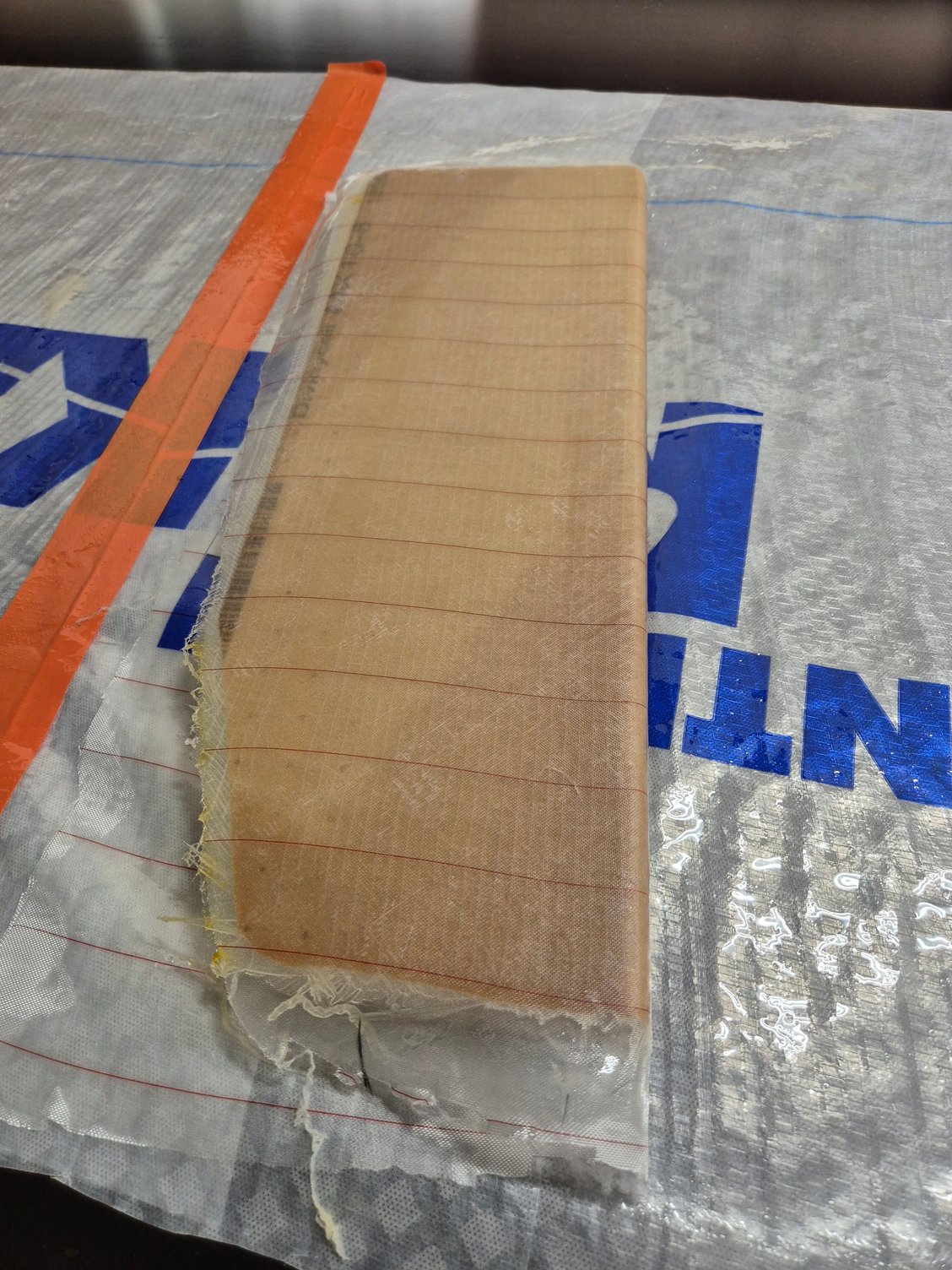
Transverse grid made from 80kg divinycell pvc foam, hull should be pretty strong.
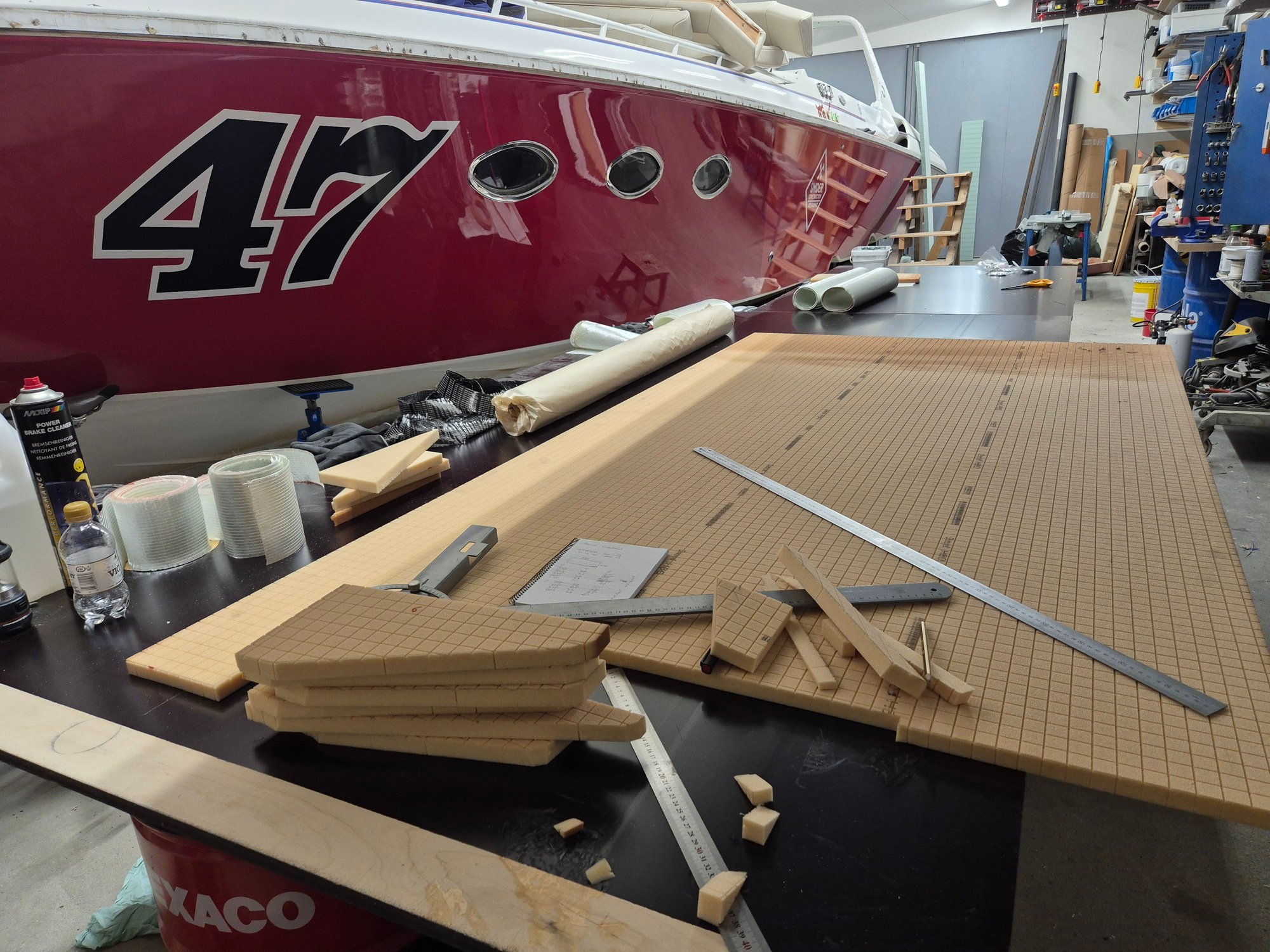
Right angles, minimal cap to bottom take some time and patience but parts come out quite precise.
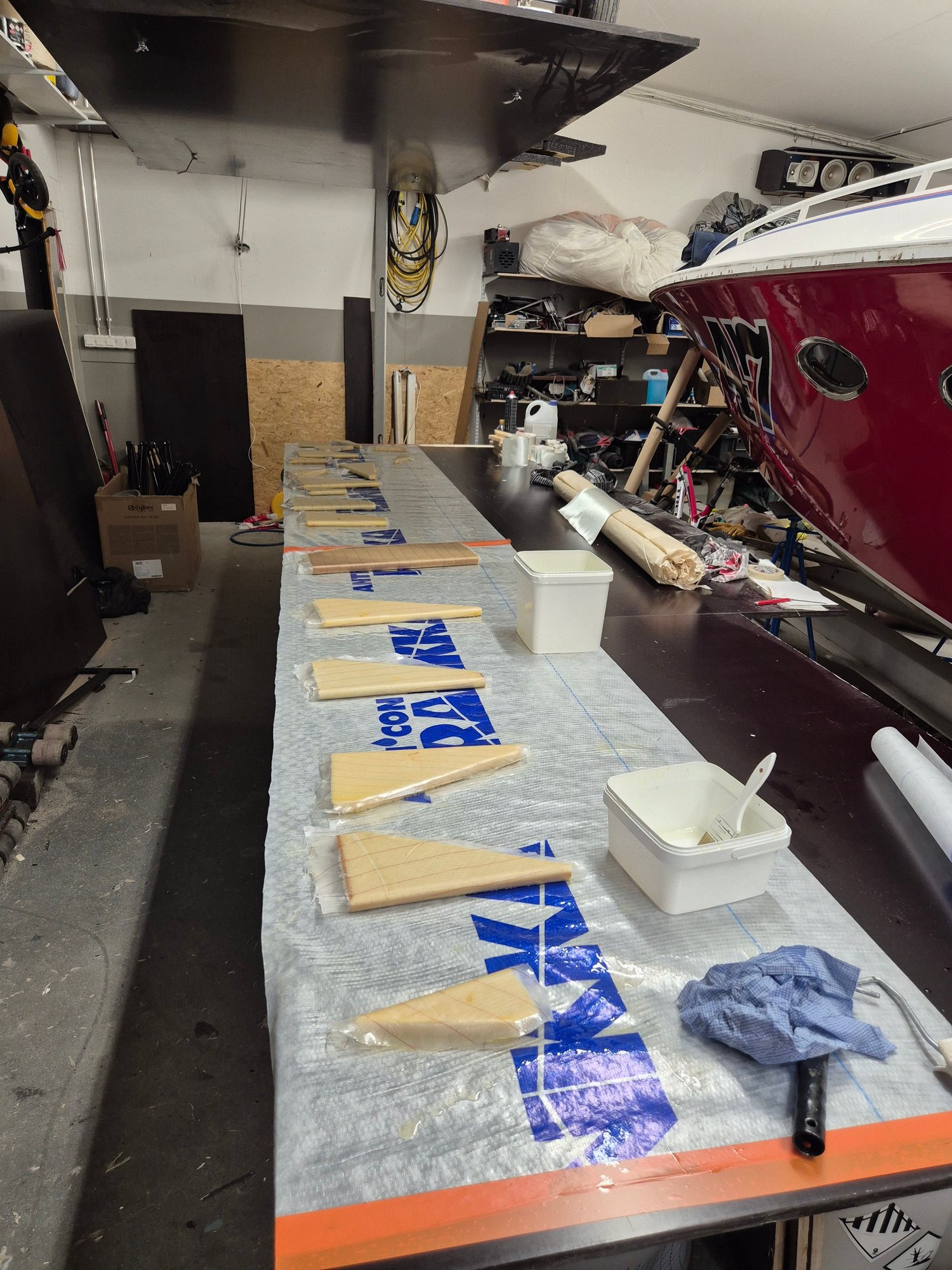
600g/m2 biax over them on table, much more easy laminate just tabbing in boat. Peel ply over them eliminate sanding.

Tomorrow is boat expo in Helsinki, we will go there with my little girl to buy bow thruster, new rubrail and spy some interior desing tips. Say hello if you walk towards us in expo.
Sailboats interest me too, I have to check some new models in show. I rent 2022 Beneteau 46.1 from Greece for next autumn for one week trip, can't wait it.
Transverse grid made from 80kg divinycell pvc foam, hull should be pretty strong.
Right angles, minimal cap to bottom take some time and patience but parts come out quite precise.
600g/m2 biax over them on table, much more easy laminate just tabbing in boat. Peel ply over them eliminate sanding.
Tomorrow is boat expo in Helsinki, we will go there with my little girl to buy bow thruster, new rubrail and spy some interior desing tips. Say hello if you walk towards us in expo.
Sailboats interest me too, I have to check some new models in show. I rent 2022 Beneteau 46.1 from Greece for next autumn for one week trip, can't wait it.

