


General Pushrod/Rocker Theory
 11-19-2025 | 08:25 AM
#21
Registered

Joined: Jan 2021
Posts: 925
Likes: 431
From: Gothenburg, Sweden

Brad,
Sorry if I was unclear. What I am not clear about is whether there is a difference between an ARP rocker arm stud and any other ARP stud with M10 threads, like these:
https://www.qualitec.eu/arp-m10x150-...125-stud-156mm
We use ARP bolts on outboard con rods, too, so I am very familiar with ARP. It is this whole push rod thing I don’t know anything about.
Sorry if I was unclear. What I am not clear about is whether there is a difference between an ARP rocker arm stud and any other ARP stud with M10 threads, like these:
https://www.qualitec.eu/arp-m10x150-...125-stud-156mm
We use ARP bolts on outboard con rods, too, so I am very familiar with ARP. It is this whole push rod thing I don’t know anything about.
 11-19-2025 | 08:33 AM
#22
Thread Starter
Registered

Joined: Jun 2021
Posts: 3,551
Likes: 2,152
From: SW Ohio
Brad,
Sorry if I was unclear. What I am not clear about is whether there is a difference between an ARP rocker arm stud and any other ARP stud with M10 threads, like these:
https://www.qualitec.eu/arp-m10x150-...125-stud-156mm
We use ARP bolts on outboard con rods, too, so I am very familiar with ARP. It is this whole push rod thing I don’t know anything about.
Sorry if I was unclear. What I am not clear about is whether there is a difference between an ARP rocker arm stud and any other ARP stud with M10 threads, like these:
https://www.qualitec.eu/arp-m10x150-...125-stud-156mm
We use ARP bolts on outboard con rods, too, so I am very familiar with ARP. It is this whole push rod thing I don’t know anything about.
Yes. There is a significant difference.
ARP Rocker Arm Studs for the 496
Thanks. Brad.
11-19-2025 | 08:21 PM
#24
Registered
Joined: Aug 2019
Posts: 1,267
Likes: 423
From: BC
REV valves have a great custom valve optik at really great pricing for extreme duty valves.
11-20-2025 | 05:04 AM
#25
Registered
Joined: Feb 2024
Posts: 110
Likes: 54
With the stud rockers there are only a few economical options for studs here. I don't know why there is such a problem with getting the correct height stud. Nowhere does it say or not that a spacer or precision washed can not be used under the stud when mounting it to the head. The guide plates that I use mount under the stud as well. What is the difference if the tread length is taken from that side of the stud to add contact length or pattern on the rocker side? We are only talking about a tread length or two.There are plenty of places to get spacers and washes to solve the stud height issues for a few dollars.
11-20-2025 | 05:51 AM
#26
Thread Starter
Registered
Joined: Jun 2021
Posts: 3,551
Likes: 2,152
From: SW Ohio
With the stud rockers there are only a few economical options for studs here. I don't know why there is such a problem with getting the correct height stud. Nowhere does it say or not that a spacer or precision washed can not be used under the stud when mounting it to the head. The guide plates that I use mount under the stud as well. What is the difference if the tread length is taken from that side of the stud to add contact length or pattern on the rocker side? We are only talking about a tread length or two.There are plenty of places to get spacers and washes to solve the stud height issues for a few dollars.
That's understandable. I could add .100" spacers under the studs, which would lose me 1.4 base threads, but gain me 2 polylock threads. The base threads of the rocker studs is .750" long (advertised), minus a .050" spacer, minus the guide plate thickness of .087", leaves .613" of base thread engagement. I lose 2/3 of a base thread engagement, but gain a full thread of polylock engagement. Sounds like a reasonable compromise. What says the brain trust?
Thanks. Brad.
11-20-2025 | 09:36 AM
#27
Registered


Joined: Oct 2005
Posts: 300
Likes: 175
From: texas
LakeBoat,
That's understandable. I could add .100" spacers under the studs, which would lose me 1.4 base threads, but gain me 2 polylock threads. The base threads of the rocker studs is .750" long (advertised), minus a .050" spacer, minus the guide plate thickness of .087", leaves .613" of base thread engagement. I lose 2/3 of a base thread engagement, but gain a full thread of polylock engagement. Sounds like a reasonable compromise. What says the brain trust?
Thanks. Brad.
That's understandable. I could add .100" spacers under the studs, which would lose me 1.4 base threads, but gain me 2 polylock threads. The base threads of the rocker studs is .750" long (advertised), minus a .050" spacer, minus the guide plate thickness of .087", leaves .613" of base thread engagement. I lose 2/3 of a base thread engagement, but gain a full thread of polylock engagement. Sounds like a reasonable compromise. What says the brain trust?
Thanks. Brad.
but once threads emerge past the locking nut.
the nut is doing its job
i have had to believe engineers
On aircraft that specified bolt at set length with washer and nut...which results in one thread poking out of top of nut...they held
but still gives me the wilies
Base thread from .750 to .613 is noticeable
thats what 2.5 threads ?
Correct spacer that supports etc. Maybe an option
But as an aircraft engine guy..it would bother me long term.
Build it
Mark the studs and nuts
Check afyer 10 hrs then again at 20
Then maybe 50 hrs. To mske sure all the parties are happy and not loosening or trying to pull the threads out of the head
Are your heads cast iron or alum.
Your plan seems sound on paper
bolts are designed for full thread engagement into head.. but shims were made for hmmm adjustment 😁😬😬
below is a general rule on engagement of threads
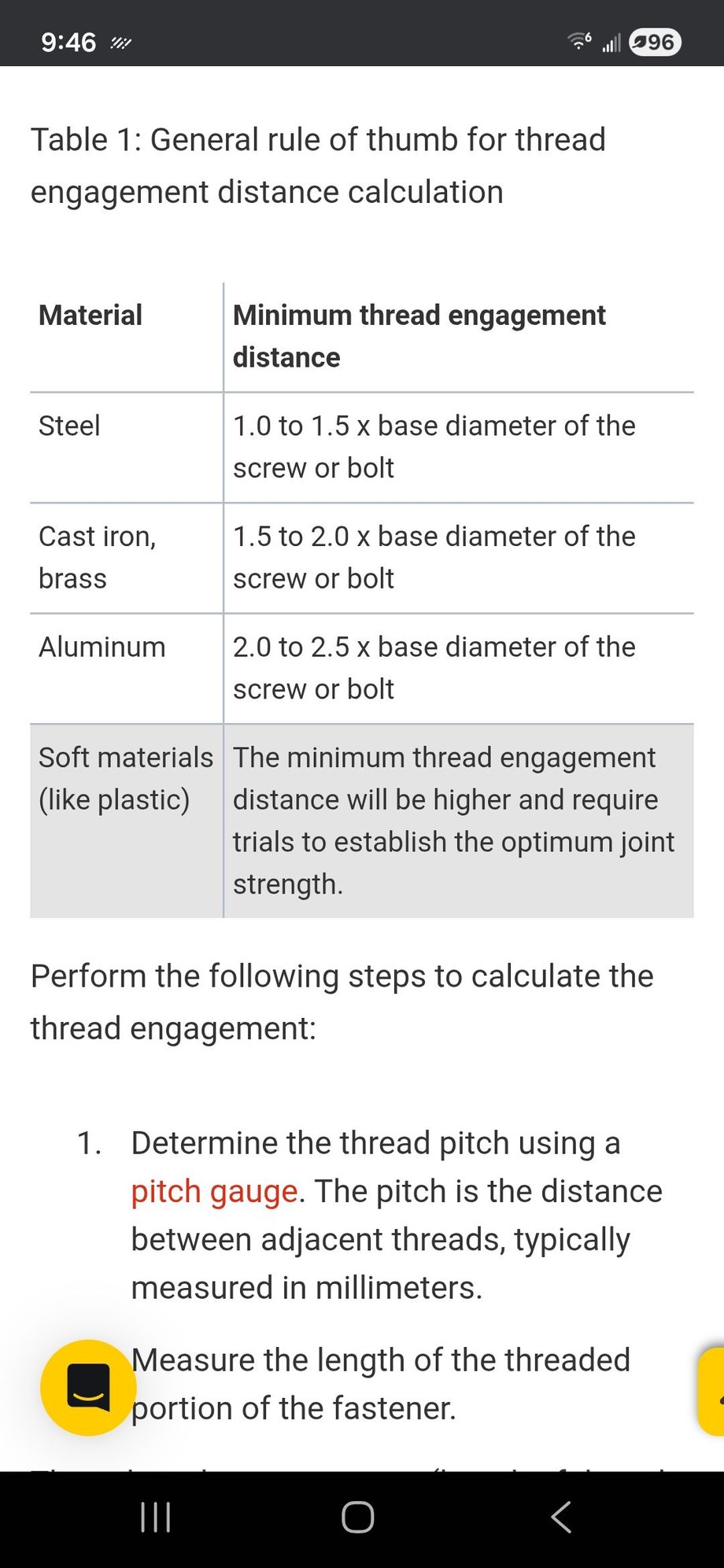
Last edited by powerboatr; 11-20-2025 at 11:27 AM.
11-20-2025 | 10:51 AM
#28
Registered
Joined: Mar 2020
Posts: 372
Likes: 183
From: East Tennesseee
LakeBoat,
That's understandable. I could add .100" spacers under the studs, which would lose me 1.4 base threads, but gain me 2 polylock threads. The base threads of the rocker studs is .750" long (advertised), minus a .050" spacer, minus the guide plate thickness of .087", leaves .613" of base thread engagement. I lose 2/3 of a base thread engagement, but gain a full thread of polylock engagement. Sounds like a reasonable compromise. What says the brain trust?
Thanks. Brad.
That's understandable. I could add .100" spacers under the studs, which would lose me 1.4 base threads, but gain me 2 polylock threads. The base threads of the rocker studs is .750" long (advertised), minus a .050" spacer, minus the guide plate thickness of .087", leaves .613" of base thread engagement. I lose 2/3 of a base thread engagement, but gain a full thread of polylock engagement. Sounds like a reasonable compromise. What says the brain trust?
Thanks. Brad.
11-20-2025 | 03:09 PM
#29
Thread Starter
Registered
Joined: Jun 2021
Posts: 3,551
Likes: 2,152
From: SW Ohio
1 to 1.5 threads emerging from top of poly lock nut is adequate. 2 or more is better
but once threads emerge past the locking nut.
the nut is doing its job
i have had to believe engineers
On aircraft that specified bolt at set length with washer and nut...which results in one thread poking out of top of nut...they held
but still gives me the wilies
Base thread from .750 to .613 is noticeable
thats what 2.5 threads ?
Correct spacer that supports etc. Maybe an option
But as an aircraft engine guy..it would bother me long term.
Build it
Mark the studs and nuts
Check afyer 10 hrs then again at 20
Then maybe 50 hrs. To mske sure all the parties are happy and not loosening or trying to pull the threads out of the head
Are your heads cast iron or alum.
Your plan seems sound on paper
bolts are designed for full thread engagement into head.. but shims were made for hmmm adjustment 😁😬😬
below is a general rule on engagement of threads
but once threads emerge past the locking nut.
the nut is doing its job
i have had to believe engineers
On aircraft that specified bolt at set length with washer and nut...which results in one thread poking out of top of nut...they held
but still gives me the wilies
Base thread from .750 to .613 is noticeable
thats what 2.5 threads ?
Correct spacer that supports etc. Maybe an option
But as an aircraft engine guy..it would bother me long term.
Build it
Mark the studs and nuts
Check afyer 10 hrs then again at 20
Then maybe 50 hrs. To mske sure all the parties are happy and not loosening or trying to pull the threads out of the head
Are your heads cast iron or alum.
Your plan seems sound on paper
bolts are designed for full thread engagement into head.. but shims were made for hmmm adjustment 😁😬😬
below is a general rule on engagement of threads
Conventional wisdom actually says 1.5XØ is maximum thread strength, which would be .656" for a 7/16" thread. With the .087" thick guide plates under the rocker studs, I'm already at .663". I was actually thinking more along the lines of a .050" spacer, which would put the thread engagement at .613", so not that much of a sacrifice. That said... I've pretty much decided to just go with what's here, as it's been working fine. I've set up the rockers with the pushrods that were in the engine and the new cam, and the rocker/valve tip engagement ain't hateful, even if less than ideal.
Thanks. Brad.
11-20-2025 | 03:16 PM
#30
Registered

Joined: Jun 2009
Posts: 9,991
Likes: 6,484
From: Chicago
Dont mean to derail this but if Aircraft engines broke down as much as Boat engines there would be a lot of planes falling from the sky.
Aren`t Airpane engines under the same load and high rpm like boat engines?
What makes them so much more reliable?
Aren`t Airpane engines under the same load and high rpm like boat engines?
What makes them so much more reliable?

